Action Item Tracker From Meetings: Short Answer
An action item tracker from meetings turns decisions, requests, and commitments into structured tasks with owners, deadlines, dependencies, and source context. Instead of letting follow-up disappear into a recording or private note, it creates a shared action plan that teams can review, verify, distribute, and connect to related meetings.
The practical goal is not a longer task list. It is a reliable answer to four questions: What needs to happen? Who owns it? When is it due? Where did the commitment come from?
| Meeting phrase | Weak recap | Action tracker record |
|---|---|---|
| “I'll send the rollout plan by Thursday.” | Send rollout plan | Owner, task, Thursday, and transcript source |
| “Let's confirm the pilot participants before the next call.” | Confirm pilot people | Named owner, meeting milestone, dependency, and due date |
| “Security needs to review this first.” | Security question | Open dependency, response owner, and check-back point |
What Is an Action Item Tracker From Meetings?
An action item tracker from meetings is a workflow that converts spoken commitments into a structured, reviewable follow-up record. It starts with a meeting source, identifies likely tasks, maps them to people and timing, retains surrounding context, and shares the outcome where the team manages work.
Meeting notes are often informative. An action tracker is operational. It turns “we should” and “I'll handle it” into work that can be checked, delegated, and carried into the next conversation. The original recording or transcript remains important because it helps a team verify what was actually agreed.
Definition: An action item tracker from meetings is a structured task layer built from a meeting record. It connects follow-up work to the owner, due date, decision context, and source that produced it.
The World Wide Web Consortium explains that transcripts make audio and video usable as text alternatives. In an operating workflow, that same text layer makes it possible to search for a commitment, confirm the speaker, and connect a task to the moment it was discussed.
Why Meeting Action Items Get Lost
Most teams do not lose action items because they do not care about follow-through. They lose them because the commitment travels through too many weak handoffs. Someone says it on a call. Another person writes incomplete shorthand. A recap lands in chat. A task may or may not be added to the project system. By the next meeting, people remember the topic but not the owner, deadline, or detail.
Transcription solves the memory problem, but not the actionability problem. A 10,000-word transcript makes a commitment searchable, yet still requires someone to decide whether it is a task, who owns it, and what date was actually agreed. An action item tracker creates a focused follow-through layer on top of the meeting source.
| Where follow-up breaks | What goes wrong | What a tracker should preserve |
|---|---|---|
| Private notes | Only one attendee understands the shorthand | Shared task language and source context |
| Transcript only | Tasks are buried in chronological conversation | Extracted task, owner, timing, and dependency |
| Chat recap | Tasks drift away as new messages arrive | Durable link to the meeting and follow-up record |
| Task board without context | People cannot remember why the task exists | Decision, customer request, or source excerpt |
| Recurring meetings | Open work is re-discussed from scratch | Prior owners, status, and the next check-back point |
How a Meeting Action Item Tracker Works
The strongest workflow treats a task as an outcome of a meeting, not as a disconnected checkbox. Capture the conversation, structure the useful parts, extract possible actions, review the important details, then share the approved list with the people who need to act.
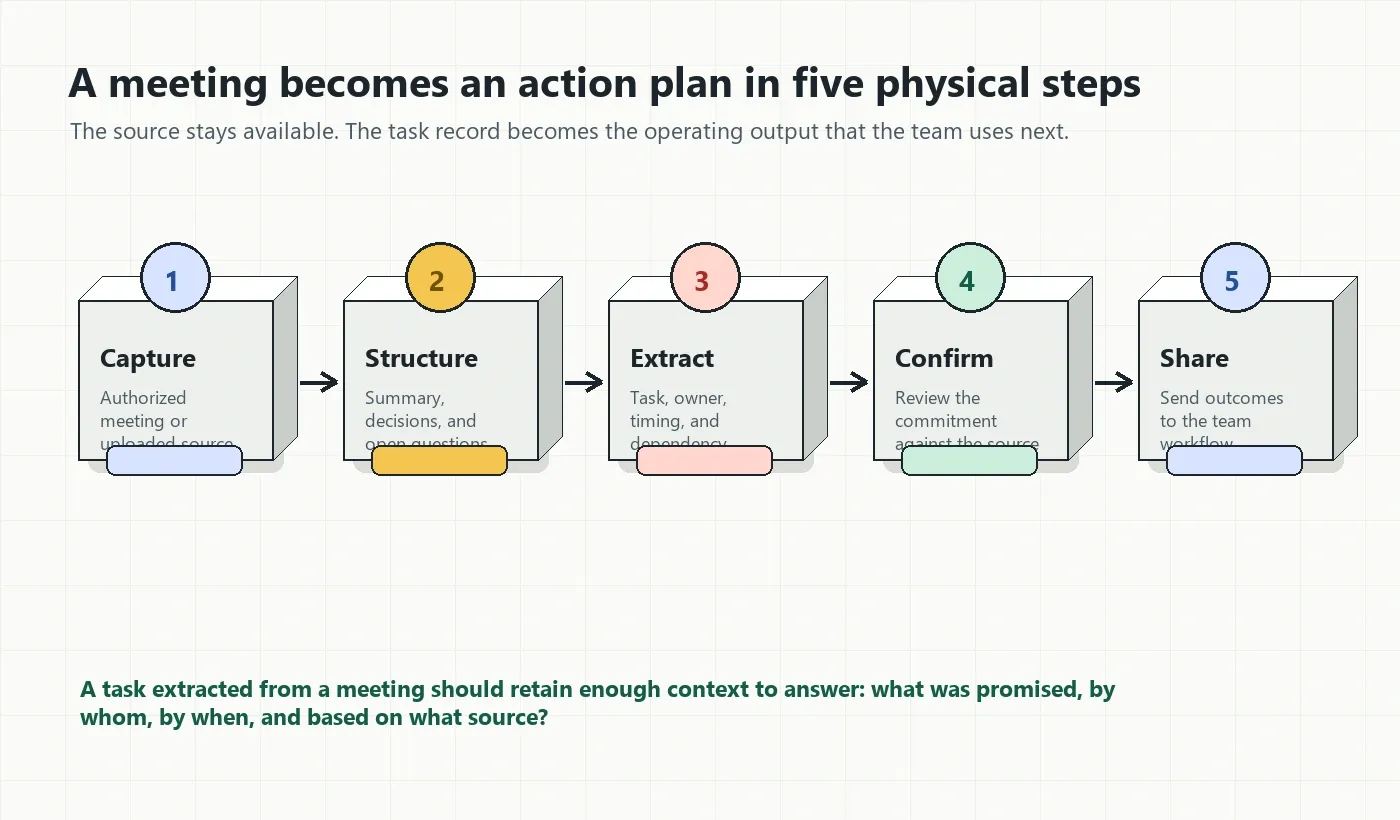
- Capture an authorized meeting or source. Start with a scheduled call, recording, audio file, video, permitted YouTube content, or related PDF. Follow your organization's policy for recording, consent, and access.
- Create a structured meeting record. Generate the transcript, summary, decisions, topics, and key moments that give a possible task meaning.
- Extract candidate action items. Look for commitments, requests, asks, approvals, decisions, dependencies, and next steps. A useful action item usually contains a verb, an owner, and a timing cue.
- Confirm owners and deadlines. Review anything that affects a customer, launch, budget, security review, or delivery promise. Conversation can be ambiguous, and high-stakes tasks deserve a human check.
- Link the action to its source. Keep a timestamp, transcript passage, or source reference near important work so someone can understand the surrounding context later.
- Send the plan to the team workflow. Export the relevant task list, summary, and source links to the tools where the team coordinates work.
What Every Meeting Action Item Should Include
A useful action item is specific enough that someone who missed the meeting can pick it up. It should name the work, the owner, the timing, and the context. When an item is unclear, mark it as an open question instead of presenting it as a confirmed commitment.
| Field | What good looks like | Why it matters |
|---|---|---|
| Task | A clear verb and result: “Send the revised rollout plan.” | Prevents a vague reminder from becoming an unowned intention |
| Owner | A named person or role confirmed in the meeting | Shows who is accountable for the next move |
| Deadline | A date, milestone, or explicit timing cue | Lets the team prioritize and check progress |
| Dependency | The review, input, approval, or other task that must happen first | Explains why work may be blocked |
| Context | The decision, customer need, risk, or outcome behind the task | Keeps task execution connected to intent |
| Source | Timestamp, excerpt, meeting title, or source link | Makes the record easier to audit and clarify |
Microsoft's conversation transcription documentation describes separating speakers in an audio stream. That distinction matters in task tracking: a deadline is much less useful if the team cannot tell which participant volunteered to own it.
Sample Output: Meeting Action Items With Owners and Deadlines
The example below is fictional, but it follows the format that makes action extraction useful in real work. The source reference is included to demonstrate how a team can verify a material commitment.
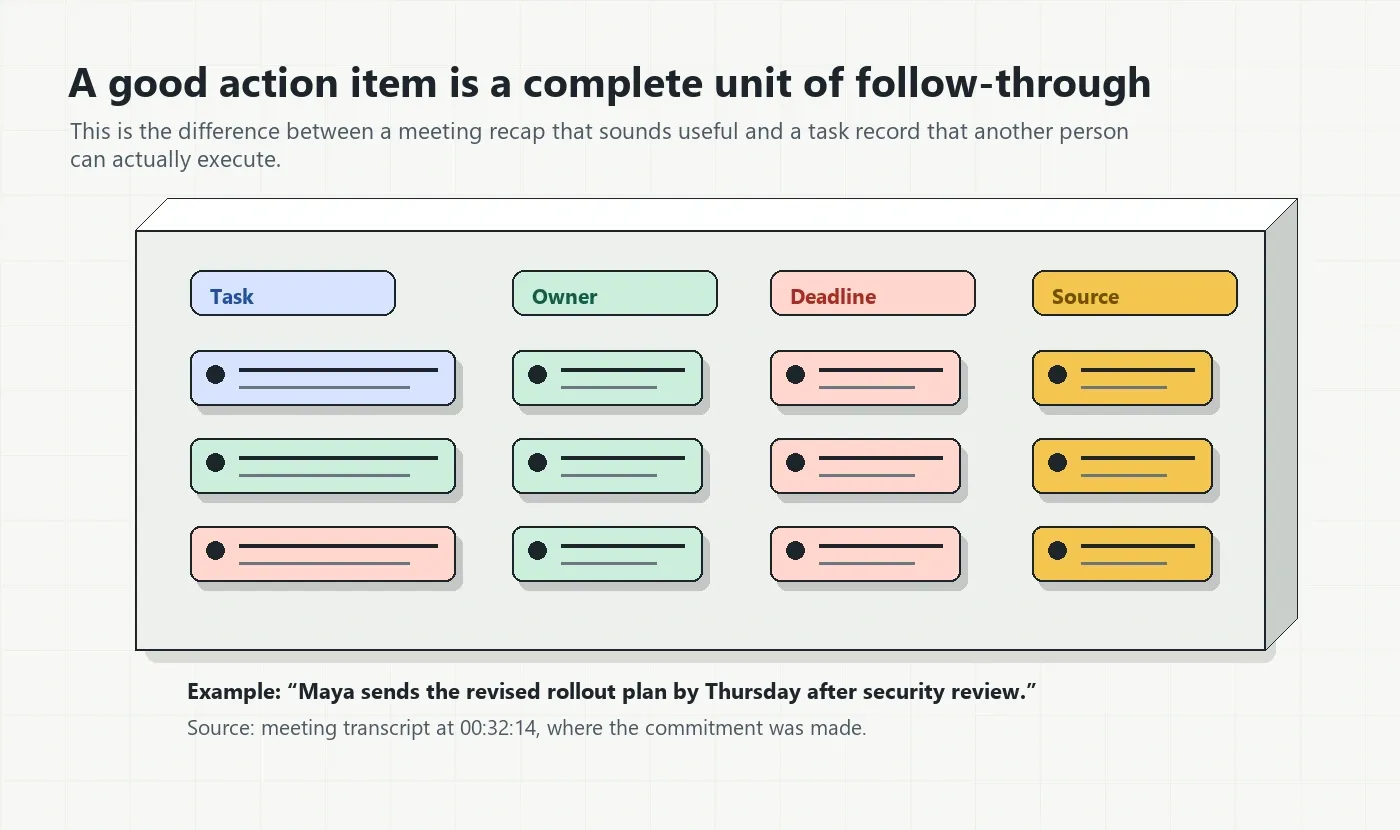
| Task | Owner | Deadline | Context and source |
|---|---|---|---|
| Send the revised rollout plan after security review | Maya, solutions lead | Thursday | Pilot planning meeting, 00:32:14 |
| Confirm the two pilot participants | Customer operations director | Before the next call | Customer commitment, 00:36:40 |
| Prepare a short risk summary for leadership | Jon, project manager | Friday | Internal delivery review, 00:21:08 |
| Validate the onboarding dependency | Engineering lead | Before implementation starts | Product planning meeting, 00:44:02 |
Copyable action item template
Task:
Owner:
Due date or milestone:
Dependency:
Why it matters:
Status:
Source meeting and timestamp:
Open question, if any:
Keep the “open question” field. It gives teams a place to record work that is not ready to be assigned instead of forcing a false sense of certainty into the task list.
Manual Notes vs. Transcript vs. Action Item Tracker
| Method | Best for | Strength | Main limitation |
|---|---|---|---|
| Manual meeting notes | Personal judgment, short calls, relationship context | Fast and selective when the note-taker is present | Listening and typing compete; details vary by person |
| Raw transcript | Searchable evidence and quotes | Preserves more of what was said | Tasks and priorities remain buried in the conversation |
| Action item tracker from meetings | Cross-functional follow-up and recurring meetings | Creates task, owner, timing, context, and source together | Important assignments still require review when language is ambiguous |
| Project management software | Planning, sequencing, execution, reporting | Manages work through a broader lifecycle | Does not automatically preserve the meeting reason behind every task |
Use manual notes for observation. Use transcripts for evidence. Use an action tracker for meeting follow-through. Then pass confirmed work into the project system that manages execution.
Source-Linked AI Chat: Ask the Meeting Record, Not Your Memory
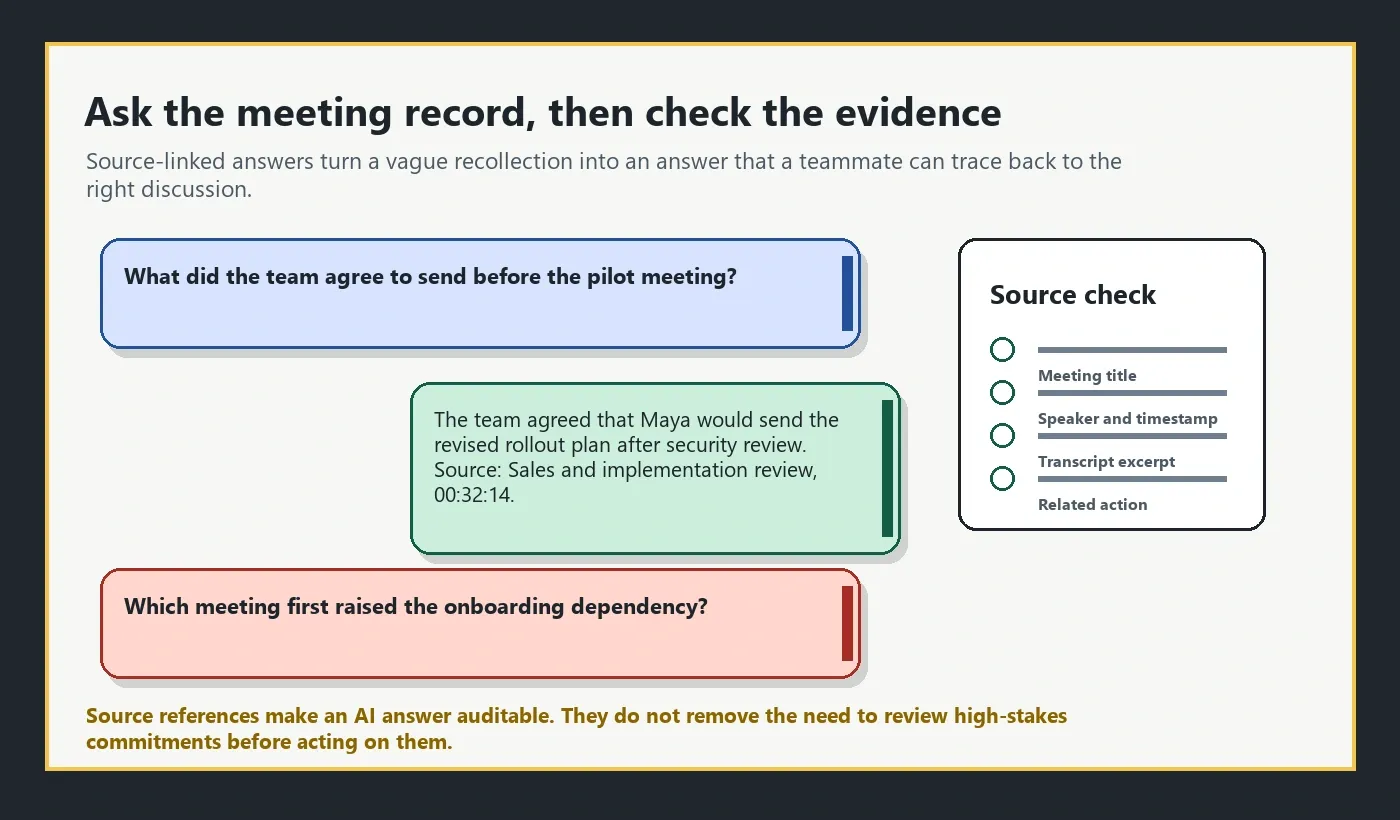
Action items become more useful when teammates can ask about them later. A good knowledge layer lets people find a task, understand why it exists, and trace an answer back to the relevant meeting or source. That is more reliable than relying on a recap that has been copied through several channels.
| Question a teammate might ask | Useful answer shape | Source check |
|---|---|---|
| “What did the team agree to send before the pilot meeting?” | Task, owner, and deadline | Meeting title, timestamp, and transcript excerpt |
| “Which meeting first raised the onboarding dependency?” | Meeting name, summary, and linked action | Source passage and surrounding context |
| “Who owns the security follow-up?” | Owner and current status | Original commitment and any later update |
| “What remains open from last week's product review?” | Open questions, dependencies, and actions | Related meeting records and their dates |
Source references make an AI answer auditable. They help users find the supporting passage and reduce the chance that an unsupported paraphrase goes unnoticed. They do not remove the need to review high-stakes commitments, dates, customer promises, financial terms, or security decisions before acting.
From Action Items to a Meeting Knowledge Base
A single meeting has limited value if its follow-up lives alone. A knowledge base becomes useful when related meetings, decisions, tasks, source passages, and summaries can be connected and searched across time. That is how a team moves from a storage archive to an operating memory.
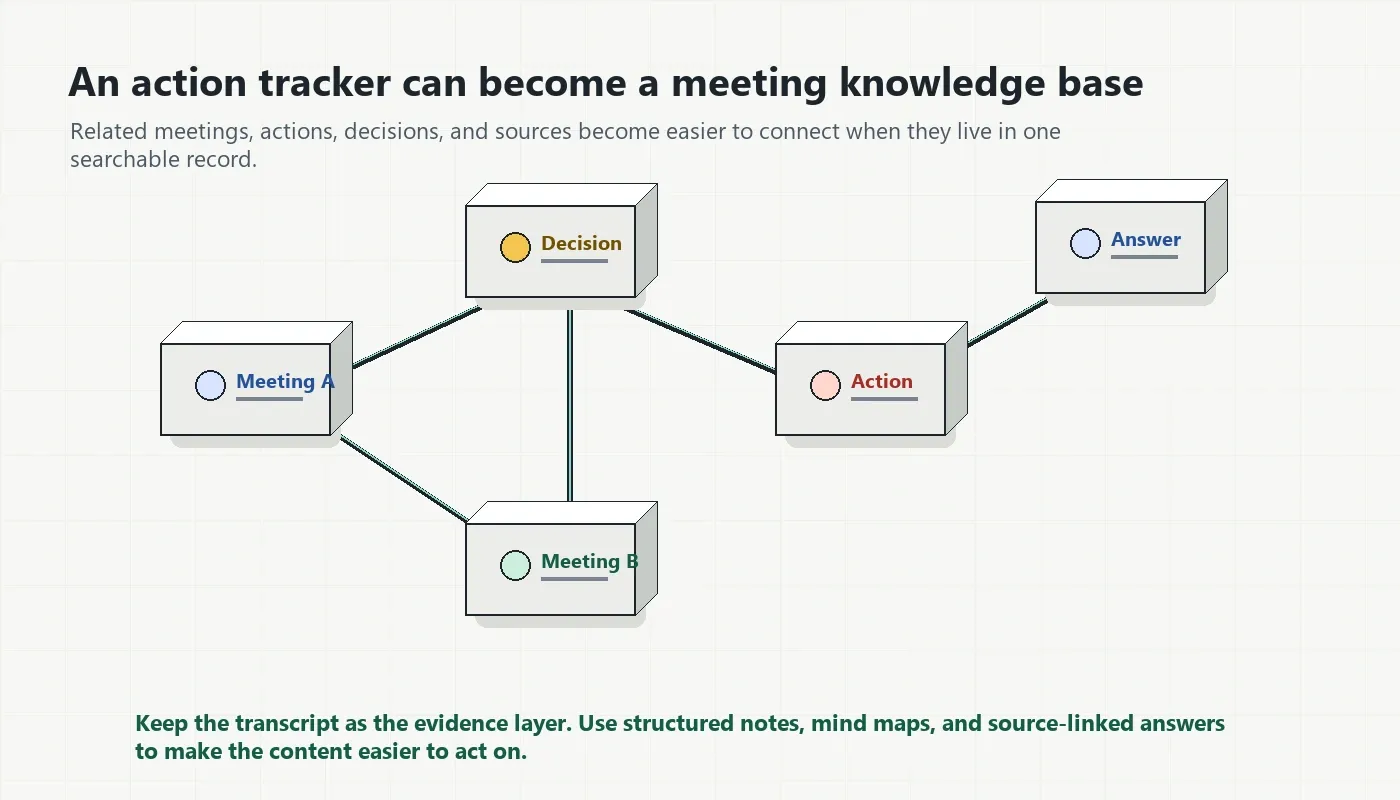
| Layer | What it contains | Why it helps |
|---|---|---|
| Source layer | Meeting recordings, transcripts, audio, video, and related documents | Preserves evidence and surrounding context |
| Structured notes | Summaries, decisions, themes, risks, and action items | Makes long conversations faster to scan |
| Mind map | Topics, relationships, dependencies, and action clusters | Helps teams see how an issue connects across discussion threads |
| AI Chat | Source-linked questions and answers | Lets teammates retrieve knowledge without re-reading everything |
| Integrations | Notion, Slack, Google Docs, calendar, and email workflows | Moves the right level of detail into the team's existing habits |
How HiNoter Tracks Action Items From Meetings
HiNoter is designed to turn meetings and content sources into usable team knowledge. It is more than a recorder: it is an AI meeting notes and transcription platform that helps teams capture a conversation, structure the useful details, extract follow-up, and retrieve the source later.
- Capture the meeting or upload a source. Connect a calendar for authorized scheduled calls, or use audio, video, permitted YouTube content, PDFs, and files as source material.
- Create the structured meeting record. HiNoter generates a transcript, summary, action items, and mind map with support for more than 50 languages and automatic detection.
- Review and confirm follow-up. Use the action list to check owners, deadlines, dependencies, and any commitments that need clarification.
- Ask the source with AI Chat. Ask questions about a meeting or a group of sources and use citations to locate the supporting evidence.
- Distribute the outcome. Export or share the appropriate summary, action plan, and source link through Notion, Slack, Google Docs, calendar workflows, and email.
Explore related HiNoter workflows for AI meeting notes, an AI meeting assistant, meeting summary generation, audio to text, AI Chat with source references, and multilingual meeting support.
Where to Send Meeting Action Items
Action items should reach the place where work is coordinated, but the full source does not have to follow every task. Share a short recap broadly, restrict the full transcript to people who need it, and keep a source reference near material commitments.
| Destination | Best use | What to send |
|---|---|---|
| Notion | Knowledge base, meeting history, and decision records | Summary, action list, mind map, and source links |
| Slack | Fast visibility and owner reminders | Concise recap with immediate actions and deadlines |
| Google Docs | Collaborative review and expanded notes | Transcript excerpts, decision context, and comments |
| Customer or stakeholder follow-up | Confirmed commitments, owners, and next meeting | |
| Calendar workflow | Recurring meeting continuity | Open actions, previous decisions, and next agenda prompts |
| Project management software | Execution and status tracking | Confirmed tasks, owners, timing, and a context link |
Permissions, Privacy, and Task Accuracy
Meeting action items can include employee data, customer commitments, commercial terms, security details, or internal decisions. Follow the organization's rules for recording, consent, retention, access, and sharing. The full recording or transcript may need a smaller audience than the task recap.
Be especially careful with tasks that carry legal, financial, customer-facing, hiring, or security implications. AI can surface a possible task, but a responsible person should confirm the owner, date, and wording before the task is treated as a final commitment. This article describes an operating workflow, not legal advice.
Action Item Tracker From Meetings FAQ
What is an action item tracker from meetings?
An action item tracker from meetings turns conversation into a structured list of tasks with owners, deadlines, context, and source references. It helps teams see what was promised, who is responsible, and where the commitment appeared in the meeting record.
How does AI find action items in meetings?
AI analyzes a meeting transcript for commitments, requests, decisions, and next steps. It can suggest a task, owner, timing, and source passage, but attendees should review important tasks because names, dates, and intent can be ambiguous in conversation.
What should every meeting action item include?
Every action item should include a clear task, a named owner, a due date or timing cue, relevant dependencies, and enough context to understand why it exists. A timestamp or transcript excerpt makes it easier to verify the commitment later.
Can HiNoter identify owners and deadlines?
HiNoter can structure authorized meeting content into action items, owners, deadlines, summaries, and source-linked notes when that information is present in the discussion. Teams should confirm high-stakes assignments and dates before treating them as final.
How does source-linked AI Chat improve trust?
Source-linked AI Chat shows the meeting or content reference behind an answer. That makes the response easier to audit, helps users find the surrounding context, and reduces the chance that an unsupported paraphrase goes unnoticed.
Is an action item tracker the same as project management software?
No. An action item tracker captures commitments from meetings and turns them into usable follow-up. Project management software plans and tracks work across a broader lifecycle. Teams often use both: the tracker creates the task record, and the project system manages execution.
Can I use an action item tracker for recurring meetings?
Yes. Recurring meetings benefit from an action tracker because the prior meeting's open tasks, owners, and decisions can be reviewed before the next call, reducing repeated discussion and unclear accountability.