Direct answer: Conversation intelligence AI analyzes meetings and customer calls to identify decisions, objections, risks, buying signals, action items, themes, and source-linked answers. The best systems do more than transcribe conversations: they turn spoken content into searchable team knowledge that sales, customer success, product, and leadership teams can verify and reuse.
Conversation intelligence AI matters because the most valuable information in a company often arrives in ordinary conversations. A customer explains why renewal is at risk. A buyer names the real decision criteria. A product manager commits to a delivery date. A recruiter hears evidence that changes the hiring recommendation. Then the call ends, and that context scatters across recordings, private notes, chat messages, and follow-up emails.
Most teams do not need another place to store recordings. They need a reliable way to turn conversation into action. HiNoter fits that workflow by capturing meetings, creating structured notes, extracting next steps, building mind maps, syncing outputs to team tools, and letting users ask AI Chat questions with references back to the source note.
What Is Conversation Intelligence AI?
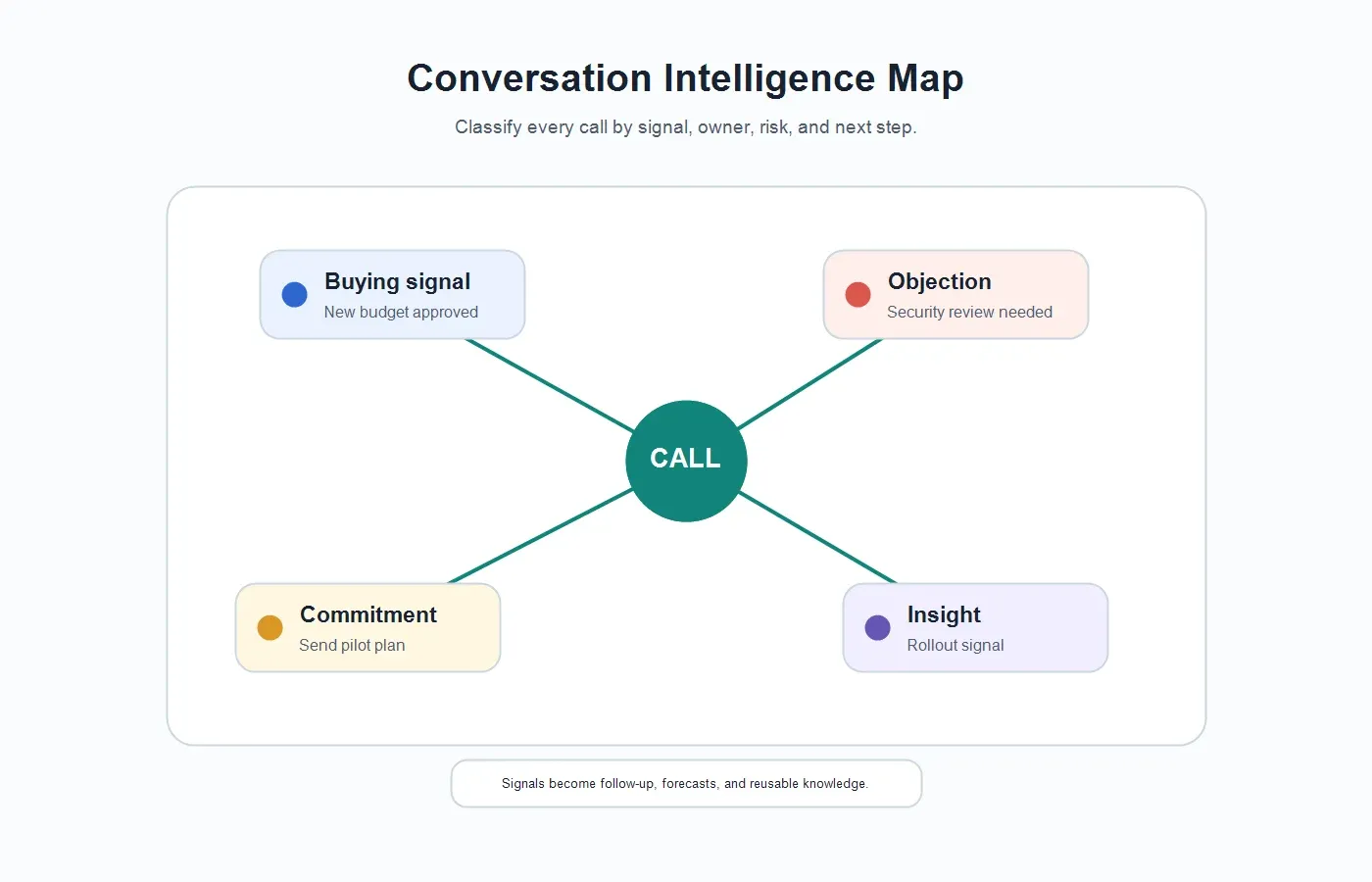
Conversation intelligence AI is software that processes spoken or recorded conversations and turns them into structured business insight. It can identify topics, speaker intent, objections, commitments, decisions, tasks, risks, questions, and follow-up opportunities. In a customer-facing workflow, it helps teams understand what was said, what it means, what should happen next, and where the evidence lives.
Traditional transcription gives you text. Conversation intelligence gives you interpretation that can be reviewed. That distinction is important. A transcript may contain every word from a sales call, but a revenue team needs the objection, the champion's concern, the promised next step, the stakeholder gap, and the evidence that supports the account plan.
Why Conversation Intelligence AI Is Becoming a Team Workflow
Modern teams are overwhelmed by conversation volume. Microsoft Work Trend Index research surveyed 31,000 people in 31 countries and found that 68% said they did not have enough uninterrupted focus time. The same research named inefficient meetings as the top productivity disruptor. When every meeting generates a recording, transcript, chat thread, and follow-up chain, the real cost is not just the call. It is the effort required to find the useful signal later.
Asana's Anatomy of Work research describes a similar drag as "work about work": searching for information, chasing status, coordinating updates, and duplicating effort. Conversation intelligence AI is valuable when it reduces that burden. The output should help someone answer a real operational question faster: What did the customer commit to? Which risk keeps repeating? Who owns the next step? What changed since the last call?
For commercial teams, this is also a revenue memory problem. Gartner has described conversation and revenue intelligence tools as systems that analyze customer interactions to improve sales execution, forecasting, coaching, and customer understanding. The most useful version is not just call scoring. It is a shared layer of evidence that helps teams act on customer conversations with less guesswork.
Conversation Intelligence AI: From Input to Outcome
| Conversation Input | AI Output | Business Outcome |
|---|---|---|
| Sales discovery call | Buyer pain, objections, decision criteria, competitors, next steps, and owner commitments. | Account teams can follow up with a stronger plan and less manual note cleanup. |
| Customer success review | Renewal risks, expansion signals, promised follow-ups, stakeholder concerns, and health themes. | CS leaders can spot risk and commitments before the account goes quiet. |
| Internal meeting | Decisions, action items, owners, due dates, blockers, and recap emails. | Teams leave with accountability instead of another recording to review. |
| Product interview | User problems, quotes, feature requests, workflow patterns, and research themes. | Product teams can connect customer evidence to roadmap decisions. |
| Uploaded audio, video, or PDF context | Transcripts, chaptered notes, summaries, mind maps, and source-linked AI answers. | Knowledge outside the meeting becomes searchable and reusable. |
How HiNoter Turns Conversations Into Intelligence
1. Capture the conversation automatically
Teams lose context when the note taker forgets, the host forgets to record, or the person who needs the summary was not invited. HiNoter helps reduce that dependency by connecting to the meeting workflow and capturing eligible scheduled conversations. The HiNoter meeting assistant can support automatic attendance so people can focus on the discussion instead of the documentation chore.
2. Generate structured notes instead of a raw transcript
A raw transcript is useful for search, but it is not the final product. HiNoter turns the conversation into structured notes with a summary, key points, decisions, action items, and follow-up context. That means a sales manager, customer success lead, or product owner can scan the output quickly and still inspect the source when details matter. The AI meeting notes workflow is designed for this step.
3. Extract action items and owners
Conversation intelligence becomes operational when it identifies what someone must do next. A good action item includes the task, owner, deadline if mentioned, and the source signal that supports it. If the speaker says, "I can send that by Thursday," the note should capture the commitment. If no owner is clear, it should flag the ambiguity for review.
4. Build mind maps and insight clusters
Customer calls rarely follow a tidy agenda. The buyer moves from budget to integration risk to competitor comparison to implementation timing. Mind maps help teams see how topics relate. They are useful for research synthesis, account planning, QBR preparation, and onboarding teammates who need to understand the story behind an account or project.
5. Sync outputs to the workspace
Conversation intelligence fails when the insights stay in a separate tool. HiNoter supports workflows where notes and summaries move into the places teams already work, including connected knowledge and documentation systems. Teams that keep customer research, launch notes, or account records in Notion can use the HiNoter Notion integration to make conversation outputs easier to reuse.
6. Ask AI Chat with source references
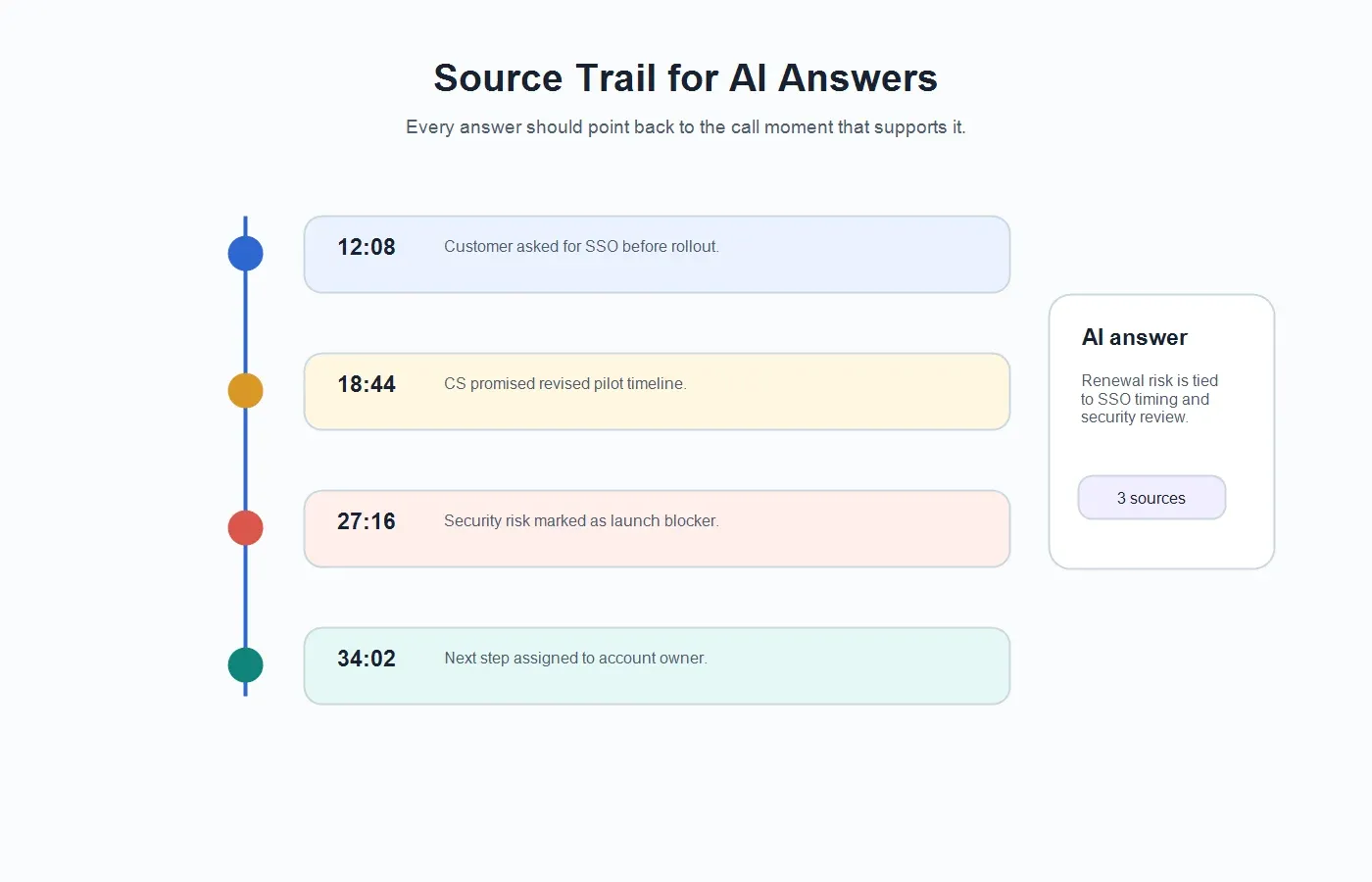
HiNoter AI Chat lets users ask questions about meeting notes and supported content, then review answers with source references. This matters because AI answers should not be treated as magic. A source-linked answer makes the reasoning easier to inspect. It does not make AI perfect, but it helps users verify the context before making a customer promise, updating a forecast, or escalating a risk. See HiNoter AI Chat.
Sample Outputs From a Customer Call
Imagine a customer success call with a mid-market account. The customer likes the product, but adoption is uneven. Security wants more documentation. The executive sponsor needs a clearer rollout plan. The account manager needs to know whether the renewal is healthy or at risk.
Example summary
The customer is broadly satisfied with the core workflow but renewal risk has increased because SSO documentation and admin training are not complete. The executive sponsor wants a revised rollout timeline before the next steering meeting. The account owner will send a security packet, confirm the training schedule, and follow up on expansion interest after the admin team reviews adoption data.
Example action item extraction
| Action Item | Owner | Due Date | Source Signal |
|---|---|---|---|
| Send updated SSO and security documentation. | Account owner | Wednesday | "Security needs the SSO packet before approval." |
| Confirm admin training schedule. | Customer success manager | This week | "We need a training date before rollout." |
| Review adoption data with the executive sponsor. | CS lead | Next QBR | "Show me which teams are actually using it." |
| Flag renewal risk if security review slips again. | Renewal manager | After security check-in | "This cannot wait until the final month." |
Example insight summary
| Insight Type | What the Call Revealed | Recommended Follow-up |
|---|---|---|
| Renewal risk | Security review and training gaps could slow renewal confidence. | Escalate timeline visibility and confirm owners. |
| Expansion signal | Executive sponsor asked for adoption by department. | Prepare adoption report and identify high-usage teams. |
| Customer objection | Admin team is unsure whether rollout support is enough. | Send training plan and offer a live enablement session. |
| Product feedback | Customer wants clearer admin permission reporting. | Add feedback to product notes with source context. |
Questions You Can Ask HiNoter AI Chat
Conversation intelligence should be queryable. The team should not need to remember which meeting contained the key detail. They should be able to ask a question and inspect the notes that support the answer.
| Question | What the Answer Should Reference | Why It Matters |
|---|---|---|
| Which renewal risks came up in the last three customer calls? | Risk sections, customer quotes, and account names from each call. | Helps customer success leaders prioritize escalation. |
| What objections are slowing enterprise deals this month? | Sales call notes, objection labels, and repeated themes. | Turns scattered sales feedback into enablement input. |
| Who promised the next step after the security review? | Action item owner, due date, and source quote. | Creates accountability without another status chase. |
| What customer evidence supports the roadmap request? | Product interview notes, customer calls, quotes, and source links. | Helps product teams separate loud requests from repeated patterns. |
| Draft a recap email for the account team. | Summary, risks, commitments, and follow-up tasks from the call. | Saves time while keeping the recap grounded in the meeting record. |
Conversation Intelligence AI vs Transcription Tools
| Option | What It Gives You | What Still Requires Manual Work |
|---|---|---|
| Recorder | An audio or video file of the conversation. | Rewatching, summarizing, sharing, and assigning tasks. |
| Transcription app | Speaker text, timestamps, and searchable wording. | Finding the decision, risk, owner, and business meaning. |
| Generic AI summary | A shorter version of the conversation. | Verifying source context and turning summary into workflow. |
| HiNoter | Structured notes, action items, mind maps, integrations, and source-linked AI Chat. | Human review for sensitive decisions, customer promises, and final judgment. |
Where Conversation Intelligence AI Helps Most
Sales teams
Sales teams need more than call recordings. They need deal context: pain points, buying criteria, next steps, objections, stakeholders, timeline, and evidence. HiNoter can help turn customer conversations into a shared account memory for sales teams that need cleaner follow-up and coaching material.
Customer success teams
Customer success conversations reveal risk before it appears in a dashboard. A customer may mention low adoption, missing training, security concerns, or stakeholder change. Conversation intelligence AI helps capture those signals and connect them to follow-up work.
Product and research teams
Product teams can use conversation intelligence to collect customer evidence, summarize interviews, group repeated themes, and connect feedback to roadmap discussions. The value is not one perfect quote. It is the pattern across many conversations.
Managers and leadership
Managers need to know which conversations created decisions, risks, or commitments without attending every call. AI-generated recaps, action lists, and source-linked Q&A can make leadership reviews faster and more grounded.
What Teams Should Measure
Conversation intelligence should be judged by the quality of follow-through, not by the number of recordings captured. A team may have hundreds of transcripts and still miss the customer signal that mattered. Better measurement starts with outcomes that connect the conversation to action.
| Metric | What It Shows | Why It Matters |
|---|---|---|
| Action item completion | Whether extracted tasks become finished work. | Shows whether meetings are producing accountable next steps. |
| Risk visibility | How quickly customer, project, or deal risks are surfaced. | Helps managers intervene before a renewal, launch, or deal slips. |
| Source review rate | How often teams check important AI answers against source notes. | Encourages trust through verification instead of blind automation. |
| Knowledge reuse | How often notes, summaries, and AI Chat answers are reused later. | Proves the conversation became team memory, not a one-time recap. |
These measures also keep expectations realistic. Conversation intelligence AI should reduce searching, summarizing, and status chasing, but it should not remove human judgment from sensitive work. The strongest teams use AI to expose the signal faster, then apply human review where the stakes are high.
Trust, Privacy, and Source References
Conversation intelligence often handles sensitive information: customer data, pricing, employee feedback, hiring notes, product strategy, and legal or security concerns. Teams should use consent-aware recording practices, limit access to sensitive notes, and review outputs before sharing them widely.
NIST's AI Risk Management Framework emphasizes that trustworthy AI depends on governance, measurement, transparency, and risk management. In a conversation intelligence workflow, that means the AI should not only produce a neat answer. It should help the user understand where the answer came from. Source references make it easier to compare the AI response against the original meeting record.
This is especially important when the output affects a customer promise, forecast update, hiring decision, or escalation path. Source references do not eliminate hallucination risk, but they reduce blind trust by making important claims reviewable.
Common Mistakes to Avoid
| Mistake | Why It Hurts | Better Approach |
|---|---|---|
| Treating transcription as the final output. | The team still has to interpret a long conversation manually. | Extract insights, actions, risks, owners, and source-backed answers. |
| Letting insights stay in private notes. | Important customer context disappears when one person owns the memory. | Sync useful outputs to shared team workspaces. |
| Using AI answers without source review. | A polished answer can hide missing or misunderstood context. | Check source references before acting on important claims. |
| Capturing tasks without owners. | Follow-up becomes vague and accountability breaks down. | Track task, owner, due date, and source signal. |
| Ignoring patterns across calls. | Repeated objections and risks remain invisible until late. | Use AI Chat and structured notes to search across related conversations. |
Try HiNoter for Conversation Intelligence AI
If your team already records meetings and customer calls but still loses the decisions, tasks, objections, and follow-ups, the bottleneck is not capture. The bottleneck is turning conversation into usable knowledge.
HiNoter helps teams move from scattered conversations to structured intelligence: automatic meeting capture, multilingual transcription, summaries, action items, mind maps, integrations, and AI Chat with source references. Connect your calendar, capture your next eligible meeting, and turn the conversation into notes your team can search, share, and act on.
CTA: Try HiNoter to turn customer calls and meetings into source-linked insights, tasks, and team knowledge.
FAQs
What is conversation intelligence AI?
Conversation intelligence AI analyzes meetings and calls to identify important business signals such as decisions, objections, risks, buying intent, action items, themes, and source-linked answers.
How is conversation intelligence AI different from transcription?
Transcription converts speech into text. Conversation intelligence AI uses the transcript to create business-ready outputs such as summaries, tasks, insights, mind maps, recap emails, and searchable answers.
Can conversation intelligence AI help customer success teams?
Yes. Customer success teams can use it to capture renewal risks, customer commitments, stakeholder concerns, expansion signals, and follow-up tasks from customer calls.
Can HiNoter analyze more than meetings?
Yes. HiNoter can support meetings and other permitted sources such as audio, video, YouTube-style content, PDFs, and documents, then turn them into notes, summaries, action items, mind maps, and source-linked AI Chat answers.
Do source references stop AI hallucinations?
No system can promise that. Source references make answers easier to verify by pointing users back to the meeting note or content that supports the claim.
Who should use conversation intelligence AI?
Sales, customer success, product, recruiting, research, operations, and leadership teams can use it whenever important decisions, risks, commitments, or customer insights are hidden inside conversations.