Direct answer: Customer success meeting notes are a structured record of account goals, adoption evidence, renewal risks, customer commitments, internal owners, due dates, and next steps. The best notes connect what the customer said to a renewal plan, make risk evidence searchable, and give every follow-up a named owner.
Customer success meeting notes usually fail for a simple reason: the conversation is valuable, but the record is scattered. One person has private notes. The recording sits in a folder. A risk is mentioned in Slack. A follow-up email says "we will check," but no owner or due date is attached. By the time a renewal review starts, the team is reconstructing account history from memory.
For customer success teams, that is more than an admin problem. Meetings hold the evidence behind retention forecasts: who is using the product, what value the customer sees, which stakeholder is unconvinced, what blocker threatens rollout, and which promise the vendor made. A generic transcript can preserve words, but a CS team needs a working account record that turns those words into renewal decisions, risk action, and customer commitments.
This page gives you a workflow, templates, and examples for renewal calls, QBRs, onboarding check-ins, and escalation reviews. It also shows how HiNoter for sales and customer success teams can capture the meeting, structure the notes, and move the output into the tools your team already uses.
What Are Customer Success Meeting Notes?
Customer success meeting notes are the written record of a customer conversation, organized around business outcomes, adoption, renewal health, risks, commitments, and next steps. They are different from general meeting notes because they are tied to an account relationship. A good CS note should help a CSM, manager, account executive, support lead, or product partner understand what changed after the call.
That means the note should not read like a court transcript. It should answer practical questions: What did the customer care about? What did they decide? What risk evidence appeared? Who owns the next move? What must be visible before the next renewal, QBR, expansion conversation, or escalation review?
Why Customer Success Meeting Notes Matter to Retention
Customer success is measured on outcomes that depend on shared memory. Gainsight's 2024 Customer Success Index, summarized in January 2025, reported that 76% of surveyed companies identify customer retention as a primary revenue metric, and 94% put cross-functional collaboration at the center of customer strategy. In a separate Gainsight report on the evolution of customer success, 61% of surveyed teams assigned CS some responsibility for renewal, expansion, or both.
Meetings are where the signal appears first. A sponsor quietly changes roles. A pilot team stops attending enablement. A procurement delay moves from "maybe" to "likely." An executive says the product is useful, but not tied to this year's cost-reduction target. None of those moments should live only in a recording or in one CSM's private notes.
Microsoft's Work Trend Index surveyed 31,000 people across 31 countries and found that inefficient meetings were the top productivity disruptor, while 68% of people said they did not have enough uninterrupted focus time. For CS teams, that pressure is familiar: more calls, more accounts, more follow-ups, and less time to turn conversations into clean account evidence.
Bain's classic retention research found that a five-percentage-point lift in customer retention can be associated with a 25% to 95% profit increase, depending on the industry and economics. Treat that range as context, not a guaranteed result. When renewal outcomes matter, meeting evidence should be easy to find, verify, and act on.
Customer Success Meeting Notes: What to Capture
The best CS notes are structured around decisions and account health, not every sentence. Use the table below as a capture checklist for renewal-focused meetings.
| Area | What to Capture | Why It Matters |
|---|---|---|
| Business goal | The customer outcome, metric, initiative, or executive priority tied to the product. | Renewal value needs a business reason, not only product usage. |
| Adoption evidence | Usage comments, team coverage, workflow progress, training gaps, and value proof. | Evidence supports health scoring and renewal confidence. |
| Stakeholder map | Champion, economic buyer, technical owner, blockers, new decision makers, and missing voices. | Renewal risk often starts when the wrong people are absent. |
| Risk signal | Budget pressure, sponsor change, low adoption, technical blocker, unresolved support issue, or competitive threat. | Teams need early warning before the renewal forecast slips. |
| Commitment | What the customer promised, what your team promised, who owns it, and when it is due. | Clear commitments prevent vague follow-up and repeated discovery. |
| Decision | Approved scope, agreed plan, next meeting, escalation path, pricing expectation, or renewal process step. | Decisions should not be buried in email threads or chat. |
| Action item | Task, owner, deadline, dependency, status, and customer-facing wording if needed. | CS notes become useful when they drive the next action. |
Before and After: From Scattered Notes to Account Knowledge
A customer meeting should produce a useful record for the entire account team. The problem is that many teams still treat documentation as an individual habit. One CSM may write excellent notes while another relies on memory. Managers then chase updates in Slack, CRM fields, call recordings, and follow-up emails.
| Stage | Scattered Process | Structured Process | HiNoter Output |
|---|---|---|---|
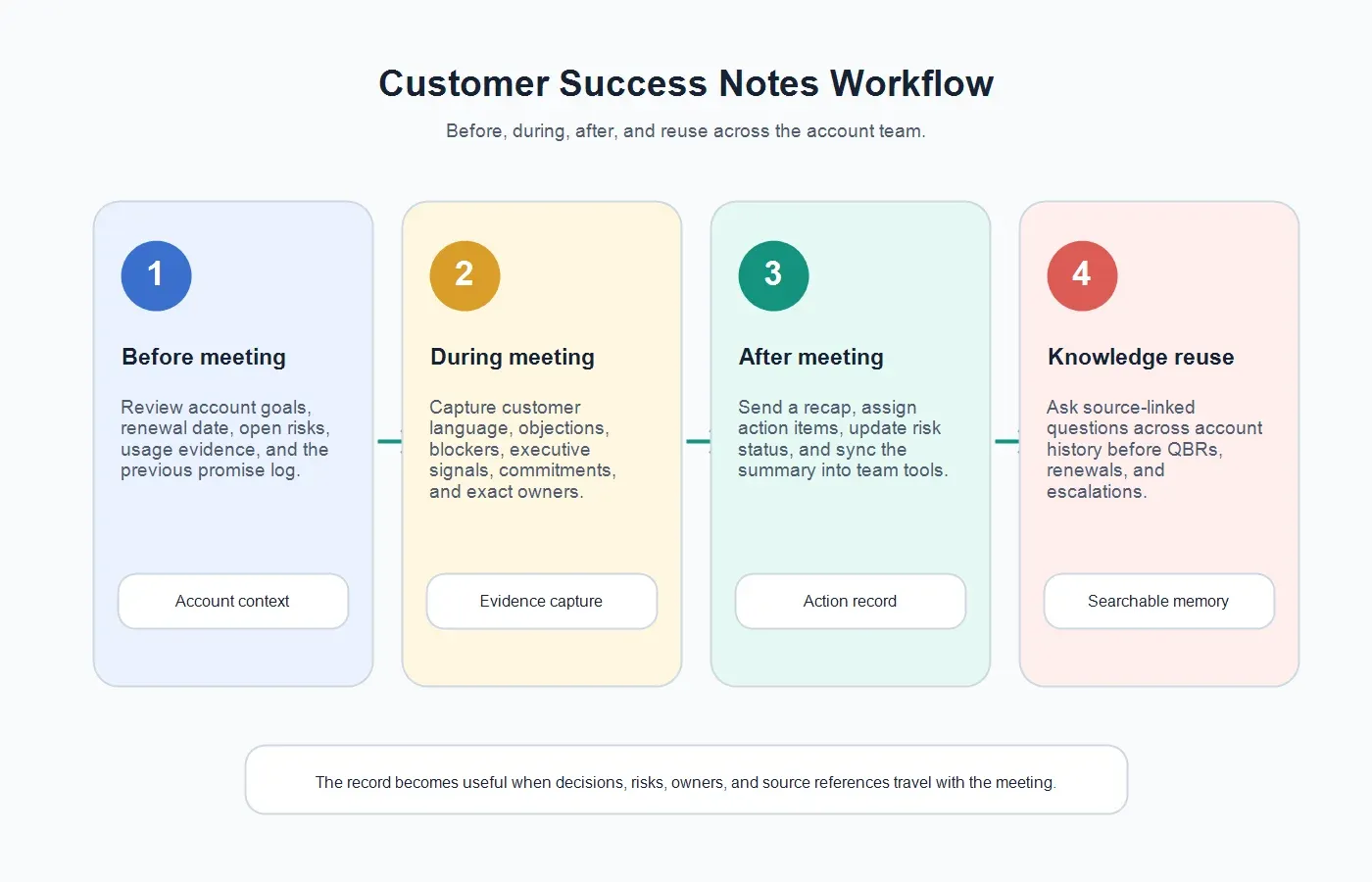
| Before meeting | CSM searches old notes, Slack, CRM, and recordings to remember the last promise. | Open account goals, risks, previous action items, and renewal date before the call. | Meeting context and a clean place for the next record. |
| During meeting | One person splits attention between listening, typing, and managing the conversation. | Team stays present while the meeting is captured with consent and structured after the call. | Auto-captured transcript, summary, decisions, and action items. |
| After meeting | Follow-up email is rewritten manually, tasks are copied into multiple tools, and risk notes remain private. | Summary, owners, due dates, renewal risk, and customer recap are reviewed once and shared. | Summary, follow-up-ready tasks, mind map, and exportable notes. |
| Renewal review | Manager asks the CSM to explain what happened across months of calls. | Team reviews searchable source-backed notes organized by account and meeting. | AI Chat answers with references to the source meeting. |
How to Run a Customer Success Notes Workflow
1. Prepare the Account Context Before the Call
Start with the account reality, not the meeting agenda. Check renewal date, contract scope, adoption status, open support escalations, executive sponsor coverage, last QBR commitments, and any expansion or downsell signals. If your team uses a CRM, customer success platform, shared workspace, or project tracker, bring the most important context into one view before the meeting.
Your pre-meeting note should include three simple prompts: What are we trying to learn? What risk needs evidence? What promise from the last call must be closed or updated? This keeps the conversation tied to account outcomes instead of becoming a general check-in.
2. Capture Customer Language During the Meeting
Exact language matters. "We are not seeing adoption in finance" is different from "Finance has not been trained yet." "Budget is tight" is different from "Procurement needs a business case by August 2." Record the customer's words around value, risk, blockers, and urgency so the team can distinguish signal from assumption.
If you use an AI assistant, make consent and meeting norms clear. HiNoter can work as an AI meeting assistant that joins scheduled meetings and captures the conversation in the background, which helps the CSM stay focused on the customer instead of typing every detail.
3. Convert the Call Into a Renewal Record
After the call, do not simply file the transcript. Turn it into a renewal record. Summarize the account health change, list customer commitments, list vendor commitments, update risk level, assign owners, and write the customer-facing recap. If the meeting created a new product request, support escalation, security review, or procurement dependency, label it clearly and route it to the right team.
HiNoter's AI meeting notes are designed for this layer: automatic summaries, decisions, action items, and mind maps that sit on top of the transcript. The review step still matters. A CSM should confirm names, deadlines, sensitive language, and customer-facing wording before sharing.
4. Reuse the Notes Across the Account Team
Customer success is rarely a solo function. Sales needs expansion and objection context. Product needs evidence behind feature requests. Support needs escalation history. Finance may need renewal timing. Leadership needs risk themes. Good notes are reusable because they are searchable, structured, and tied to source meetings.
This is where source-backed search changes the workflow. With HiNoter AI Chat, teams can ask questions such as "Which accounts mentioned implementation blockers this quarter?" or "What did Northstar say about SSO before renewal review?" and trace the answer back to the relevant source note.
Copyable Customer Success Meeting Notes Template
Use this template for QBRs, renewal check-ins, executive alignment calls, escalation reviews, and onboarding follow-ups. Keep customer-facing language separate from internal-only risk notes so the team can share confidently without exposing private assessment.
Account and Meeting Details
Account: [Account name] | Meeting type: [QBR / renewal / onboarding / escalation / executive alignment] | Date: [Date] | Renewal date: [Date] | Contract scope: [Plan / seats / products] | Participants: [Customer attendees and internal attendees]
Customer Goals
Primary business outcome: [What the customer is trying to achieve]
Success metric: [Metric, timeline, or observable result]
Customer quote: "[Exact language that describes value, frustration, risk, or urgency]"
Adoption and Value Evidence
What is working: [Adoption proof, use case, department, workflow, or value realized]
What is not working: [Gap, blocker, missing stakeholder, support issue, or training need]
Evidence quality: [Confirmed / assumed / needs validation]
Renewal Risk Register
Risk level: [Low / medium / high]
Risk signal: [Budget, sponsor change, adoption, implementation, support, procurement, competitor]
Evidence: [What the customer said or what data shows]
Impact: [What could happen if the risk is not resolved]
Owner: [Internal owner] | Next review: [Date]
Decisions and Commitments
Decision made: [What was agreed]
Customer commitment: [Task, owner, due date]
Internal commitment: [Task, owner, due date]
Follow-up email draft: [Short customer-safe recap]
Action Items
1. [Task] - Owner: [Name] - Due: [Date] - Status: [Open / waiting / done]
2. [Task] - Owner: [Name] - Due: [Date] - Status: [Open / waiting / done]
3. [Task] - Owner: [Name] - Due: [Date] - Status: [Open / waiting / done]
Generate this automatically with HiNoter: Connect your calendar, let HiNoter capture the customer meeting, then review the generated transcript, summary, decisions, action items, and mind map before sending the customer recap or updating your workspace.
Fictional Example: Renewal Risk Notes for Northstar Logistics
The example below is fictional, but it reflects the level of specificity a customer success manager should aim for. The meeting is a renewal check-in for a logistics software account 74 days before renewal.
Account context: Northstar Logistics uses the product in two of three regions. The original executive sponsor moved to another role. The EMEA rollout is delayed because SSO testing has not been completed.
Customer goal: Reduce route exception resolution time from six hours to three hours by the end of Q3. The operations director said, "The two live regions are seeing faster handoffs, but EMEA is stuck until IT finishes SSO."
Renewal risk: Medium. The value story is credible in two regions, but the third region is blocked and the new executive sponsor has not joined a business review. Evidence includes delayed SSO testing, missing EMEA training date, and no confirmed executive review before procurement starts.
Decisions: Northstar will keep the current renewal scope under review until the July rollout check. HiNoter team will send the SSO guide and schedule a 30-minute technical unblocker call. Northstar IT will name the test owner by July 17.
Action items: CSM sends SSO guide by July 15. Support confirms testing prerequisites by July 16. Customer IT names test owner by July 17. Account executive schedules sponsor alignment call for the week of July 22. CSM updates renewal risk after the technical call.
Customer-facing recap: "Thanks for walking through the EMEA rollout status. We captured three next steps: our team will send the SSO guide, your IT team will confirm the test owner, and we will schedule a short unblocker session before the July rollout review."
Internal-only note: Do not treat the renewal as secure until the new executive sponsor attends a value review or confirms the Q3 outcome. The adoption story is strong in two regions, but procurement may question scope if EMEA is not live.
How to Document Renewal Risk Without Guessing
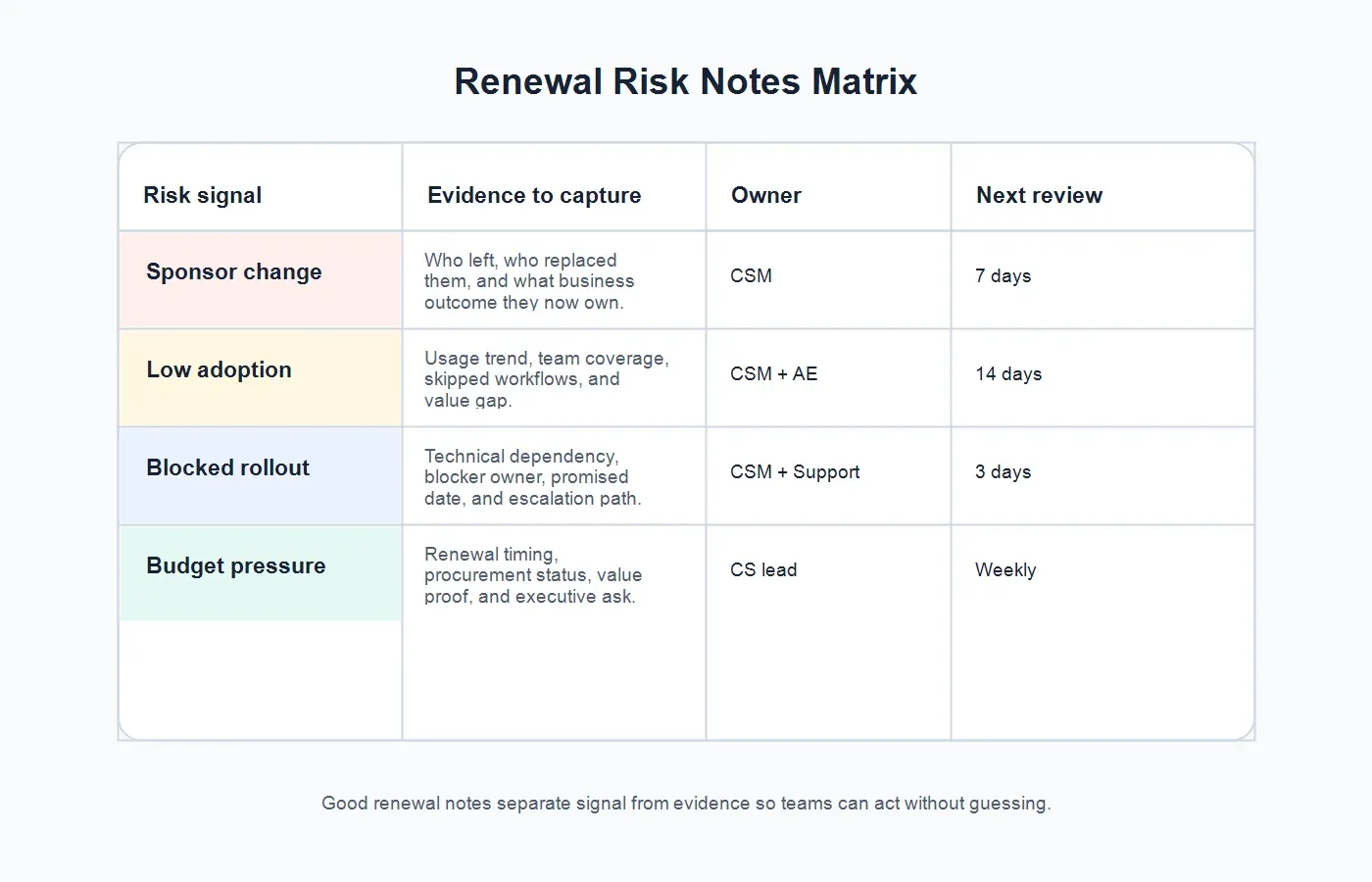
Renewal risk notes are strongest when they separate signal from evidence. A signal is a pattern that may affect renewal. Evidence is the quote, behavior, date, blocker, usage trend, or decision that supports the signal. Without evidence, teams overreact to vague anxiety or underreact to real risk.
| Risk Signal | Evidence to Capture | Owner | Next Review |
|---|---|---|---|
| Sponsor change | Who left, who replaced them, and what business outcome the new sponsor owns. | CSM | 7 days |
| Low adoption | Usage trend, team coverage, skipped workflows, enablement gaps, and value proof. | CSM + AE | 14 days |
| Blocked rollout | Technical dependency, blocker owner, promised date, and escalation path. | CSM + Support | 3 days |
| Budget pressure | Renewal timing, procurement status, value proof, and executive ask. | CS lead | Weekly |
KPIs Customer Success Notes Should Support
Meeting notes are not a substitute for product telemetry, CRM fields, or financial reporting. They are the qualitative evidence layer that explains why the metrics are moving. When written well, they make customer health reviews less dependent on memory and more grounded in account history.
| KPI | Meeting Note Evidence | How Managers Use It |
|---|---|---|
| Renewal forecast confidence | Decision-maker sentiment, procurement status, risk level, and next review date. | Validate whether the renewal story matches the forecast category. |
| Gross retention risk | Budget pressure, value gap, low adoption, or unresolved blocker. | Prioritize save plays and executive involvement. |
| Expansion readiness | New use case, additional team interest, success metric, and buying signal. | Coordinate CS and sales without repeating discovery. |
| Action-item closure | Owner, due date, status, dependency, and customer commitment. | Find stalled promises before they turn into trust issues. |
| Executive sponsor coverage | Named sponsor, recent attendance, value language, and decision authority. | Spot accounts where renewal depends on a missing stakeholder. |
How HiNoter Fits the Customer Success Workflow
HiNoter is useful when the team needs more than a transcript. The workflow is simple enough for a busy CSM and structured enough for managers who need consistent account evidence.
1. Connect the calendar. The team chooses which customer meetings should be captured. This is especially helpful for recurring QBRs, renewal calls, onboarding check-ins, and escalation reviews.
2. Let the assistant join the meeting. HiNoter can automatically attend scheduled calls so the CSM does not need to remember to start a recording or assign a human notetaker.
3. Get structured outputs after the meeting. HiNoter generates a transcript, concise summary, decisions, action items, and mind map. Its language detection and 50+ language support are useful for global CS teams managing accounts across English, Portuguese, Spanish, French, and mixed-language conversations.
4. Send notes into the workspace. Teams can move meeting knowledge into existing systems. For example, the HiNoter Notion integration can push summaries, action items, dates, tags, and content blocks into a selected database so account notes do not sit in a separate silo.
5. Ask questions later. Before a renewal review, a CSM or manager can ask source-linked questions across meeting history, such as "What risks has this account raised in the last 90 days?" or "Which customer commitments are still open?"
Role-Specific Q&A Blocks for Revenue Teams
How should customer success teams use AI meeting notes?
Customer success teams should use AI meeting notes as a structured draft, not as an unchecked final record. The CSM should review the summary, confirm customer commitments, assign action items, separate internal risk notes from customer-facing recaps, and update the account plan. The value is not just faster notes; it is consistent renewal evidence across the team.
How should sales teams use customer success meeting notes?
Sales teams should use CS notes to understand expansion signals, renewal objections, stakeholder changes, and customer language. A good handoff tells the account executive what value has been proven, which risk needs attention, who owns procurement, and which customer quote supports the business case. That prevents sales from restarting discovery in late-stage renewal conversations.
What should product teams receive from CS notes?
Product teams need evidence, not vague requests. Share the customer segment, use case, blocker, quote, impact, frequency, and whether the request affects retention, expansion, or adoption. A note that says "customer wants better reporting" is weak. A note that says "three regional operations leads cannot reconcile exception data before weekly planning" is useful.
What should support teams receive from CS notes?
Support teams should receive the exact blocker, customer impact, environment details, urgency, owner, and promised next step. CS notes are especially useful when they connect support escalations to renewal risk, because that helps the team prioritize issues that affect trust, adoption, or contract decisions.
Privacy, Consent, and Sharing Rules
Customer conversations can include commercial terms, product issues, personal information, contract strategy, and internal assessment. Tell attendees when a meeting assistant or recording is used, follow applicable consent rules, and respect customer security requirements. If an account forbids external notetakers or recording, use an approved manual workflow with the same structure.
Separate the customer-facing recap from internal notes. The customer-facing version should confirm decisions, commitments, owners, dates, and next steps. Internal notes can include renewal confidence, escalation strategy, stakeholder risk, and coaching comments. Mixing those two audiences is how useful notes become risky notes.
Access control matters after the meeting too. Renewal notes should be visible to the right account team, not every employee. If the note includes sensitive pricing, legal, security, or personnel details, use the same care you would apply to CRM data and customer contracts.
Common Mistakes in Customer Success Meeting Notes
Writing a transcript instead of a decision record. A transcript is useful for source review, but managers need the decision, risk, evidence, owner, and date.
Using vague risk language. "Account feels risky" is not actionable. "New sponsor has not attended a value review and procurement starts in 21 days" is actionable.
Skipping customer commitments. CS teams often document their own tasks but forget what the customer promised. Renewal plans depend on both sides.
Letting notes live in private docs. Private notes help one person. Shared account notes help the team act without asking the same questions again.
Sending internal notes to the customer. Keep customer-safe recaps separate from internal renewal assessment, risk scoring, and negotiation strategy.
Try HiNoter for Customer Success Meeting Notes
Use HiNoter when customer meetings need to become renewal evidence, not just stored recordings. Connect your calendar, let HiNoter join the meeting, and review the generated transcript, summary, decisions, action items, mind map, and source-linked answers. Then send the right version to the customer and sync the working record into your team tools.
The practical win is simple: CSMs stay present in the conversation, managers get cleaner account evidence, and the team spends less time chasing what happened after every call. Customer success meeting notes should help the renewal move forward. HiNoter helps make that the default workflow.
FAQs
What should customer success meeting notes include?
Customer success meeting notes should include account goals, adoption evidence, stakeholder updates, renewal risk, customer commitments, internal commitments, decisions, action items, owners, due dates, and the next review date.
How long should customer success meeting notes be?
Most CS notes should be concise enough to scan in a few minutes but specific enough to support renewal decisions. A useful note usually includes a short summary, a risk section, a decision section, and an action-item list.
How do you document renewal risk?
Document renewal risk by separating the risk signal from the evidence. Name the issue, quote or summarize the supporting evidence, assign an owner, state the business impact, and set a next review date.
What is the difference between meeting notes and a transcript?
A transcript captures what was said. Meeting notes organize what matters: decisions, commitments, risks, owners, deadlines, and follow-up. CS teams often need both, because source context helps verify the summarized account record.
Can customer success notes be shared with customers?
Yes, but share a customer-facing recap rather than internal assessment. The recap should include decisions, next steps, owners, and due dates. Keep renewal confidence, negotiation strategy, and internal risk commentary in a private account record.
Can AI meeting notes support multilingual customer calls?
Yes, when the tool supports the languages in the conversation. HiNoter supports 50+ languages with automatic detection, which helps global CS teams create consistent notes from multilingual customer meetings.