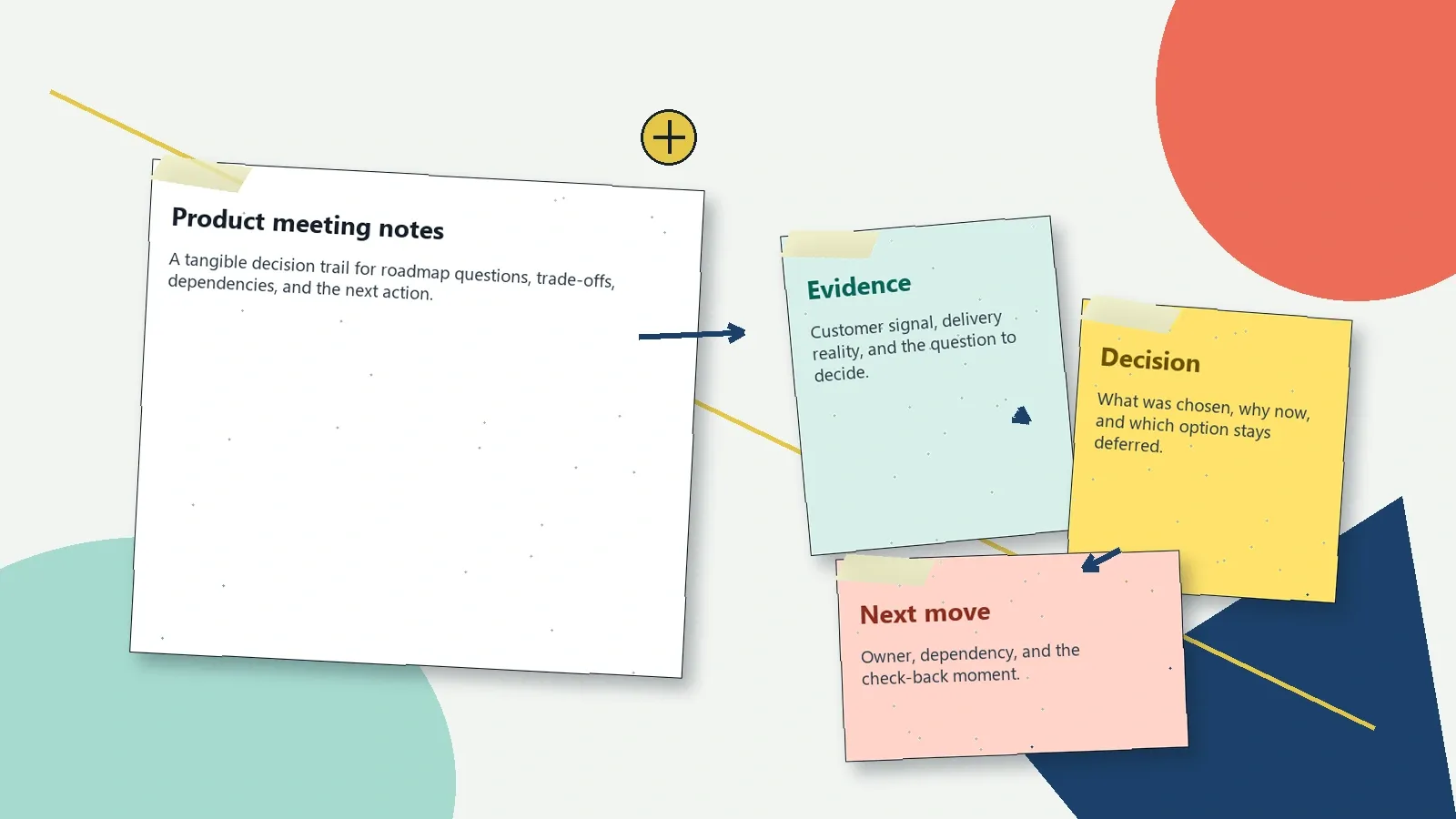
Product Meeting Notes: Short Answer
Product meeting notes are a structured record of the evidence, options, decisions, trade-offs, dependencies, and action items discussed by a product team. They turn a roadmap or planning conversation into a reusable decision trail, so teammates can understand what changed, why it changed, who owns the next move, and where to verify the source.
Good product notes should answer a question that always returns later: “Why did we make this call?”
| If the meeting is about... | Capture... | So the team can... |
|---|---|---|
| Roadmap priority | Evidence, outcome, trade-off, and decision owner | Revisit priority without rebuilding the case from memory |
| Delivery planning | Dependencies, risks, assumptions, and timing | Coordinate work before a hidden blocker becomes a delay |
| Product discovery | Customer language, behavior, unmet need, and question | Separate an observed problem from a proposed feature |
| Cross-functional review | Decision, dissent, commitments, and next check-back | Know what was agreed and what remains open |
What Are Product Meeting Notes?
Product meeting notes are working records for the conversations that shape a product: discovery reviews, roadmap planning, backlog refinement, design critiques, sprint planning, delivery risk reviews, launch retrospectives, and customer-feedback discussions. They are not just a list of topics. They explain the evidence behind a decision and the work that follows it.
A transcript preserves the full discussion. A product note distills the decision-ready parts: what the team learned, the options considered, the chosen path, the reason, the constraints, and the next action. That distinction matters when a team returns to the roadmap six weeks later and finds an issue it no longer remembers debating.
Definition: Product meeting notes are a shared decision-and-follow-up record for product work. They link discussion to the roadmap, delivery plan, customer evidence, and people responsible for the next move.
Atlassian's DACI decision framework distinguishes a Driver, Approver, Contributors, and Informed parties. A product team does not need to use DACI in every meeting, but it does need clarity about who is deciding, who is doing the work, and who must understand the outcome.
The Product Meeting Notes Problem: Decisions Lose Their Context
Product organizations create a surprising amount of decision material. A customer-success call reveals an adoption problem. A product review considers three ways to address it. Engineering raises a dependency. A designer identifies an edge case. The roadmap shifts slightly. Then the detail disperses: a recording in one tool, a private note in another, a chat update somewhere else, and a task with no explanation of why it exists.
That fragmentation has a cost. Teams relitigate old decisions because the reasoning is missing. A new teammate sees a roadmap item but not the customer evidence behind it. An engineer sees a ticket but not the trade-off that made a simpler approach acceptable. A product manager spends time answering questions that were already resolved in a meeting.
| Scattered artifact | What gets lost | What structured notes preserve |
|---|---|---|
| Recording | Fast retrieval for a busy team | Summary links to the source moment for verification |
| Personal notes | Shared meaning and the full range of perspectives | Decision, rationale, and action plan that others can read |
| Chat thread | Context as messages move upward and fragment | One canonical record for the meeting outcome |
| Project ticket | The customer or business reason behind the work | Evidence, trade-offs, dependencies, and the decision owner |
| Follow-up email | Internal reasoning and unresolved questions | Audience-specific recap without losing the fuller record |
Generic transcripts help with search, but they do not decide what is important. A product team still needs to interpret the conversation and confirm whether something is an observation, a hypothesis, a decision, a dependency, or an action item.
Product Meeting Notes Workflow: Evidence to Decision to Action
A reliable note-taking workflow gives each product conversation a clear exit. The team should not have to guess whether the meeting ended in a decision, an experiment, a request for more evidence, or a deferred question.
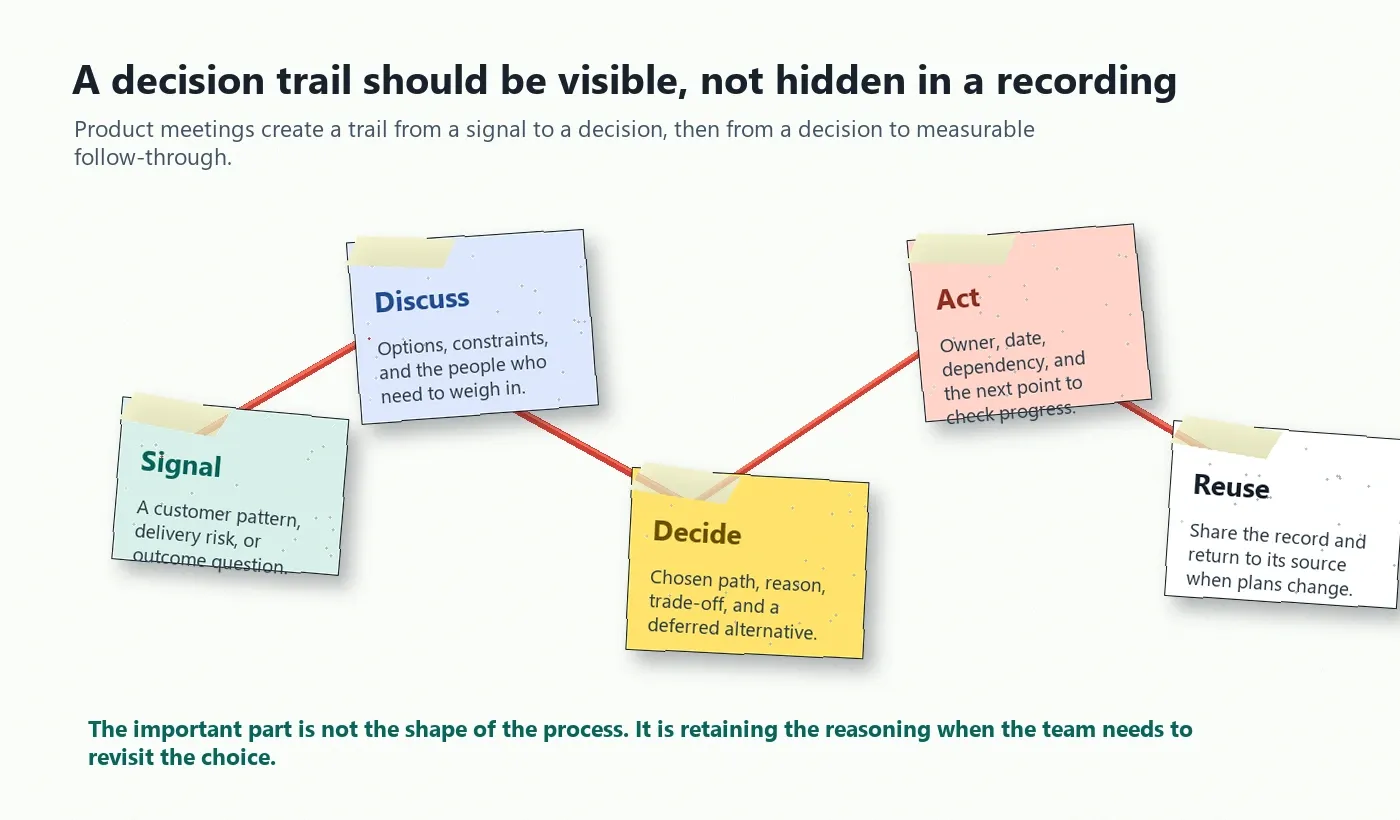
- Prepare the decision context. State the meeting goal, the decision owner, available evidence, open questions, and expected outcome. This prevents a planning discussion from becoming a broad status update.
- Capture the authorized conversation. Record the meeting or use an approved assistant so participants can explain trade-offs, challenge assumptions, and listen closely instead of trying to transcribe each other.
- Separate facts from proposals. Mark customer evidence, delivery constraints, options, assumptions, and opinions. A note should not present a hypothesis as a confirmed problem.
- Record the decision clearly. Name the selected path, the decision owner, the rationale, the main trade-off, any dissent, and the condition that would trigger a revisit.
- Assign follow-through. Each action needs an owner, timing, dependency, and next verification point. A task without an owner is an intention, not a plan.
- Make the knowledge reusable. Put the recap in the systems where product, design, engineering, sales, and customer success can find it, with the source record available when someone needs more context.
The World Wide Web Consortium describes transcripts as text alternatives that make audio and video more usable. For product work, the same principle makes an important discussion usable for the researcher, designer, engineer, or stakeholder who was not in the room.
What Product Teams Should Capture in Every Product Meeting
Product teams do not need an enormous template. They need fields that protect the integrity of a decision. The following fields work for roadmap reviews, discovery conversations, design critiques, planning meetings, and launch readiness sessions.
| Field | What to capture | Why it matters |
|---|---|---|
| Decision question | The specific choice the meeting exists to make | Keeps the discussion from ending without an outcome |
| Evidence | Customer feedback, behavior, delivery data, research, or business context | Shows what informed the choice |
| Options considered | Viable paths, not every idea mentioned in passing | Makes later trade-off review possible |
| Decision and owner | Selected path and the person accountable for deciding | Prevents unclear ownership after the meeting |
| Trade-off and dissent | What was accepted, deferred, or still contested | Stops the decision from being remembered as more certain than it was |
| Dependencies and risk | Teams, systems, timing, assumptions, and delivery constraints | Connects the roadmap to execution reality |
| Action and check-back | Owner, due date, success signal, and next review | Turns the meeting into accountable work |
A useful rule for product notes is to preserve the degree of certainty. “We will ship this in the next release” is a decision. “We will validate the implementation path before committing to the next release” is a different decision. The second version may be less exciting, but it is more honest and more useful.
Completed Example: Product Meeting Notes for a Roadmap Review
The example below is fictional. It shows the level of detail that makes a roadmap review understandable to someone joining the project after the meeting.
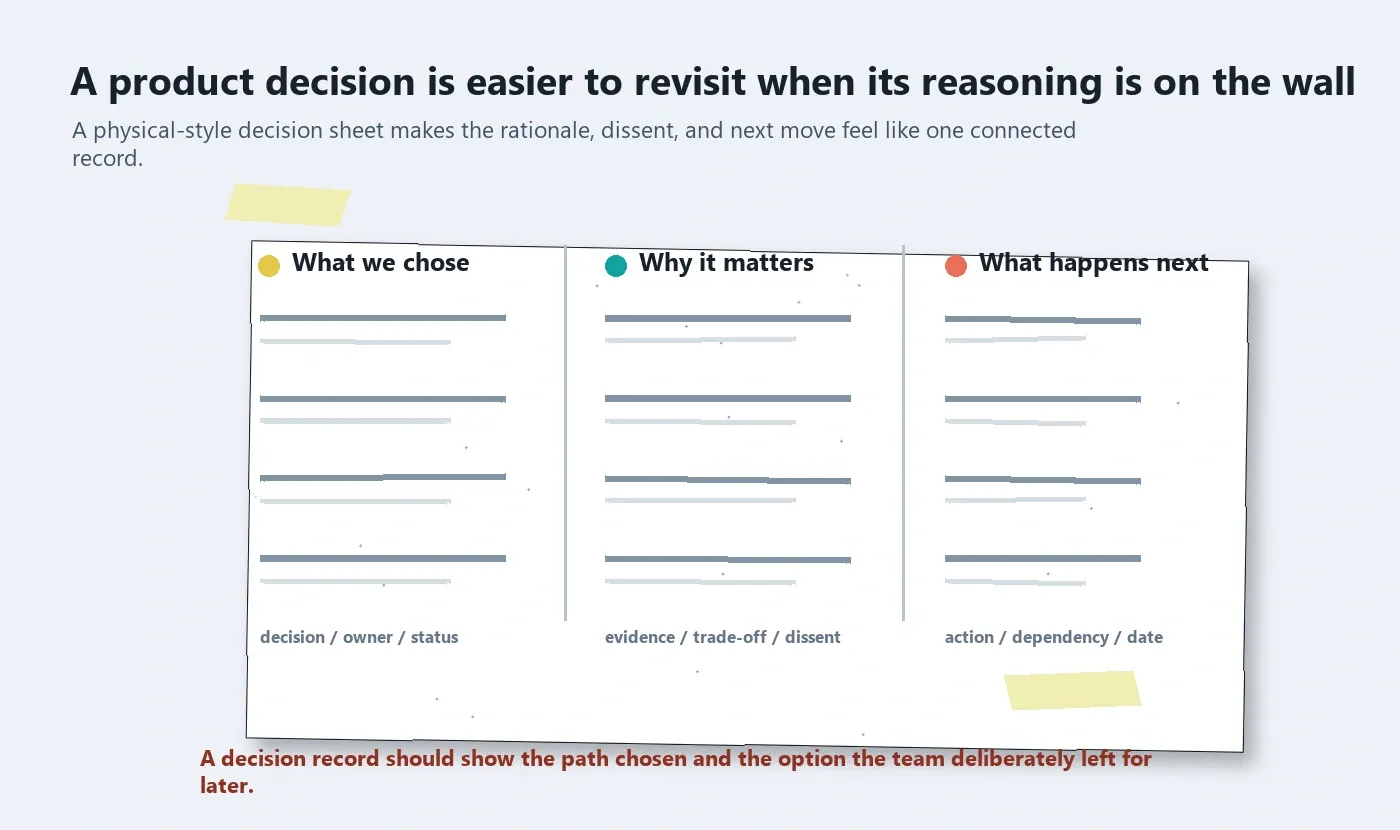
Initiative: First-week setup experience (fictional)
Meeting: Roadmap review | July 13 | 50 minutes
Decision owner: Product lead
Participants: Product, design, engineering, customer success, research

Decision question:
- Should the next roadmap increment focus on guided setup or on expanding customization?

Evidence reviewed:
- Customer success reports that new administrators ask for help during the first setup session.
- Research interviews show that users can complete core setup but hesitate at the configuration handoff.
- Engineering notes that guided setup can reuse the current rules engine; broad customization needs new permission work.

Options considered:
- A: Guided setup with a short checklist and contextual prompts.
- B: New customization controls before guided setup.
- C: No change; publish more documentation.

Decision:
- Choose A for the next increment. Keep B in discovery until permission constraints are clearer.

Rationale and trade-off:
- A addresses the observed first-week problem with lower implementation dependency.
- The team accepts that advanced users will still need a separate customization path later.

Open questions:
- Which setup milestone best predicts successful adoption?
- What wording should distinguish optional from required configuration?

Action items:
- Product manager | Write the experiment brief | Wednesday
- Designer | Produce the setup flow draft | Friday
- Engineering lead | Validate rules-engine assumptions | Friday
- Customer success lead | Provide five recent setup examples | Thursday

Check-back point:
- Review experiment scope and instrumented milestone before implementation starts.
The note is not a substitute for product judgment. It is a way to make judgment legible: the evidence, option, decision, trade-off, and action can all be examined without replaying the meeting.
Product Meeting Notes vs. a Decision Log vs. a Transcript
These three records work together, but each has a different job. Product teams often lose clarity when they try to make one artifact do all three jobs.
| Artifact | Primary use | Best reader | Limitation |
|---|---|---|---|
| Meeting transcript | Searchable source of what was said | People checking exact wording or timeline | Too much detail for a fast product handoff |
| Product meeting notes | Context, options, decisions, risk, and next actions | Cross-functional product team | Needs source links for nuanced or disputed detail |
| Decision log | Running catalog of consequential choices | Product, engineering, leadership, future teammates | May omit the broader discussion and experiment detail |
| Roadmap item | Visibility into planned work and sequencing | Stakeholders and delivery teams | Does not explain all of the evidence behind the priority |
Use a transcript when you need evidence. Use product meeting notes when a team needs context and follow-through. Use a decision log when a choice needs a durable home beyond the individual meeting that produced it.
How Product Notes Connect Roadmaps to Customer and Delivery Reality
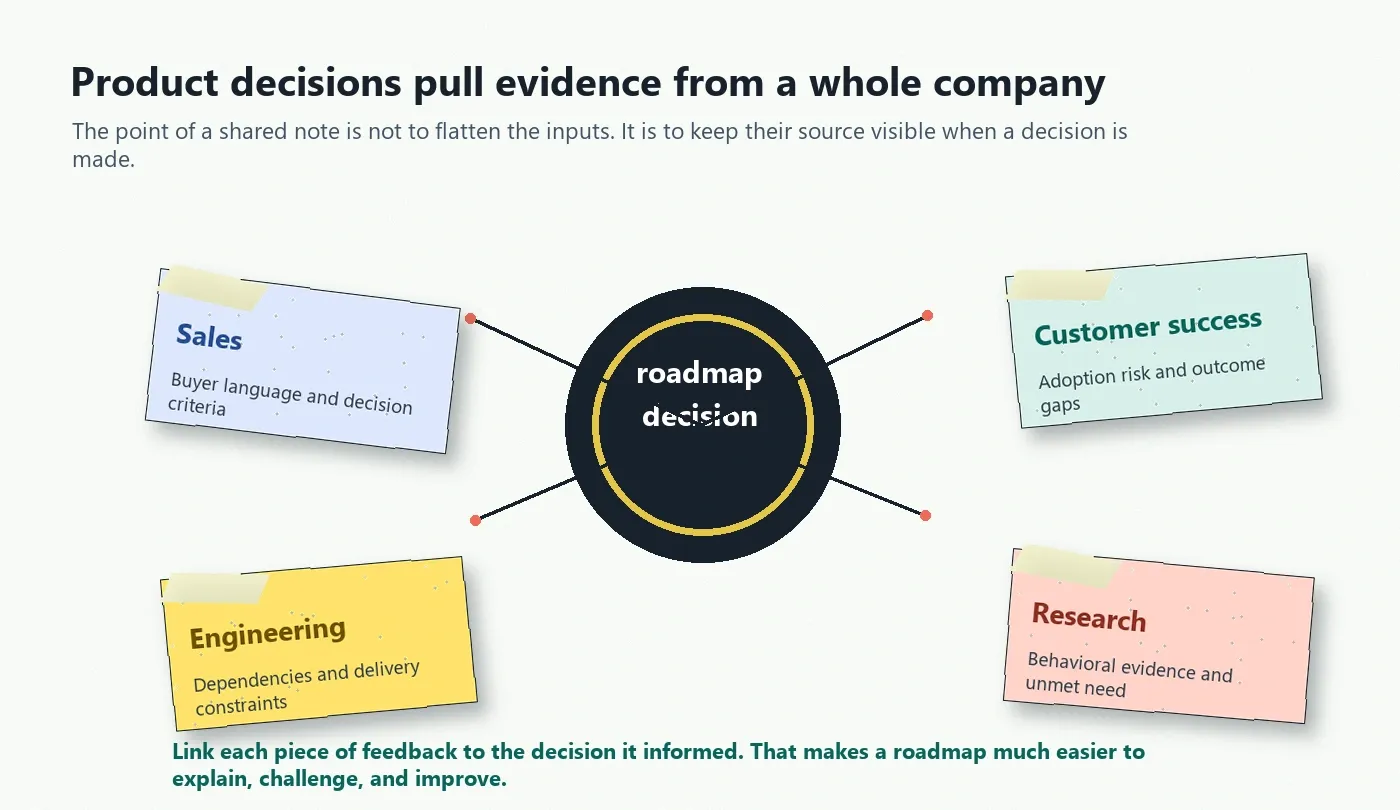
Roadmaps are shaped by more than a product manager's meeting. Sales sees deal criteria and objections. Customer success sees where adoption stalls. Engineering sees constraints and dependencies. Research sees patterns in behavior. Product meeting notes become more valuable when they connect those inputs to a specific decision instead of creating separate pools of feedback.
| Partner team | What product should capture | How to keep it useful |
|---|---|---|
| Sales | Customer objections, buyer language, decision criteria, and competitive context | Link the signal to the opportunity and avoid treating one request as a roadmap commitment |
| Customer success | Adoption risk, workarounds, outcome gaps, and stakeholder changes | Separate recurring patterns from one-off account context |
| Engineering | Dependencies, delivery risk, operational impact, and assumptions | Mark what is confirmed, estimated, or awaiting technical validation |
| Research | Behavioral evidence, unmet need, and questions requiring further study | Keep raw evidence close to the interpretation and proposed action |
| Project management | Scope, owner, timing, risk, and decision escalation path | Update the action plan whenever a dependency changes |
How should product teams use AI meeting notes?
Product teams should use AI meeting notes to stay engaged during the discussion, then review a structured recap afterward. Confirm the decision, preserve the rationale and trade-off, assign owners, and share the record with the people who must design, build, validate, sell, or support the outcome. Treat the source transcript as evidence, not as a replacement for product judgment.
What should customer success teams share with product?
Customer success teams should share adoption risk, outcome gaps, recurring workarounds, stakeholder context, requested results, and source evidence. Product notes should distinguish an observed customer problem from the internal solution proposed in response, so the team can understand both the need and the assumption.
How HiNoter Fits a Product Meeting Workflow
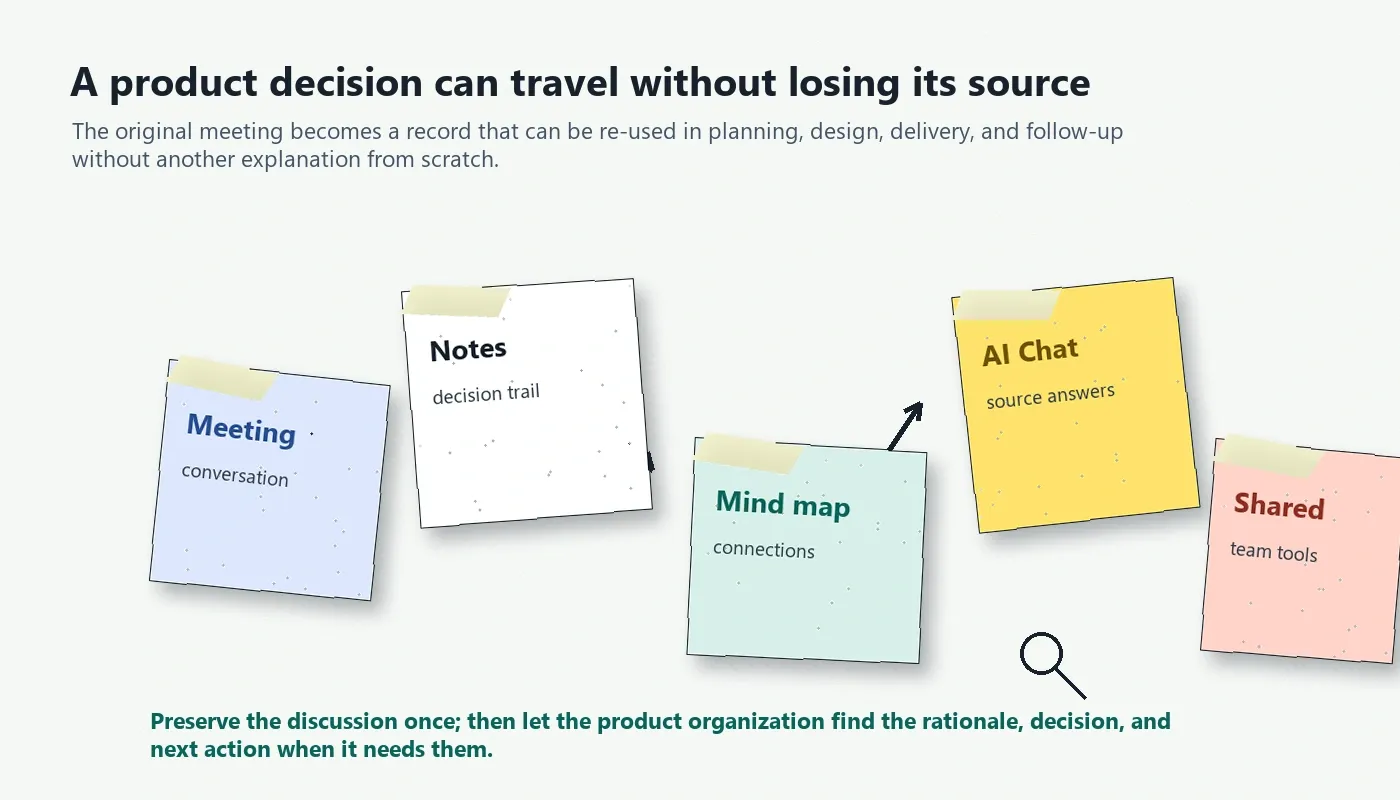
HiNoter is designed for the moment when a product discussion needs to become organized knowledge. Before a meeting, a team can connect its calendar so an approved assistant joins scheduled calls. During the meeting, people can debate trade-offs and surface evidence without dividing attention between listening and typing. After the meeting, the conversation becomes a structured record rather than a recording that is hard to reuse.
- Before the meeting: connect the calendar or upload the relevant source materials, such as a recording, video, permitted YouTube content, audio, or PDF.
- During the meeting: let HiNoter capture the authorized discussion so participants can focus on decision quality and clear ownership.
- After the meeting: receive a transcript, summary, action items, and mind map that make themes and dependencies easier to scan.
- For knowledge reuse: ask source-linked questions through AI Chat when someone needs to locate the rationale behind a roadmap or delivery decision.
- For distribution: send the appropriate outputs to Notion, Slack, Google Docs, calendar workflows, and email.
Use HiNoter to turn product meetings into structured notes, action items, mind maps, and cited answers without asking one person to manually capture every discussion.
Related HiNoter workflows include AI meeting notes, an AI meeting assistant, meeting summary generation, audio to text, AI Chat with source references, and multilingual meeting support.
Where Product Meeting Notes Should Go After the Call
Not every person needs the full transcript, and not every meeting output should become a roadmap artifact. Match the destination to the audience and the job. The source record should stay accessible to authorized people, while the working summary should travel to the place where the next action happens.
| Destination | Best use | What to send |
|---|---|---|
| Notion | Product knowledge base, decision records, and initiative context | Summary, rationale, source link, decision, and action plan |
| Slack | Fast visibility and owner follow-up | Short recap, important decision, and immediate actions |
| Google Docs | Collaborative review, comments, and long-form planning | Expanded notes, evidence, and unresolved questions |
| Executive or partner recap | Verified decision, responsibilities, and next review date | |
| Calendar workflow | Recurring product reviews and agenda continuity | Open actions, decision question, and links to prior context |
Measure the Quality of Product Meeting Notes
The goal is not to create more documents. The goal is to make product decisions and commitments easier to understand, execute, and revisit. These operating measures help teams assess the quality of their meeting records without claiming that a note-taking tool alone causes a product outcome.
| Quality check | Question to ask | Healthy signal |
|---|---|---|
| Decision clarity | Can a teammate state what was decided and who owned it? | The selected path and decision owner are visible near the top |
| Rationale quality | Can the team explain why this path was chosen? | Evidence and trade-offs are attached to the decision |
| Action completeness | Does each material follow-up have an owner and timing? | Open work is assignable without another clarification meeting |
| Dependency visibility | Can delivery teams see what could change timing or scope? | Constraints, assumptions, and check-back points are named |
| Source traceability | Can a claim be checked against the meeting? | Important facts point to a transcript passage or source |
| Reuse | Can a new teammate locate the context later? | Notes live in a shared, searchable system |
Permissions, Privacy, and Product Context
Product meetings can include unreleased plans, customer feedback, security details, commercial terms, employee information, and private opinions. Treat recordings, transcripts, summaries, and AI-generated outputs as product records. Follow the organization's policy for recording, consent, access, sharing, and retention.
Be deliberate about audience. The roadmap summary might be useful to a broad group, while a full transcript of customer context should remain limited to the people who need it. Confirm customer-facing or externally shared summaries before they leave the product team. This guide describes a working process, not legal advice.
Product Meeting Notes FAQ
What should product meeting notes include?
Product meeting notes should include the meeting goal, participants, customer or delivery evidence, options discussed, the decision made, the rationale, trade-offs, dissent or open questions, action items with owners and due dates, and the next review point.
How should product teams use AI meeting notes?
Product teams should use AI meeting notes to stay focused on the discussion, then review a structured record after the meeting. Confirm the decision, preserve the reason behind it, assign the work, and share the output with the people responsible for roadmap, design, engineering, and customer outcomes.
What is the difference between product meeting notes and a decision log?
Product meeting notes capture the broader conversation, context, and follow-up from a meeting. A decision log is a concise running record of chosen paths, their rationale, owners, and status. Many product teams use meeting notes to create or update a decision log.
How do product meeting notes help roadmaps?
Product meeting notes connect roadmap changes to the customer evidence, delivery constraints, trade-offs, and decision owner behind them. That context helps teams revisit priorities without reconstructing the original discussion from chat messages or memory.
What should customer success teams share with product?
Customer success teams should share outcome gaps, adoption risks, requests, recurring workarounds, stakeholder context, and source evidence. Product notes should distinguish observed customer behavior from a proposed solution so the product team can assess the underlying problem.
What should engineers capture in product planning notes?
Engineers should capture technical constraints, dependencies, delivery risk, operational impact, assumptions that need validation, and the owner of each follow-up. The note should make clear whether an item is a confirmed constraint, an estimate, or an open question.
Can HiNoter create product meeting notes automatically?
HiNoter can turn authorized meetings and content sources into transcripts, summaries, action items, mind maps, exports, and source-linked AI Chat. Product teams can use those outputs to create a decision record, roadmap context, and follow-up workflow without manually transcribing each discussion.