Direct answer: Recruiting interview notes are structured records of candidate answers, role-related evidence, interviewer observations, scorecard ratings, concerns, follow-up questions, and hiring recommendations. The best notes separate evidence from opinion, keep feedback tied to job competencies, and make candidate comparisons easier during debriefs.
Recruiting interview notes often break down at the exact moment they become valuable. The interview ends, the recruiter has three more calls, the hiring manager writes two private bullets, a panelist drops a comment in chat, and the candidate's strongest example lives only in a recording. By debrief time, the team is comparing memory, personality impressions, and incomplete feedback instead of consistent evidence.
For recruiting teams, this is not just messy administration. Interview notes affect candidate experience, hiring speed, quality of feedback, debrief accuracy, and the ability to explain why a candidate should advance, pause, or be declined. Generic transcripts help preserve the conversation, but they do not automatically create a role-specific evaluation record. A recruiter needs notes that connect what the candidate said to the role, competency, hiring stage, and next step.
This guide gives a practical workflow, templates, scorecard examples, and evidence-first feedback language for recruiter screens, hiring manager interviews, panel interviews, executive interviews, and debriefs. It also shows how HiNoter for interviews and recruiters can capture interviews, summarize candidate responses, and help teams compare feedback without turning every recruiter into a full-time note taker.
What Are Recruiting Interview Notes?
Recruiting interview notes are the written record of a candidate conversation, organized around role requirements, competencies, evidence, interviewer feedback, risks, and next steps. They are different from raw transcripts because they help hiring teams make a decision. They are different from casual notes because they should be comparable across candidates and interviewers.
A strong recruiting note answers practical questions: Which competency was assessed? What example did the candidate give? What evidence supports the rating? What concern needs a follow-up probe? What should the hiring team do next? When a note can answer those questions, it becomes a hiring asset instead of a private memory aid.
Why Interview Notes Matter for Hiring Quality
Hiring is expensive enough that weak documentation has a real cost. SHRM has reported an average cost per hire of nearly $4,700, and that figure does not include every downstream cost of a poor match, delayed decision, or repeated interview loop. Good notes cannot guarantee a great hire, but they help teams make decisions from the same evidence rather than from scattered impressions.
Research on employment interviews also supports the value of structure. A comprehensive meta-analysis of interview validity found that interview results depend on what the interview measures and how structured the process is. Structured interviews tend to make candidate comparison more consistent because the team asks job-related questions, evaluates defined competencies, and records evidence against the same criteria.
There is also a compliance reason to keep interview notes disciplined. EEOC guidance explains that covered employers should not use selection practices that have a disproportionately negative effect unless they are job-related and necessary to the business. The Uniform Guidelines on Employee Selection Procedures treat interviews as a type of employee selection procedure. That does not mean every interview note is a legal document, but it does mean hiring teams should keep notes job-related, factual, and consistent.
AI is now part of the recruiting conversation too. LinkedIn's 2025 Future of Recruiting report is based on LinkedIn data and a survey of more than 1,000 talent professionals; the report says AI is reshaping recruiting by helping teams work faster and focus on higher-value work. The practical question is not whether AI can produce text. It is whether AI can help recruiters create structured, evidence-backed notes while humans keep responsibility for judgment.
Recruiting Interview Notes: What to Capture
Good interview notes are specific enough for a hiring decision and concise enough for a debrief. Use the table below as a capture checklist.
| Area | What to Capture | Why It Matters |
|---|---|---|
| Role context | Role title, level, hiring stage, interview type, interviewer, and target competencies. | Feedback must be tied to the job being evaluated. |
| Candidate evidence | Specific examples, outcomes, numbers, decisions, tradeoffs, and quotes from the candidate. | Evidence makes feedback more useful than general impressions. |
| Competency signal | The skill or behavior each answer supports, such as problem solving, leadership, role scope, or communication. | Competency labels help interviewers compare the same signal across candidates. |
| Concern | Unclear ownership, missing experience, role-level mismatch, communication gap, or unresolved risk. | Concerns become fairer when they are specific and follow-up ready. |
| Rating | Scorecard rating with a short explanation and supporting evidence. | A rating without evidence is hard to defend in debrief. |
| Next step | Advance, reject, hold, request work sample, schedule follow-up, or ask another interviewer to probe. | Recruiting notes should move the process forward. |
Before and After: From Scattered Feedback to Hiring Evidence
Most hiring teams do not need more meeting artifacts. They need one consistent record that helps the recruiter, hiring manager, panel, and coordinator understand what happened and what should happen next.
| Stage | Scattered Process | Structured Process | HiNoter Output |
|---|---|---|---|
| Before interview | Interviewer opens a resume and improvises questions based on memory. | Team aligns on competencies, scorecard fields, role level, and planned probes. | Clear context for the interview record. |
| During interview | Recruiter splits attention between listening, typing, and keeping the conversation human. | Conversation is captured with consent while the interviewer stays present. | Transcript and candidate response record. |
| After interview | Feedback sits in private notes, chat, email, or the ATS as vague bullets. | Summary, evidence, ratings, concerns, and follow-up items are reviewed once. | AI summary, scorecard-ready notes, and action items. |
| Hiring debrief | Panelists compare feelings, recency bias, and partial memories. | Team compares candidate evidence against the same competencies. | Source-linked answers for specific interview claims. |
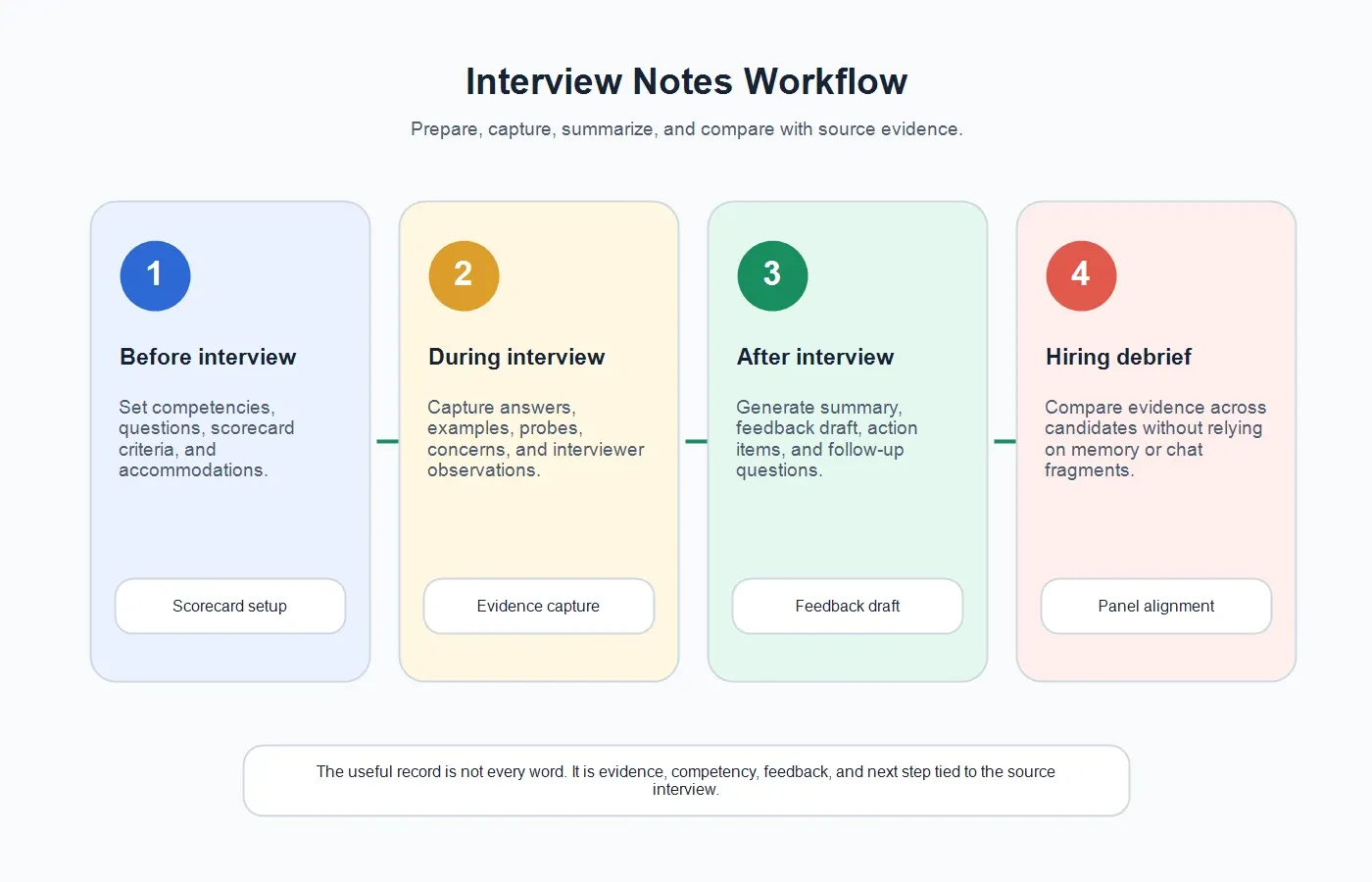
How to Run a Recruiting Interview Notes Workflow
1. Prepare the Scorecard Before the Interview
Start with the role, not the resume. Define the competencies the interview is responsible for evaluating: technical depth, customer judgment, leadership, problem solving, communication, execution, collaboration, or domain expertise. Each competency should have a question, a scoring definition, and a clear example of strong evidence.
This helps the interviewer avoid drifting into personal preference. Instead of writing "great culture fit," the interviewer can record "gave a concrete example of disagreeing with a product leader, using customer data to change the roadmap, and preserving the relationship." That sentence is more useful, more comparable, and easier to discuss.
2. Capture Candidate Answers Without Losing the Conversation
Recruiters and hiring managers are expected to listen closely, build trust, sell the opportunity, manage time, ask follow-up questions, and document everything. That is a lot to ask in a 30- or 45-minute interview. A missed quote, number, or caveat can change how the feedback reads later.
With HiNoter AI Meeting Assistant, teams can capture authorized interviews from scheduled calls, so the interviewer can focus on the candidate instead of typing every answer. For candidate conversations, consent, company policy, and local recording rules should always come first.
3. Turn the Transcript Into Candidate Feedback
After the interview, the raw transcript should become a decision record. Summarize the candidate's background, highlight role-relevant examples, list strengths, name concerns, capture unanswered questions, and draft next steps. Keep opinion and evidence separate. "Strong communicator" is not enough. "Explained a complex migration plan in plain language and checked stakeholder understanding twice" is better.
HiNoter's AI meeting notes can generate summaries, action items, and structured notes after the interview. The recruiter or interviewer should still review names, dates, sensitive details, scorecard ratings, and hiring recommendations before sharing feedback with the hiring team.
4. Reuse Interview Knowledge During Debriefs
Debriefs become easier when the team can ask source-backed questions. Which candidate gave the strongest customer-facing example? Who has managed a team at the required scale? Which concern was confirmed by two interviewers and which concern was just uncertainty from one conversation?
With HiNoter AI Chat, teams can ask questions about one interview or a set of interview notes and trace answers back to the source. That is especially useful when a hiring loop includes recruiter screens, technical interviews, panel interviews, reference calls, and follow-up discussions.
Copyable Recruiting Interview Notes Template
Use this template for recruiter screens, hiring manager interviews, structured panels, executive interviews, and final debrief preparation. Keep internal evaluation notes separate from candidate-facing communication.
Interview Details
Role: [Role title] | Candidate: [Candidate name or ID] | Interviewer: [Name] | Interview type: [Recruiter screen / hiring manager / technical / panel / executive] | Date: [Date] | Stage: [Stage]
Target Competencies
Competency 1: [Skill or behavior] | Question asked: [Question] | Evidence standard: [What strong evidence looks like]
Competency 2: [Skill or behavior] | Question asked: [Question] | Evidence standard: [What strong evidence looks like]
Competency 3: [Skill or behavior] | Question asked: [Question] | Evidence standard: [What strong evidence looks like]
Candidate Evidence
Example: [What the candidate described]
Outcome: [Result, metric, business impact, or learning]
Quote or exact language: "[Candidate's words]"
Evidence quality: [Confirmed / needs probe / unclear]
Feedback and Rating
Strengths: [Evidence-backed strengths]
Concerns: [Specific concerns tied to role requirements]
Rating: [Score or recommendation] | Reason: [One or two evidence-backed sentences]
Follow-up probe: [What the next interviewer should validate]
Next Steps
Recommendation: [Advance / hold / reject / follow-up / work sample]
Action item: [Task] - Owner: [Name] - Due: [Date]
Candidate communication: [Short, candidate-safe update]
Generate this automatically with HiNoter: Capture the interview, review the transcript-backed summary, then fill the scorecard with evidence, concerns, action items, and follow-up probes before the debrief.
Fictional Example: Product Manager Interview Notes
The example below is fictional, but it shows the level of detail that makes interview feedback useful. The role is Senior Product Manager for a B2B SaaS platform, and the interview is a hiring manager round focused on product judgment, execution, and cross-functional leadership.
Candidate summary: The candidate has seven years of product experience, including four years in B2B SaaS. They described leading roadmap prioritization for an onboarding product that improved activation by 18% over two quarters.
Evidence for product judgment: The candidate explained that the team originally planned to build a reporting feature requested by enterprise customers. After reviewing support tickets and onboarding drop-off data, they shifted the roadmap toward setup automation. The candidate named the tradeoff, the data source, and the stakeholder communication plan.
Evidence for execution: The candidate described a launch plan with engineering, design, customer success, and sales enablement. They shipped the first release in six weeks and used weekly adoption reviews to adjust onboarding prompts. This supports execution discipline and cross-functional operating rhythm.
Concern to probe: The candidate has led squads of six to eight people, but the target role may require influence across three product teams. The next interviewer should ask for an example of setting direction across multiple teams without direct authority.
Recommendation: Advance to panel. Product judgment and communication are strong. Validate role scope and multi-team leadership before final decision.
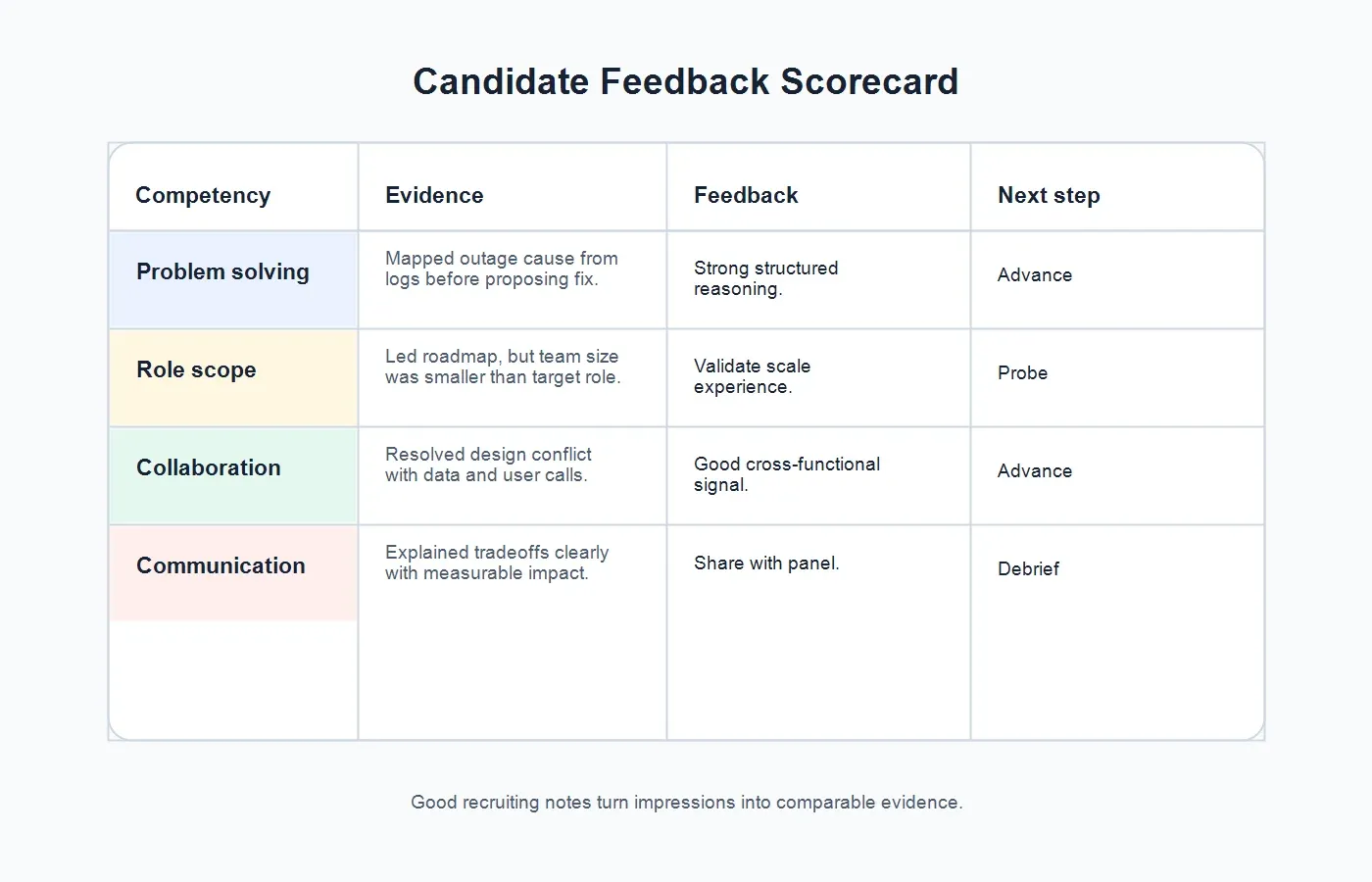
How to Write Evidence-Based Candidate Feedback
The strongest feedback uses the pattern: competency, evidence, interpretation, and next step. This keeps hiring discussions grounded without pretending that a single interview can answer every question.
| Competency | Evidence | Feedback | Next Step |
|---|---|---|---|
| Problem solving | Mapped outage cause from logs before proposing a fix. | Strong structured reasoning. | Advance. |
| Role scope | Led roadmap, but team size was smaller than target role. | Validate scale experience. | Probe. |
| Collaboration | Resolved design conflict with customer data and user calls. | Good cross-functional signal. | Advance. |
| Communication | Explained tradeoffs clearly with measurable impact. | Share with panel. | Debrief. |
KPIs Recruiting Notes Should Support
Interview notes are not a replacement for an ATS, assessment design, compensation strategy, or hiring manager calibration. They are the evidence layer that explains why candidates move through the funnel and where the hiring process slows down.
| KPI | Interview Note Evidence | How Recruiters Use It |
|---|---|---|
| Quality of hire signal | Competency evidence, rating reason, and later hiring outcome. | Improve interview questions and scorecard calibration. |
| Time to decision | Clear recommendation, unresolved concerns, and follow-up owner. | Reduce stalled debriefs and repeated interview loops. |
| Candidate experience | Follow-up commitments, timeline promises, and communication notes. | Send faster, more accurate updates. |
| Panel alignment | Evidence by competency across interviewers. | Compare candidates without relying on memory. |
| Fairness and consistency | Job-related criteria, structured questions, and evidence-backed ratings. | Keep feedback focused on role requirements. |
How HiNoter Fits the Recruiting Workflow
HiNoter is helpful when recruiters need more than a transcript. It gives hiring teams a repeatable path from interview capture to searchable candidate evidence.
1. Connect the interview calendar. Choose the interviews that should be captured, such as recruiter screens, hiring manager rounds, panel interviews, reference calls, or internal debriefs.
2. Let the assistant capture the call. With proper consent and policy alignment, HiNoter can join scheduled online interviews so the interviewer does not need to manually start and stop a recording.
3. Review structured outputs. HiNoter generates transcript-backed summaries, action items, and mind maps. Its 50+ language support and automatic language detection are useful when recruiting across regions, accents, and multilingual hiring teams.
4. Send notes into the workspace. Teams can move the interview record into their preferred workspace. For example, the HiNoter Notion integration can push summaries, action items, dates, tags, and content blocks into a selected database for hiring team review.
5. Ask source-linked questions later. Before debrief, recruiters can ask which candidates showed specific competencies, where concerns were raised, or what follow-up probes remain open.
Role-Specific Q&A Blocks for Hiring Teams
What should recruiters capture in interview notes?
Recruiters should capture the role, stage, target competencies, candidate examples, measurable outcomes, concerns, rating rationale, follow-up probes, timeline commitments, and next steps. Notes should be factual and role-related, not personality judgments or unsupported impressions.
How should hiring managers use AI interview notes?
Hiring managers should use AI interview notes as a structured draft. They should review the summary, confirm evidence, complete the scorecard, add human judgment, and make sure the final feedback matches the role criteria. AI can organize the record, but the hiring decision remains human.
What should interview panels compare?
Panels should compare job-related evidence by competency: examples, outcomes, role scope, decision quality, communication, collaboration, and unresolved concerns. They should avoid comparing who felt most familiar or who gave the most polished answer unless those signals are tied to the role.
What should candidate feedback avoid?
Candidate feedback should avoid protected characteristics, vague personality labels, assumptions about culture fit, unrelated personal details, and unsupported claims. Keep feedback tied to the role, the question asked, and the evidence provided in the interview.
Privacy, Consent, and Fairness Rules
Interviews can include personal history, compensation expectations, immigration details, disability accommodation requests, and sensitive career information. Recruiting teams should follow company policy, local recording and consent rules, and candidate privacy requirements before capturing or sharing an interview.
Separate the internal evaluation record from candidate-facing communication. The candidate-facing version should be respectful, concise, and safe to share. Internal notes can include role-specific evaluation, unresolved concerns, and follow-up probes, but they should still remain factual and job-related.
Access control matters. Candidate notes should be visible only to people who need them for the hiring process. Delete, retain, or export notes according to the organization's data retention policy and applicable employment rules.
Common Mistakes in Recruiting Interview Notes
Writing impressions without evidence. "Great presence" is weaker than "explained a complex migration plan clearly and tied it to customer impact."
Letting every interviewer use a different standard. A panel cannot compare candidates fairly when one person rates leadership, another rates likability, and another rates only resume pedigree.
Over-trusting the transcript. A transcript is source material. The hiring record still needs structured feedback, ratings, and human review.
Ignoring follow-up probes. If a concern is unresolved, write the exact question the next interviewer should ask.
Mixing internal notes with candidate communication. Keep evaluation notes separate from updates, rejections, and next-step messages.
Try HiNoter for Recruiting Interview Notes
Use HiNoter when interviews need to become candidate evidence, not scattered notes. Capture authorized interviews, generate a transcript-backed summary, review strengths and concerns, add scorecard ratings, and use source-linked questions before the debrief.
The practical win is simple: recruiters stay present, hiring managers give clearer feedback, panels compare candidates more consistently, and the team spends less time reconstructing what happened after every interview.
FAQs
What should recruiting interview notes include?
Recruiting interview notes should include role context, interview stage, competencies assessed, candidate evidence, quotes or examples, concerns, rating rationale, recommendation, follow-up probes, and next steps.
How long should interview notes be?
Interview notes should be concise enough to review quickly but specific enough to support a hiring decision. A strong note usually includes a short summary, evidence by competency, concerns, rating rationale, and a recommendation.
How do AI interview notes differ from transcripts?
A transcript captures what was said. AI interview notes organize the conversation into summaries, evidence, action items, concerns, and scorecard-ready feedback. Recruiters should still review important details before sharing.
Can recruiters use AI notes for candidate feedback?
Yes, but AI notes should be treated as a draft. Recruiters should review the evidence, remove unsupported language, keep feedback job-related, and follow company policy before sending any candidate-facing communication.
Can AI interview notes reduce hiring bias?
AI notes can support consistency by capturing the same interview structure and evidence fields, but they do not automatically remove bias. Hiring teams still need job-related criteria, structured questions, human review, and fair process design.
Can HiNoter support multilingual interviews?
Yes. HiNoter supports 50+ languages with automatic detection, which helps recruiting teams create consistent notes from global interviews and multilingual candidate conversations.