Sales Meeting Notes: Short Answer
Sales meeting notes are a shared record of a customer conversation that captures context, goals, objections, decisions, commitments, and next steps. Unlike a generic transcript, they explain the commercial meaning of the meeting and assign follow-up work to named owners, while preserving a source record when details need to be verified.
For an account team, the goal is simple: everyone should leave the meeting with the same understanding of what the customer needs and what happens next.
| Meeting moment | What to capture | What the team needs afterward |
|---|---|---|
| Customer describes the situation | Context, trigger, and stakeholders | A shared account brief |
| Customer raises a concern | Objection, evidence, and unresolved question | A response owner and a way to confirm resolution |
| People agree on work | Commitment, person, date, and dependency | An action item that can be followed up |
| Meeting ends | Next meeting, decision point, or milestone | A concise recap that everyone can act on |
What Are Sales Meeting Notes?
Sales meeting notes are structured notes created from a discovery call, demo, deal review, renewal discussion, account planning session, or customer check-in. They turn conversation into a usable account record by separating customer context from internal assumptions and turning commitments into visible follow-up.
A good sales note should be useful to three people at once: the rep who ran the meeting, the specialist who needs to contribute next, and the manager who needs a reliable view of deal progress. That is why a few vague bullets such as “good call, send follow-up” are not enough.
Definition: Sales meeting notes are not a transcript with less text. They are a decision-and-follow-up layer built on the conversation.
Salesforce's State of Sales, Sixth Edition reports that sales representatives spend only 28% of their week selling. A meeting-note workflow does not make a sales team more effective by itself, but it can reduce the clerical scramble that follows a useful customer conversation.
The Problem: Valuable Sales Information Scatters Fast
Most sales meetings create several versions of the same story. The rep has personal notes. The call recording contains the exact language. A teammate posts a loose recap in chat. The follow-up email includes a few commitments. The CRM may get a stage update that leaves out the reason behind it. By the time a product specialist or manager enters the account, the customer context has been reduced to fragments.
Generic transcripts do not solve this on their own. They preserve more detail, but they also create another long document that someone has to interpret. Sales teams need a note that makes customer language easy to retrieve while keeping objections, decision criteria, owners, and dates visible.
| Where the detail lands | Common failure | What a shared sales note changes |
|---|---|---|
| Private notebook | Only the attendee understands the shorthand | Customer context is visible to the account team |
| Recording link | Few people rewatch a long call | Important passages can be found from the summary and source |
| Chat thread | Decisions and tasks drift upward and disappear | Action items stay attached to the meeting record |
| Follow-up email | Only one audience receives the recap | Internal and external follow-up can be coordinated separately |
| CRM stage update | Pipeline status lacks customer reasoning | Decision criteria and risk are preserved alongside the opportunity |
Sales Meeting Notes Workflow: Before, During, After, Reuse
Strong sales meeting notes start before the call. That does not mean the team needs a complicated process; it means the meeting has enough context for the recap to be useful when it lands. The full workflow has four moments.
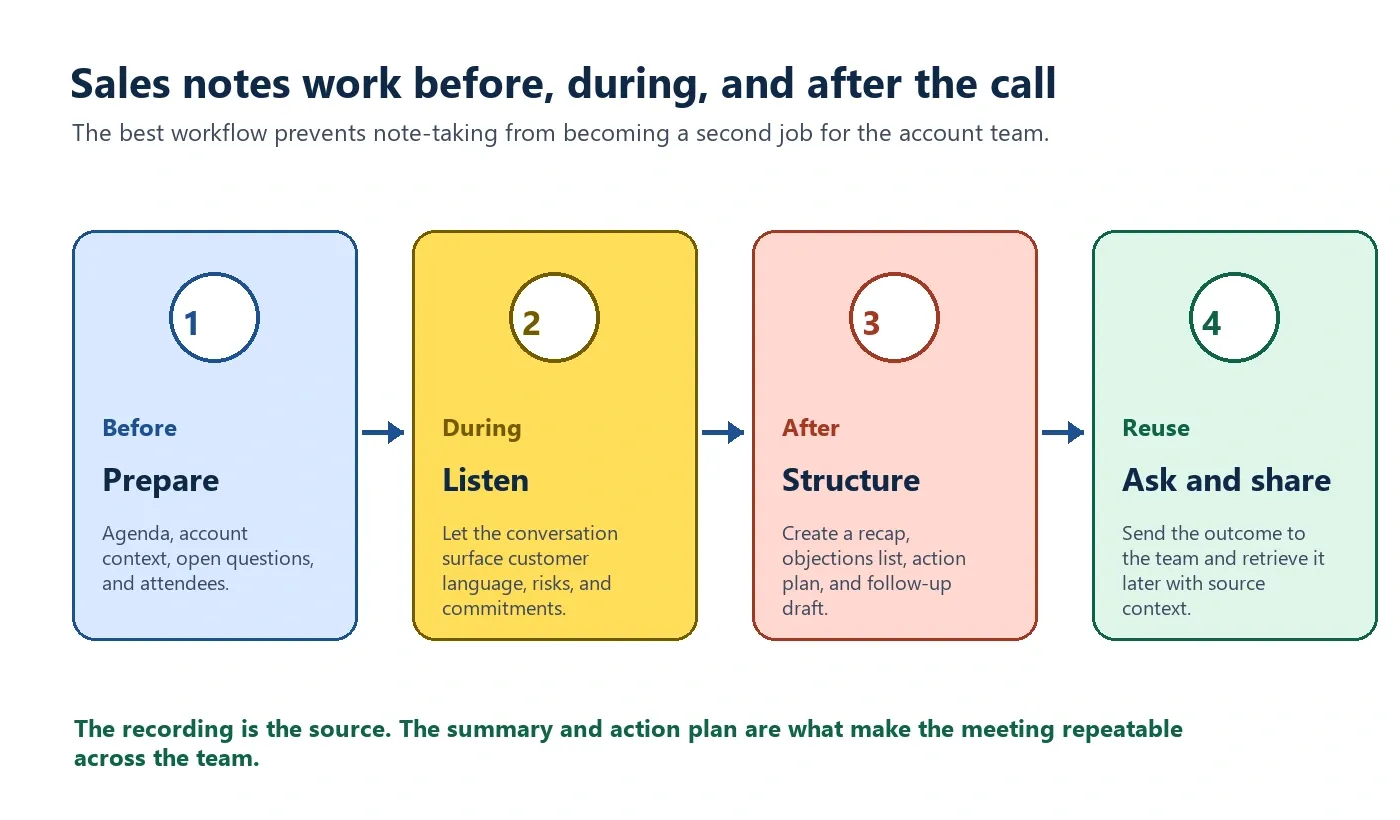
- Before the meeting: prepare the decision context. Add the meeting purpose, account background, attendees and roles, previous commitments, open questions, and a useful outcome. This gives the team a frame without scripting the conversation.
- During the meeting: participate instead of transcribing. Listen for the buyer's phrasing, ask clarifying questions, and say the next step out loud before the meeting ends. If an approved assistant is capturing the conversation, no one has to divide attention between typing and listening.
- After the meeting: turn source material into a practical recap. Review the summary, correct significant names or numbers, confirm real objections, and turn spoken commitments into owner-specific action items.
- Reuse the knowledge: make the account easy to hand off. Send the recap to the systems where people work. Later, teammates should be able to ask what the customer requested, what risk is open, and what was promised without starting from an empty page.
The World Wide Web Consortium's transcript guidance explains why a text alternative makes audio and video more usable. In sales operations, the same principle makes a call accessible to the specialist, manager, or customer success teammate who could not attend.
What Sales Teams Should Capture in Meeting Notes
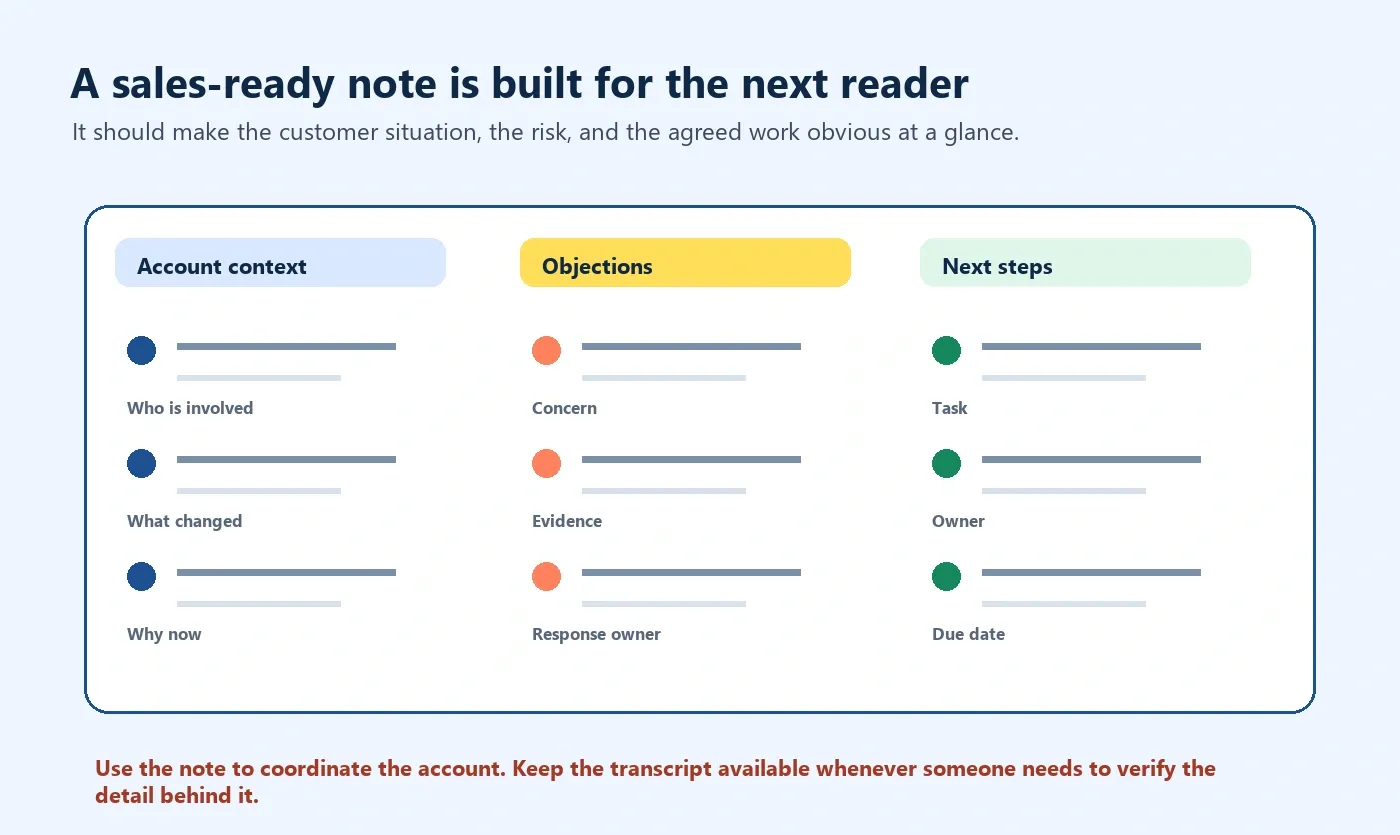
Most sales teams do not need more fields. They need a reliable short list of fields that create a clear account narrative. The table below is a practical baseline for discovery calls, demos, executive reviews, implementation conversations, and renewal meetings.
| Field | What to write down | Why it changes the next move |
|---|---|---|
| Customer context | Trigger, current process, stakeholder roles, and timing | Prevents a generic pitch or generic follow-up |
| Desired outcome | What success looks like in the buyer's terms | Keeps the account plan tied to a real outcome |
| Decision criteria | Requirements around capabilities, security, timing, budget, implementation, or proof | Shows what must be true before the customer can move forward |
| Objections and risks | Concern, source language, context, response owner, and open question | Separates a real blocker from a casual mention |
| Decision or commitment | Who agreed to do what, by when, and what depends on it | Turns a conversation into accountable work |
| Next step | Next meeting, decision point, handoff, or mutual action | Stops momentum from evaporating after the call |
There is a useful discipline behind this structure: distinguish a customer's fact from your team's interpretation. “The customer is concerned about implementation time” is an interpretation. “They asked whether rollout requires a services engagement and said their operations team cannot absorb a long project this quarter” is evidence. Keep both, but label them clearly.
Completed Example: Sales Meeting Notes for a Discovery Call
The example below is fictional, but the shape is intentionally realistic. It shows how a meeting recap can be concise while still giving a specialist enough context to act.
Account: Harborline Field Services (fictional)
Meeting: Discovery call | July 13 | 42 minutes
Attendees: Account executive, operations director, IT manager

Customer context:
- Field supervisors send end-of-day updates through a mix of calls, voice notes, and spreadsheets.
- The operations director wants a cleaner record of customer issues and work commitments.

Goals and priorities:
- Reduce manual recap work after regional calls.
- Give managers a way to locate decisions without replaying meetings.

Decision criteria:
- Simple adoption for field teams.
- Clear access controls for customer discussions.
- Exports that fit the team's existing documentation workflow.

Objections and open questions:
- Concern: IT manager asked how meeting data is shared and retained.
- Evidence: Request for a security and access-control overview before a pilot decision.
- Owner: Solutions consultant provides approved materials by Thursday.

Decisions and commitments:
- Customer will identify two regional teams for a pilot conversation.
- Account executive will send the recap and schedule a follow-up after IT review.

Action items:
- Solutions consultant | Share approved security overview | Thursday
- Account executive | Send recap with pilot scope | Today
- Customer operations director | Confirm pilot participants | Before next meeting

Next step:
- 30-minute pilot planning session after IT review.
Notice what this example does not do: it does not claim that every question is an objection, or that every action is final. It preserves enough evidence for the next reader to understand the customer situation and move the work forward.
Before and After: From Scattered Meeting Details to a Sales Record
| Before structured sales notes | After structured sales notes |
|---|---|
| Rep has private shorthand and a long recording link | Account team has a concise, shared summary with source context |
| “Budget came up” is the only record of an objection | Concern, evidence, response owner, and check-back point are visible |
| Follow-up depends on what one person remembers | Actions list an owner, date, and dependency |
| Specialists enter the account with no customer language | They can review a summary, quote, or source-linked answer before joining |
| Deal reviews focus on activity instead of evidence | Managers can discuss criteria, risk, commitments, and next move |
The point is not to document every sentence. It is to prevent the details that change a deal from being reduced to memory.
Sales Meeting Notes vs. Sales Call Transcription
These terms are related, but they serve different jobs. A team often needs both.
| Output | Primary purpose | Best reader | Main limitation |
|---|---|---|---|
| Sales call transcript | Preserve searchable evidence of what was said | Rep, manager, specialist checking detail | Too long for fast handoff on its own |
| Sales meeting notes | Explain the commercial meaning and required follow-up | Account team and cross-functional partners | Needs a source record for disputed or nuanced details |
| Follow-up email | Confirm commitments with the customer | Customer and internal owners | Should not replace the internal account record |
| Deal review brief | Assess risk, stage, and support needed | Manager and leadership | Can become detached from customer language |
Choose a transcript when exact language or timestamps matter. Choose sales meeting notes when the team needs to coordinate. Keep both connected so the summary never becomes unsupported speculation.
How Other Teams Use the Same Meeting Knowledge Layer
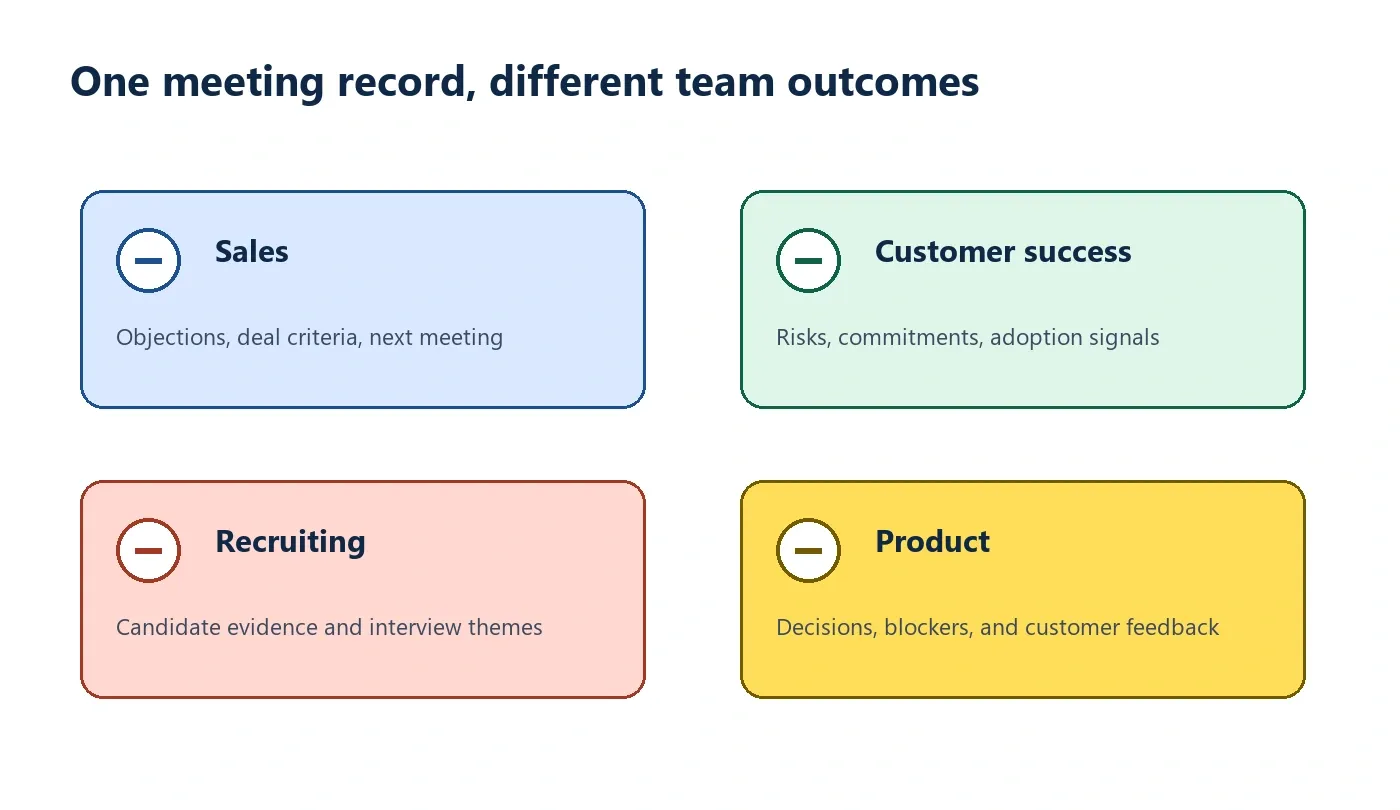
Sales teams are not the only teams with a meeting follow-up problem. The meeting record can be structured differently for each job without requiring every group to reinvent the capture process.
| Team | What they need from notes | Useful output |
|---|---|---|
| Sales | Customer needs, decision criteria, objections, commitments, and next steps | Account recap and action plan |
| Customer success | Adoption goals, risk, stakeholder changes, and promised outcomes | Health context and milestone plan |
| Recruiting | Candidate evidence, interview themes, open questions, and feedback | Structured interview note |
| Product | Customer feedback, trade-offs, decisions, blockers, and dependencies | Decision log and problem summary |
| Project teams | Status, risks, owners, due dates, and delivery decisions | Action tracker and meeting summary |
How should sales teams use AI meeting notes?
Sales teams should use AI meeting notes to remain active in the customer conversation, then review a structured recap while the call is still fresh. Confirm any objection or commitment that changes the deal, assign the follow-up, and share the approved record with the account team. The source transcript is there when someone needs proof, not as a substitute for judgment.
What should recruiters capture in interview notes?
Recruiters should capture evidence connected to the role criteria, examples shared by the candidate, open questions, interview feedback, and next steps. Use permission-aware recording, avoid unneeded personal detail, and follow the organization's hiring and retention policies.
How HiNoter Fits the Sales Meeting Workflow
HiNoter is built for the point where a recorded meeting needs to become team knowledge. Before a meeting, connect a calendar so an approved assistant can join scheduled calls. During the call, the team stays focused on the customer. Afterward, HiNoter turns the authorized source into structured notes without asking one person to keep up with every sentence.
- Before the meeting: connect the calendar and make the meeting context available to the team.
- During the meeting: let HiNoter capture the authorized conversation while attendees listen, clarify, and participate.
- After the meeting: receive a transcript, summary, action items, and a mind map rather than a recording that no one revisits.
- For knowledge reuse: use source-linked AI Chat to ask about customer requirements, decisions, and commitments, then trace answers back to the meeting.
- For distribution: share the outcome through Notion, Slack, Google Docs, calendar workflows, and email.
Try HiNoter for automatic sales meeting notes when your account team needs a shared record of customer context, objections, decisions, and next steps.
Explore related workflows for AI meeting notes, an AI meeting assistant, meeting summary generation, audio to text, AI Chat with source references, and multilingual meeting support.
Integrations: Put the Right Output Where Work Happens
A sales meeting note is only useful if it reaches the people who need it. The original transcript may belong with the account team. The summary may go to a manager. Action items may need to enter a team workspace. The customer follow-up should be reviewed before it is sent externally.
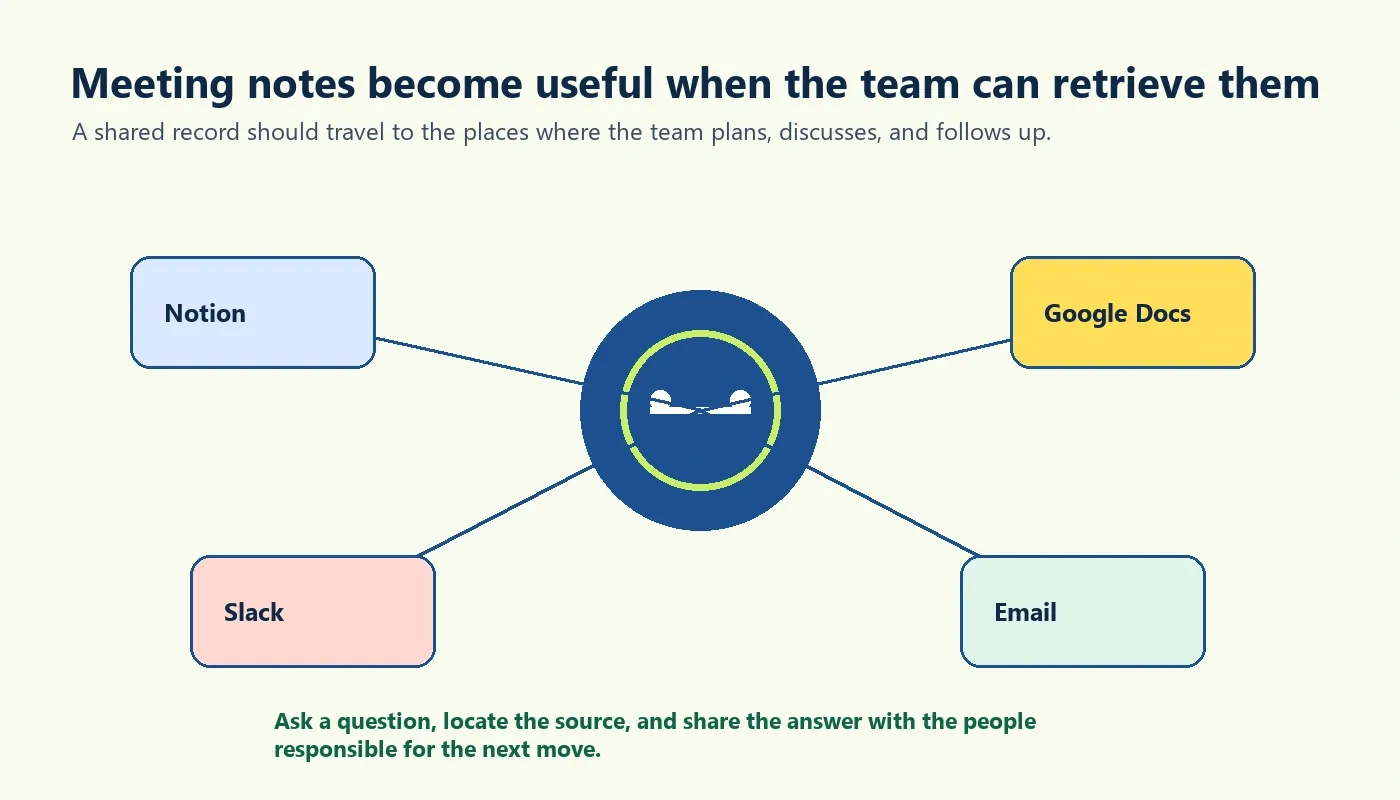
| Destination | Best use | What to send |
|---|---|---|
| Notion | Account documentation and shared knowledge | Summary, source links, decision criteria, and account context |
| Slack | Fast internal visibility and owner reminders | Short recap and immediate action items |
| Google Docs | Editable review with specialists and managers | Expanded notes, comments, and approved attachments |
| Customer confirmation and internal follow-up | Verified commitments, tasks, and next meeting | |
| Calendar workflow | Recurring calls and reminders | Previous actions and the next agenda prompt |
Measure the Quality of Sales Meeting Notes, Not Just the Number of Notes
More notes do not automatically mean more clarity. Sales leaders can assess whether a meeting-note workflow is helping by checking whether the notes make next actions, risk, and customer evidence easier to find. These are operating measures, not promises of revenue outcome.
| Quality check | Question to ask | Healthy signal |
|---|---|---|
| Action completeness | Does each material commitment have an owner and timing? | Teams can name the next action without replaying the call |
| Objection clarity | Can the team distinguish a blocker from a passing question? | Real concerns have evidence, a response owner, and a check-back point |
| Handoff readiness | Can a specialist understand the customer context in five minutes? | The recap contains goals, criteria, risk, and next step |
| Source traceability | Can a claim be checked against the meeting? | Important details include a transcript passage or timestamp |
| Reuse | Can teammates retrieve the account answer later? | Notes live in a shared, searchable system |
Privacy, Consent, and Review
Sales meetings can include personal data, commercial terms, security questions, financial detail, and private opinions. Treat the recording, transcript, and AI-generated recap as business records. Give any required notice, obtain consent where required, and follow the company's approved rules for access, retention, and sharing.
Use judgment before a note moves outside the account team. A broad summary may be appropriate for a manager, while a full transcript should be restricted to people who need that detail. Confirm customer-facing messages before sending them. The Federal Trade Commission's privacy and security guidance for businesses is a useful starting point for understanding why data handling needs a deliberate process; it is not a substitute for your legal advice.
Sales Meeting Notes FAQ
What should sales meeting notes include?
Sales meeting notes should include customer context, attendees and roles, goals, pain points, decision criteria, objections, decisions, commitments, action items with owners and due dates, and the next meeting or milestone. Keep the source transcript available for important details.
How should sales teams use AI meeting notes?
Sales teams should use AI meeting notes to stay present during the call, then review a structured recap after it ends. Confirm objections and commitments, assign owners, send the follow-up, and store the meeting record where account teammates can retrieve it later.
What is the difference between sales meeting notes and a sales call transcript?
A sales call transcript is a chronological text record of what was said. Sales meeting notes organize the commercial meaning of the conversation: customer needs, objections, decision criteria, risks, commitments, and next steps.
Can AI meeting notes capture sales objections?
AI meeting notes can surface likely objections and supporting passages from the conversation. A sales rep or manager should confirm the context before treating a mention as a deal blocker, then assign an owner and next action.
What should customer success teams capture in meeting notes?
Customer success teams should capture adoption goals, risks, commitments, unresolved issues, stakeholder changes, requested outcomes, and the next customer milestone. The note should separate observed facts from internal interpretation.
What should recruiters capture in interview notes?
Recruiters should capture candidate evidence tied to job criteria, examples offered by the candidate, open questions, interview feedback, and next steps. Use permission-aware recording and follow the organization's hiring and retention policies.
Can HiNoter send sales meeting notes to team tools?
HiNoter can turn authorized meetings and sources into transcripts, summaries, action items, mind maps, and source-linked AI Chat, then distribute useful outputs through Notion, Slack, Google Docs, calendar workflows, and email.