I've read maybe three thousand executive summaries at this point. Most are bad. Not because the writers can't write — most of them can — but because they fundamentally misunderstand what an executive summary is supposed to do. They treat it like a table of contents. "Chapter 1 discusses the market. Chapter 2 covers the product. Chapter 3 addresses financials." That's not an executive summary. That's an index. Nobody reads an index and thinks "ah yes, now I understand the business."
A real executive summary is a standalone document. It should make sense on its own, without the rest of the report. A CEO or investor should be able to read it in ninety seconds and understand: what's the problem, what's the solution, why does it matter, and what do you want from me. If they have to flip to page seven for context, the summary failed.
This page covers how to write an executive summary using a five-part framework, then walks through eight real examples — each with the full text and my annotations on why it works or doesn't. I'll also cover the five most common mistakes I see, the difference between an executive summary and other types of summaries (because people confuse these constantly), and how to generate a first draft with AI.
What's in this page:
1. The 5-part framework
2. 8 real examples with annotations
3. 5 mistakes to avoid
4. Executive summary vs. abstract vs. synopsis
5. Generating a first draft with AI
6. FAQ
The 5-Part Framework
Every executive summary I've seen that actually works follows roughly the same structure. I call it the five-part framework, though the proportions shift depending on the document type. Here's the breakdown:
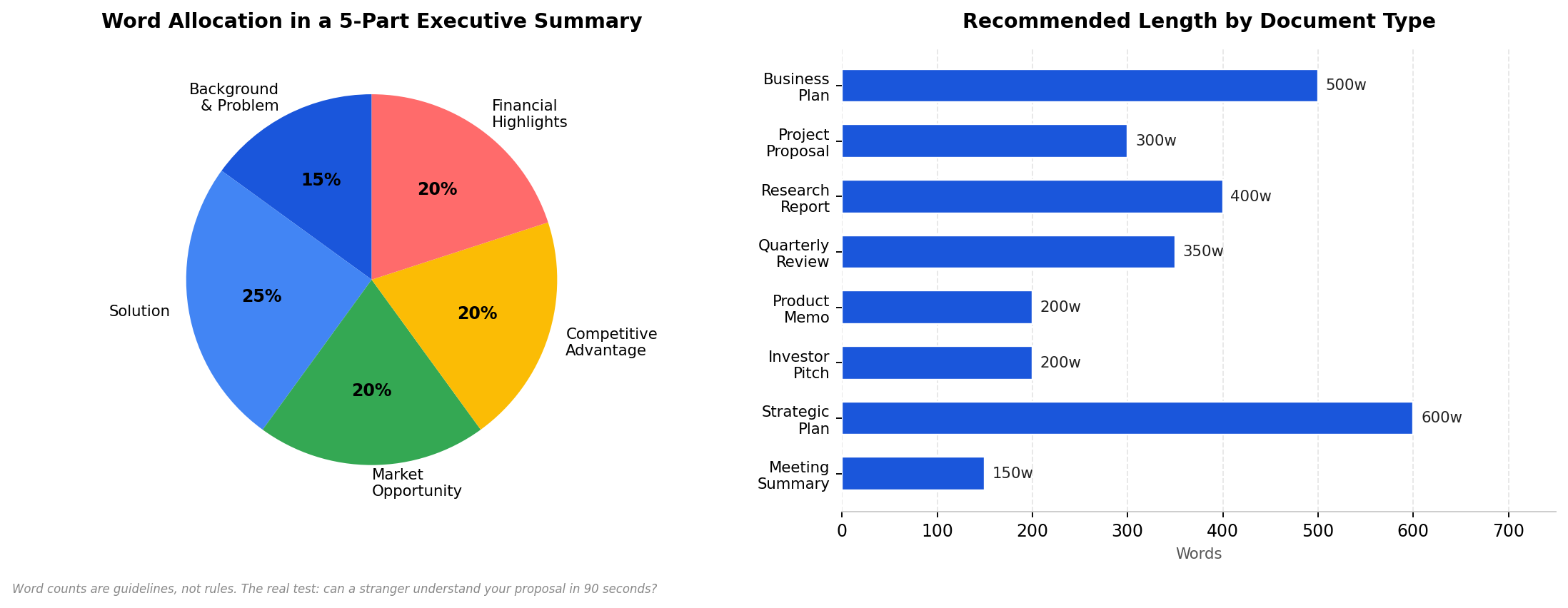
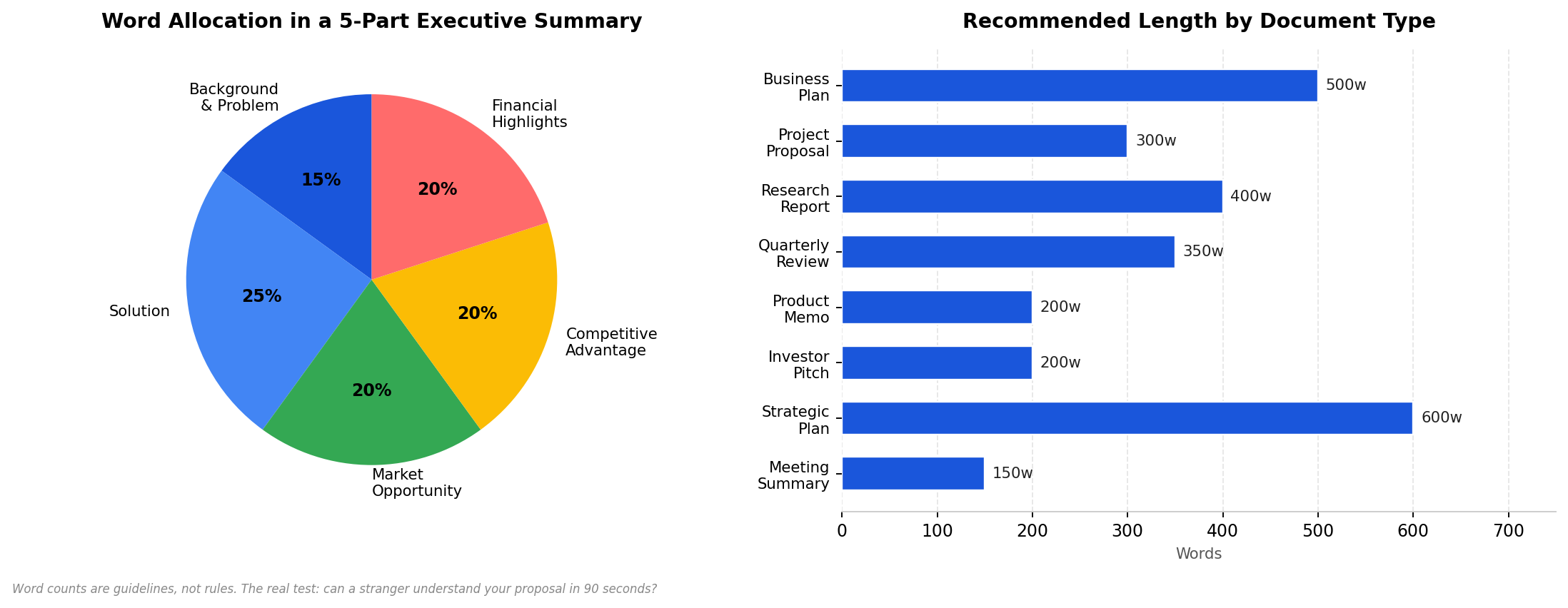
Proportions are guidelines. For investor pitches, shift more weight to market opportunity. For internal proposals, shift to solution and action items.
7. Background & Problem (15%). What's the situation? What problem exists? One or two sentences max. Don't over-explain — your reader is smart. State the problem, move on.
8. Solution (25%). What are you proposing? This is the largest section because it's the most important. Be specific. "A new CRM system" is not a solution. "Replacing the current manual onboarding process with an automated workflow that reduces activation time by 60%" is a solution.
9. Market Opportunity (20%). Why now? What's the size of the prize? Use numbers. "The market is large" is useless. "The global market is $4.2B and growing 15% annually" is useful.
10. Competitive Advantage (20%). Why you? What makes your approach different or better? Be honest — if your advantage is thin, say so. Investors can smell exaggeration.
11. Financial Highlights / Call to Action (20%). What are the numbers? What do you want? "We're seeking $500K in seed funding to reach $2M ARR in 18 months" tells the reader exactly what they need to decide.
The total length should be 5-10% of the full document. For a 20-page business plan, that's one page — roughly 400-500 words. For a short proposal, 150-200 words may be enough. The chart above shows recommended lengths by document type.
The test: hand your executive summary to someone who has never seen the full document. If they can explain your proposal back to you in two sentences, it works. If they ask "what does this mean?" or "what are you asking for?", it doesn't.
8 Real Examples With Annotations
Each example below is a complete executive summary. I've annotated the first two in detail. The rest follow the same structure — read them, copy the format, adapt for your own use.
Example 1
Business Plan Executive Summary
Use for: Business plans, startup pitches, loan applications | Target length: 400-500 words
TaskFlow Pro — Business Plan Executive SummaryTaskFlow Pro is a project management platform built specifically for creative agencies of 10-50 employees. The global agency management software market is valued at $4.2 billion and growing 15% annually, yet existing tools (Asana, Monday.com, Trello) are built for software teams and fail to address the unique workflow needs of creative shops — revision cycles, client approval chains, and asset versioning.TaskFlow Pro solves this with a purpose-built platform that integrates revision tracking, client portals, and asset management into a single dashboard. Early beta testing with 12 agencies showed a 40% reduction in revision-cycle time and a 25% increase in on-time project delivery.The founding team brings 30+ years of combined agency experience from Wieden+Kennedy, Droga5, and R/GA. Unlike competitors who retrofit creative features onto developer tools, TaskFlow Pro was designed from the ground up for creative workflows.We are seeking $750,000 in seed funding to complete product development, launch our go-to-market strategy, and reach $1.8M ARR within 18 months. Projected break-even at month 22. The funds will be allocated 45% to engineering, 30% to sales and marketing, and 25% to operations.
Example 2
Project Proposal Executive Summary
Use for: Internal project proposals, budget requests | Target length: 250-350 words
Customer Onboarding Automation — Project ProposalThis proposal recommends replacing our manual customer onboarding process with an automated workflow built on our existing CRM platform. The current process takes an average of 14 days from signup to activation, resulting in a 22% churn rate within the first 30 days — significantly above the industry benchmark of 12%.The proposed solution uses Salesforce Flow and custom email sequences to automate data collection, account provisioning, and welcome messaging. Implementation requires 8 weeks of development time and a $45,000 investment (software licenses + contractor hours).Based on pilot data from our EMEA team, who tested a similar workflow in Q3, automation is projected to reduce onboarding time from 14 days to 5 days and cut 30-day churn from 22% to 14%. At our current customer volume (1,200 new signups per quarter), this represents approximately $340,000 in retained revenue annually.The project will be led by Sarah Chen (VP Customer Success) with delivery by the internal engineering team. No new headcount is required. We request approval to begin development on March 1, with go-live targeted for May 1.
Example 3
Research Report Executive Summary
Use for: Market research, user research, academic reports | Target length: 300-400 words
Q4 User Research: Mobile Checkout AbandonmentThis report presents findings from a mixed-methods study of mobile checkout behavior among 847 users across three key markets (US, UK, Germany). The research was conducted between October and December 2024 to understand why mobile checkout abandonment rates (68%) significantly exceed desktop rates (45%) on our platform.Key findings indicate that 73% of mobile abandonment occurs at the payment information stage. Users cited three primary barriers: excessive form fields (median: 14 fields versus industry best practice of 5), lack of digital wallet options (Apple Pay, Google Pay), and mandatory account creation before purchase.The study recommends three interventions, prioritized by projected impact: (1) reducing payment fields from 14 to 6, projected to reduce abandonment by 15 percentage points; (2) adding Apple Pay and Google Pay, projected to reduce abandonment by 12 points; (3) implementing guest checkout, projected to reduce abandonment by 8 points.Combined, these changes are estimated to reduce mobile abandonment from 68% to 33%, recovering approximately $2.1M in annualized revenue. Implementation cost is estimated at $85,000 with a payback period of under two months.
Why it works: Methodology in one sentence. Key finding up front (73% at payment stage). Three specific barriers. Three specific solutions with projected impact. Total ROI quantified. An executive can scan this in 45 seconds.
Example 4
Quarterly Business Review Executive Summary
Use for: QBRs, board updates, investor reports | Target length: 300-350 words
Q3 2024 Business Review — Executive SummaryQ3 closed at $4.2M revenue, up 18% YoY and 6% sequentially, exceeding the $4.0M target by 5%. Growth was driven primarily by enterprise expansion (28 new enterprise accounts) and a 12% increase in average contract value.Gross margin improved from 72% to 75% due to infrastructure optimizations that reduced cloud spend by $180K annually. Net revenue retention reached 114%, up from 108% in Q2.Three areas require attention. First, our SMB segment declined 8% as smaller customers delayed renewals amid budget pressure. Second, customer support response time increased from 4 hours to 11 hours due to staffing gaps — two open positions remain unfilled. Third, the EMEA launch is delayed from Q4 to Q1 2025 pending regulatory compliance review.Q4 priorities: (1) close the two support roles and restore SLA to 4-hour response, (2) launch the self-service onboarding flow to reduce support ticket volume by 30%, (3) complete EMEA compliance review and set launch date, (4) hit $4.8M revenue target (20% sequential growth).
Why it works: Leads with the number that matters ($4.2M, +18%). Doesn't hide the bad news (SMB decline, support SLA, EMEA delay). Each problem has a corresponding Q4 priority. No fluff. No spin.
Example 5
Product Launch Memo Executive Summary
Use for: Internal product launches, feature announcements | Target length: 150-200 words
Product Launch: Smart Categorization v2.0On November 15, we're shipping Smart Categorization 2.0 — an upgrade that uses machine learning to automatically tag and organize uploaded documents with 94% accuracy, up from 78% in v1.The upgrade addresses the #1 customer complaint from Q3: manual tagging taking 20+ minutes per batch. With v2.0, tagging is automatic and instant. Beta testing across 50 customers showed a 90% reduction in tagging time and a 15% increase in user satisfaction scores.Go-to-market: in-app announcement + email campaign to all 4,200 active users on November 14. Customer success team briefed on top 5 expected questions. No pricing changes. No downtime required — the upgrade deploys via feature flag.Owner: Product Team. Engineering complete. QA signed off. Ready to ship.
Why it works: Short. Date up front. The problem it solves (#1 complaint). The improvement quantified (78% → 94%, 90% time reduction). Go-to-market plan in two sentences. Ship readiness confirmed. Done.
Example 6
Investor Pitch Executive Summary
Use for: Pitch decks, investor updates, fundraising | Target length: 200 words (or 1 slide)
DataPipe — Investor SummaryDataPipe turns unstructured enterprise data into searchable knowledge in minutes, not months. We use proprietary NLP models to automatically extract, categorize, and link information from documents that large enterprises currently process manually.Market: $12B enterprise search market, growing 18% annually. 73% of enterprise data is unstructured — documents, emails, PDFs, transcripts — and effectively unsearchable.Traction: $1.2M ARR, 140% net revenue retention, 34 enterprise customers including 3 Fortune 500. Growth rate: 22% MoM for the past 6 months.Advantage: Our models are trained on 200M+ enterprise documents, creating a data moat that improves accuracy with every customer. Competitors (Elastic, Algolia) index structured data well but fail on unstructured content.Ask: $3M Series A to scale go-to-market (triple sales team), expand to 2 new verticals (legal, healthcare), and reach $8M ARR in 18 months. Lead investor commitment from Accel at $2M. $1M remaining.
Why it works: Every sentence has a number. Problem, market, traction, advantage, ask — in 200 words. An investor can decide whether to take a meeting in 30 seconds.
Example 7
Strategic Plan Executive Summary
Use for: Annual strategic plans, OKR documents | Target length: 500-600 words
2025 Strategic Plan — Executive SummaryIn 2025, we will transition from a product-led growth model to a hybrid PLG + enterprise sales motion. This shift is driven by two factors: (1) our enterprise segment grew 3x faster than SMB in 2024, and (2) average enterprise deal size reached $87K, 15x our SMB ACV.The plan centers on four strategic pillars:1. Enterprise Sales Buildout. Hire 6 enterprise AEs and 3 SEs in Q1-Q2. Target: 50 new enterprise accounts by year-end, contributing $4.3M in new ARR.2. Product: Enterprise Features. Ship SSO/SAML, audit logs, role-based access control, and a Salesforce integration by Q2. These features are required by 80% of enterprise prospects in our pipeline.3. Pricing Restructure. Move from per-seat to platform pricing with tiered plans. Based on cohort analysis, this is projected to increase net revenue retention from 114% to 130% by Q4.4. International Expansion. Launch EMEA operations in Q3 with a London-based team. Target: $1.2M EMEA ARR by year-end.Financial projections: total revenue $18M (up from $10.5M in 2024), gross margin 78%, operating cash flow positive by Q4. Total investment required: $2.1M (funded from existing cash reserves, no external raise needed).
Why it works: States the strategic shift and why, in two sentences. Four pillars, each with a specific target. Financial projections at the end. A board member can read this and know exactly what 2025 looks like.
Example 8
Meeting Executive Summary
Use for: Post-meeting summaries, decision logs | Target length: 100-150 words
Meeting Summary — Q1 Marketing Budget ReviewJan 22, 2025 | Attendees: Sarah, James, Maria, DavidThe team reviewed the Q1 marketing budget and approved a $15K reallocation from display advertising to LinkedIn ads, effective February 1. The decision is based on Q4 data showing LinkedIn campaigns drove 3x higher conversion at 40% lower CPC.Two open items: (1) Sarah to pull LinkedIn spend projections by Jan 29 for the revised budget, (2) James to complete a competitive ad analysis by Feb 5 to inform creative direction.No changes to the overall Q1 budget ($85K). The next budget review is scheduled for March 1.
Why it works: The decision is in the first sentence. The numbers are specific ($15K, 3x, 40%). Open items have owners and dates. Total length: 120 words. This is different from meeting minutes or meeting notes — it's a summary of what mattered, not a full record.
5 Mistakes to Avoid
I've seen these five errors repeatedly. Each one turns a potentially good executive summary into something that gets skipped.
12. Writing a table of contents instead of a summary. "Section 1 discusses X. Section 2 covers Y." Nobody cares about your section structure. They care about your proposal. Write the content, not the index.
13. Starting with company history. "Founded in 2018 by two Stanford graduates..." Delete this. The reader doesn't care yet. Start with the problem. You can mention the founders later, in the competitive advantage section, if it's actually relevant.
14. Using vague language. "Significant market opportunity" means nothing. "$4.2B market growing 15% annually" means something. Every claim should have a number or a specific example attached to it.
15. Hiding the ask. Many executive summaries never state what the writer actually wants. Money? Approval? A meeting? Say it. "We are seeking $500K" or "We recommend approval to proceed." Don't make the reader guess.
16. Going too long. If your executive summary is longer than one page, it's not a summary — it's a document. Cut until it fits. If you can't cut without losing essential information, your full document is probably too dense and needs restructuring.
Executive Summary vs Abstract vs Synopsis
These three terms get confused constantly, and using the wrong one signals that you don't know the difference. Here's the breakdown:
Executive Summary | Abstract | Synopsis | |
Audience | Decision-makers (executives, investors) | Researchers, academics | General readers, often for creative work |
Purpose | Persuade and recommend | Inform about methodology and findings | Give an overview of plot or content |
Contains | Problem, solution, ask | Method, results, conclusion | Key points, narrative arc |
Length | 200-500 words (5-10% of doc) | 150-250 words | Varies widely |
Typical document | Business plan, proposal, report | Academic paper, research study | Book, film, creative project |
If you're writing for a business audience, you need an executive summary. If you're submitting to a journal, you need an abstract. If you're pitching a novel, you need a synopsis. Using "abstract" in a business context marks you as someone who's read more academic papers than business documents.
Generating a First Draft With AI
Writing an executive summary from scratch is the hardest part of any document because you have to compress everything into one page. AI tools are genuinely good at this — not as a replacement for your judgment, but as a first draft that you then edit.
If you already have the full document written, paste it into a tool and ask for a five-part executive summary following the framework above. The AI will pull out the key points and structure them. You then edit: cut the fluff, fix the vague language, add the specific numbers the AI might have missed, and make sure the ask is clear.
For meeting-specific executive summaries, a tool like HiNoter handles this automatically. It joins the meeting, transcribes it, and produces a structured summary with decisions and action items. You get the meeting executive summary (Example 8 above) without writing it yourself. For teams working across languages, it auto-detects the spoken language and produces notes regardless. Syncs to Notion, Slack, and Google Docs.
FAQ
How long should an executive summary be?
5-10% of the full document. For a 20-page business plan, that's one page — 400-500 words. For a short proposal, 150-200 words. The real test isn't word count; it's whether a stranger can understand your proposal in 90 seconds. If they can, it's the right length. If they can't, cut.
What's the difference between an executive summary and an abstract?
An executive summary is for decision-makers — executives, investors, managers. It focuses on recommendations and asks. An abstract is for researchers and focuses on methodology and findings. Executive summaries persuade. Abstracts inform. If you're in a business context, you need an executive summary.
What should an executive summary include?
Five things: background and problem, proposed solution, market opportunity, competitive advantage, and financial highlights or call to action. The solution section should be the largest (about 25% of the summary). Everything else splits roughly evenly. End with a clear ask — money, approval, a meeting.
Should I write the executive summary first or last?
Last. Always last. You can't summarize a document you haven't written yet. Write the full document, then write the summary. The exception: if you're using an AI note taker for meeting summaries, the summary is generated automatically during the meeting — no writing required.
Should the executive summary have a different tone than the full document?
Yes, slightly. The summary should be more direct. Less hedging. Fewer qualifiers. The full document can explore nuance and present multiple perspectives. The summary picks a lane and states the recommendation clearly. If your full document says "the data suggests that the market may be trending toward consolidation," your summary says "the market is consolidating. Here's our move."
Can I use these examples as templates?
Yes. Copy the structure — not the content. Replace the [bracketed] information with your own. The five-part framework works for business plans, proposals, research reports, and investor pitches. For meeting summaries, use the Example 8 format. For related templates, see our meeting minutes template and meeting notes template.
HiNoter joins your meetings, transcribes in 50+ languages, and produces structured executive summaries with decisions and action items — automatically.
That's the guide
Eight examples. Five-part framework. Five mistakes. The takeaway: an executive summary is not a table of contents. It's a standalone argument — problem, solution, why it matters, what you want. Write it last. Keep it to one page. Use real numbers. End with a clear ask. If a stranger can read it in 90 seconds and explain your proposal back to you, it works.
If you're generating summaries for meetings specifically, AI handles that — you pick the format, it fills in the content. Related reading: AI chat for document Q&A and multilingual support.
About the author: Written by the HiNoter Editorial Team. We build tools that turn conversations into structured documents — meeting notes, AI chat with citations, and automatic summaries across 50+ languages. Syncs to Notion, Slack, Google Docs. Also transcribes audio, video, YouTube, and PDFs. Looking for a meeting assistant? That's us.