The hottest AI startups in Silicon Valley are no longer competing only on who can produce the cleverest answer. The more durable race is about who can enter a workflow, use trusted context, complete a task, and return the result to the systems where teams already work. That shift is visible across coding agents, AI search, customer support, legal work, meeting intelligence, and knowledge management.
Short Answer
In 2026, the strongest productivity AI startups are moving from chat interfaces to workflow-native products. Cursor and Cognition act inside software development. Sierra and Decagon resolve customer issues across systems. Harvey runs legal workflows. Perplexity and Glean connect answers to sources and enterprise context. Otter.ai and emerging tools such as HiNoter turn meetings into searchable knowledge and follow-up actions.
The market signal is simple: buyers want less work completed by humans after the AI produces an answer.
Methodology
This is a category analysis, not a definitive investment ranking. Companies were selected using public evidence available as of July 3, 2026. Foundation-model labs such as OpenAI and Anthropic are excluded so the analysis can focus on the application and workflow layer.
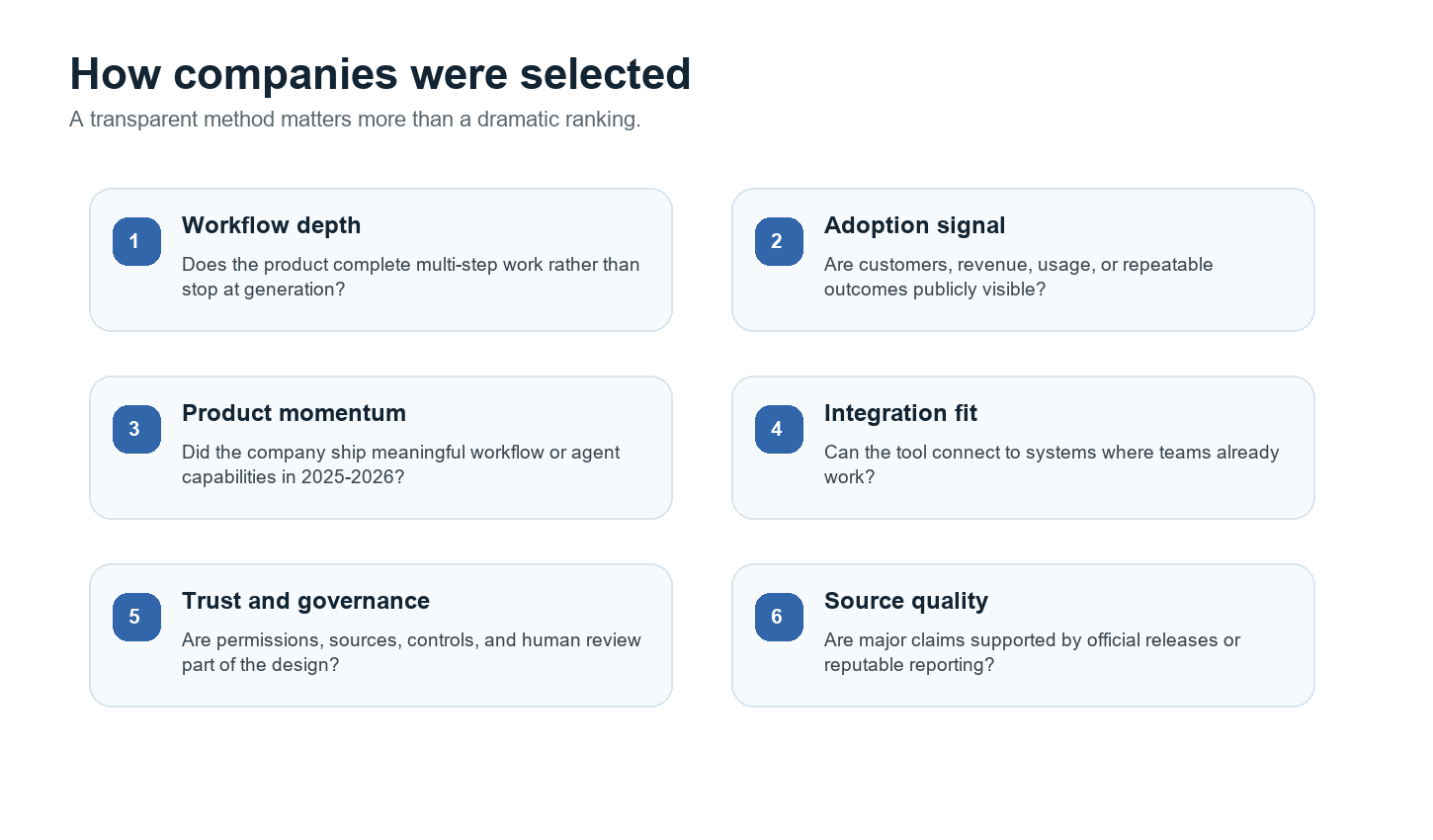
Workflow depth: the product handles multiple steps or writes results back into work systems.
Adoption signal: customers, revenue, usage, or repeatable outcomes are publicly visible.
Product momentum: meaningful agent, workflow, or knowledge features shipped in 2025-2026.
Integration fit: the product connects to the data and tools required to finish work.
Trust: sources, permissions, governance, and human review are part of the product story.
Source quality: funding and product claims come from official releases or reputable reporting.
For context, Forbes' 2026 AI 50 reported that 33 of the selected startups were headquartered in California and highlighted a shift toward real-world applications, AI agents, efficiency, and industry-specific products.
The 2026 Category Map
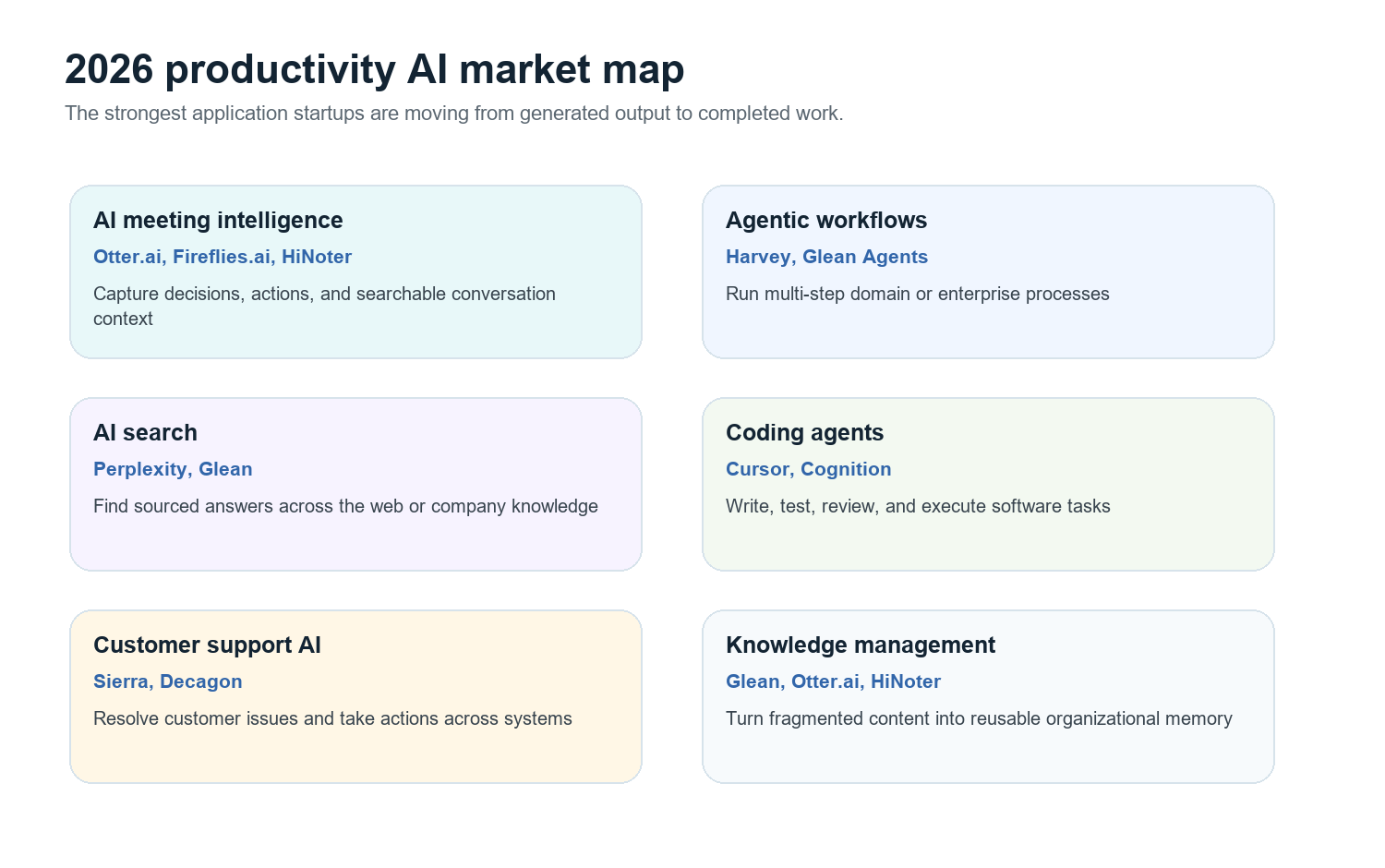
Category | Concise definition | Notable companies | Why it matters |
AI meeting intelligence | Captures conversations and converts them into structured knowledge and follow-up. | Otter.ai, Fireflies.ai, HiNoter | Meetings contain decisions that rarely reach systems of record. |
Agentic workflows | Plans and executes multi-step work in a business domain. | Harvey, Glean Agents | Value comes from completed processes, not generated text. |
AI search | Returns synthesized, sourced answers from the web or enterprise data. | Perplexity, Glean | Trust and retrieval quality determine whether answers can guide decisions. |
Coding agents | Writes, tests, reviews, and executes software tasks. | Cursor, Cognition | Software development offers measurable, high-frequency workflows. |
Customer support AI | Resolves customer requests and takes actions across company systems. | Sierra, Decagon | Resolution and containment can be measured directly. |
Knowledge management | Connects fragmented information into searchable organizational memory. | Glean, Otter.ai, HiNoter | AI needs governed context before it can act reliably. |
Notable Companies and Market Signals
Company | Category | Public signal | What the signal suggests |
Cursor / Anysphere | Coding agents | Official June 2025 announcement: $900M funding at a $9.9B valuation; more than $500M ARR; used by over half of the Fortune 500. | AI coding moved from experiment to core developer workflow. |
Cognition | Coding agents | TechCrunch reported a May 2026 raise of more than $1B at a $26B post-money valuation for the maker of Devin. | Investors are betting on agents that own end-to-end engineering tasks. |
Harvey | Vertical agents | March 2026: $200M at an $11B valuation; Harvey reported 25,000 custom agents and more than 100,000 lawyers across 1,300 organizations. | Domain-specific workflows can support deep adoption and premium economics. |
Glean | Search and knowledge | June 2025: $150M Series F at a $7.2B valuation; over 100M agent actions annually at the time of the announcement. | Enterprise context is becoming infrastructure for agents. |
Sierra | Customer support AI | September 2025: $350M at a $10B valuation; Sierra said more than half its customers had over $1B in revenue. | Support agents are moving into complex enterprise environments. |
Decagon | Customer support AI | January 2026: $250M raise and a reported $4.5B valuation, following a $131M Series C in June 2025. | Customer support remains one of the clearest measurable agent markets. |
Otter.ai | Meeting intelligence | April 2026 launch of a Conversational Knowledge Engine with connectors and MCP access to meeting history. | The category is expanding from notes to organizational memory and action. |
Perplexity | AI search | Its 2026 product positioning spans sourced answers, research, browser actions, APIs, and multi-step computer workflows. | AI search is becoming an execution surface rather than a destination page. |
Funding is a momentum signal, not proof of durable value. Revenue quality, retention, reliability, security, workflow ownership, and switching costs matter more over time.
1. Coding Agents: Cursor and Cognition
Coding is the clearest proof that AI applications can move beyond chat. Cursor embeds AI directly in the development environment, while Cognition's Devin is designed to plan and execute broader software tasks. Both reduce the distance between an instruction and a production artifact.
The operational lesson is not that every function will look like software engineering. It is that AI adoption accelerates when the product lives inside an existing workflow, has access to the required tools, and produces outputs that can be tested.
2. AI Search and Enterprise Context: Perplexity and Glean
Perplexity helped normalize the expectation that AI answers should show sources. Its current product direction moves beyond query and response into research, browser action, APIs, and multi-step computer work.
Glean attacks a different retrieval problem: company knowledge is fragmented across email, documents, chat, tickets, and business systems. Its shift from enterprise search toward agents shows why context is becoming a strategic layer. An agent cannot complete meaningful work if it cannot retrieve the right information while respecting permissions.
3. Vertical Workflow Agents: Harvey
Harvey illustrates why vertical AI can become more defensible than a general chatbot. Legal work has domain language, sensitive data, established review processes, and repeatable workflows. Harvey's 2026 funding announcement described agents running M&A, due diligence, contract drafting, document review, and longer-horizon legal processes.
The broader lesson is that high-value workflows reward products that combine domain context, governance, and implementation support. The model is only one component.
4. Customer Support Agents: Sierra and Decagon
Customer support is another category where AI can be measured against operational outcomes. The important metric is not how fluent the bot sounds. It is whether the system resolves an issue, follows policy, updates the right account, escalates exceptions, and leaves an auditable record.
Sierra and Decagon are both pushing toward agents that take actions rather than merely suggest replies. Their funding reflects strong demand, but buyers should still test reliability, escalation design, integration depth, and performance on their own support data.
5. Meeting Intelligence: From Transcripts to Knowledge
AI meeting assistants began as transcription and summarization tools. In 2026, the category is being reframed as a knowledge and workflow layer. Otter.ai describes a conversational knowledge engine. Fireflies positions itself across meeting preparation, capture, post-meeting automation, and cross-meeting context.
That evolution matters because meetings are not content endpoints. A decision should update a project, a customer commitment should reach a CRM, and an action item should have an owner. A transcript without distribution is still unfinished work.
Why Workflow-Native AI Is Different
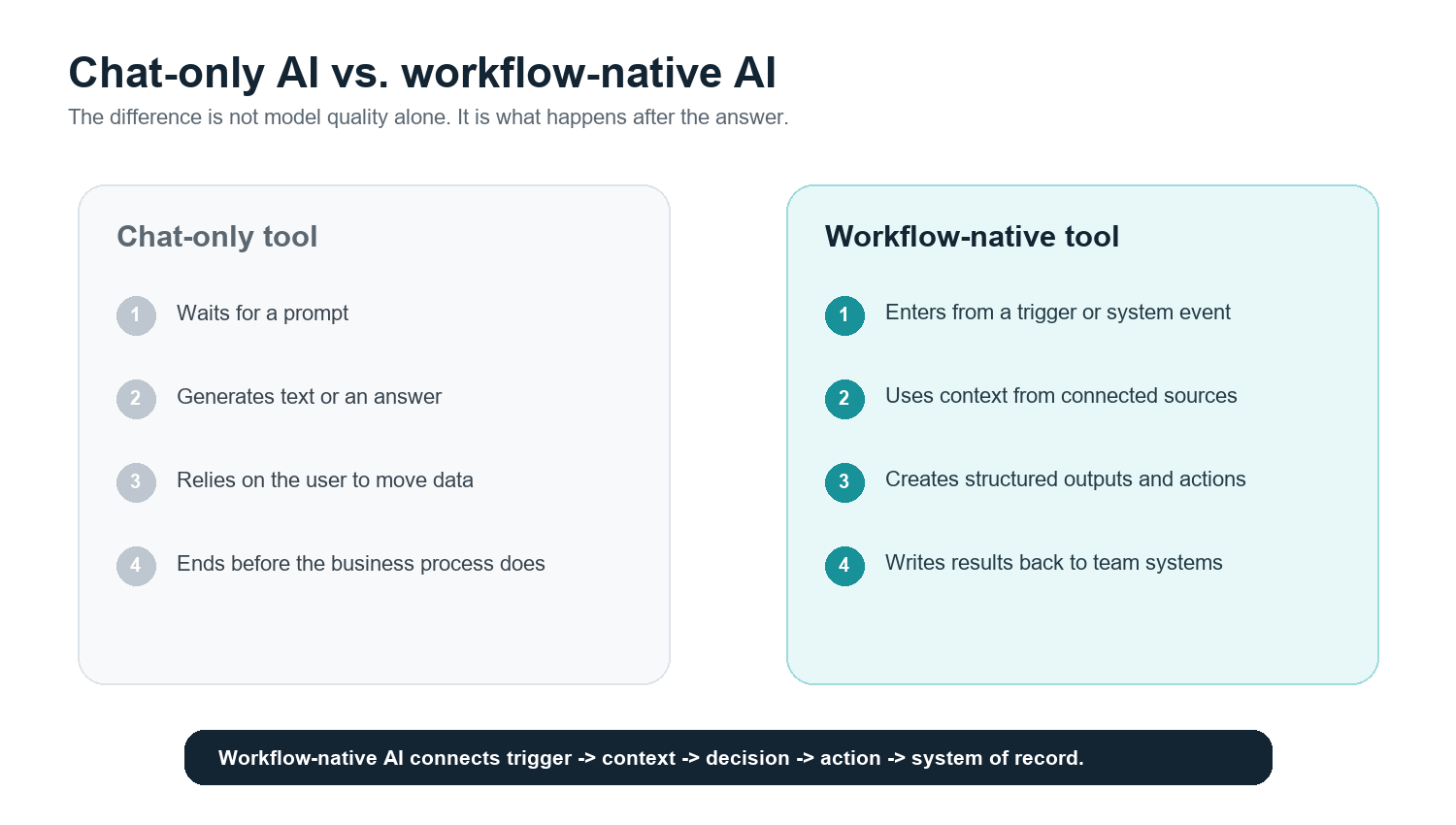
A chat-only tool waits for the user to formulate a prompt, generates an answer, and leaves the user to move that answer into the next system. A workflow-native tool can start from a calendar event, support ticket, code issue, document, or system trigger. It retrieves relevant context, applies rules, produces structured output, and writes the result back.
Trigger: a meeting starts, a customer asks a question, or a developer opens an issue.
Context: the system retrieves calendars, documents, prior conversations, code, policies, or account data.
Reasoning: the AI identifies the request, constraints, and next actions.
Action: it creates code, resolves a ticket, drafts a document, or assigns follow-up.
Write-back: the result appears in the CRM, project tool, knowledge base, chat channel, or document system.
Review: humans can verify sources, exceptions, and high-risk decisions.
Microsoft's 2026 Work Trend Index describes an operating model in which people orchestrate multiple agents across workflows. McKinsey's 2025 State of AI survey similarly found that scaled value remains difficult and that high-performing organizations are more likely to redesign workflows rather than simply add AI tools.
Where HiNoter Fits in the Shift
HiNoter is best understood as a workflow-native productivity AI example, not simply another note-taking app. Its entry point is the calendar and the meeting, but the useful output is structured team knowledge.
Calendar auto-join reduces the need for someone to remember to record or take notes.
Automatic summaries, action items, and mind maps turn conversation into structured output.
Support for 50+ languages with automatic detection gives multilingual teams one shared record.
YouTube, video, audio, and PDF processing extends the knowledge layer beyond live calls.
AI Chat with source references lets teams ask questions without losing traceability.
Connections across Notion, Slack, Google Docs, calendars, and email move information into existing workflows.
The product pattern aligns with the market shift: HiNoter AI Meeting Assistant handles capture, while AI Meeting Notes and AI Chat turn the result into reusable organizational context.
Primary CTA: Try HiNoter when the goal is to remove manual note-taking and convert meetings, videos, PDFs, and audio into structured, source-linked team knowledge.
What Buyers and Investors Should Watch Next
Workflow completion rates, not prompt volume.
Retention after pilots move into production.
Access to proprietary context without compromising permissions.
Reliable write-back into systems of record.
Human review for financial, legal, security, and customer-impacting actions.
Unit economics as agents perform longer and more compute-intensive tasks.
Whether the product removes tools and manual steps or adds another dashboard.
The next phase of productivity AI will be less visible than the chatbot era. The best systems may feel like infrastructure: present at the moment work begins, connected to trusted context, and judged by whether the process finishes correctly.
FAQ
What are the hottest AI startups in Silicon Valley in 2026?
Notable application-layer companies include Cursor, Cognition, Perplexity, Glean, Harvey, Sierra, Decagon, and Otter.ai. They span coding, search, enterprise knowledge, legal workflows, customer support, and meeting intelligence.
How were these AI startups selected?
The methodology weighs workflow depth, public adoption signals, 2025-2026 product momentum, integrations, governance, and source quality. It does not rank companies by valuation alone.
What is workflow-native AI?
Workflow-native AI starts from a business trigger, uses connected context, completes one or more actions, and writes results back into the systems where teams work.
Why are AI meeting assistants becoming knowledge platforms?
Meetings contain decisions, commitments, and context. The category is expanding beyond transcription so that meeting knowledge can be searched, shared, and used to trigger follow-up.
Is HiNoter a Silicon Valley startup?
This article uses HiNoter as a product example of the workflow-native productivity shift. It is not presented as a ranked Silicon Valley funding company.