The best note taking methods are not the fanciest templates. They are systems that help you capture what matters, understand it later, retrieve it quickly, and act on it. This guide compares manual systems such as Cornell, outline, charting, mapping, sentence notes, Zettelkasten, and meeting minutes with AI-assisted notes for the moments when listening, participating, and following up matter more than typing everything yourself.
Definition: Note taking methods are repeatable systems for capturing, organizing, reviewing, and using information. A good method reduces cognitive load during capture and increases the chance that notes become useful later, whether that means exam recall, research synthesis, searchable knowledge, or accountable meeting follow-up. |
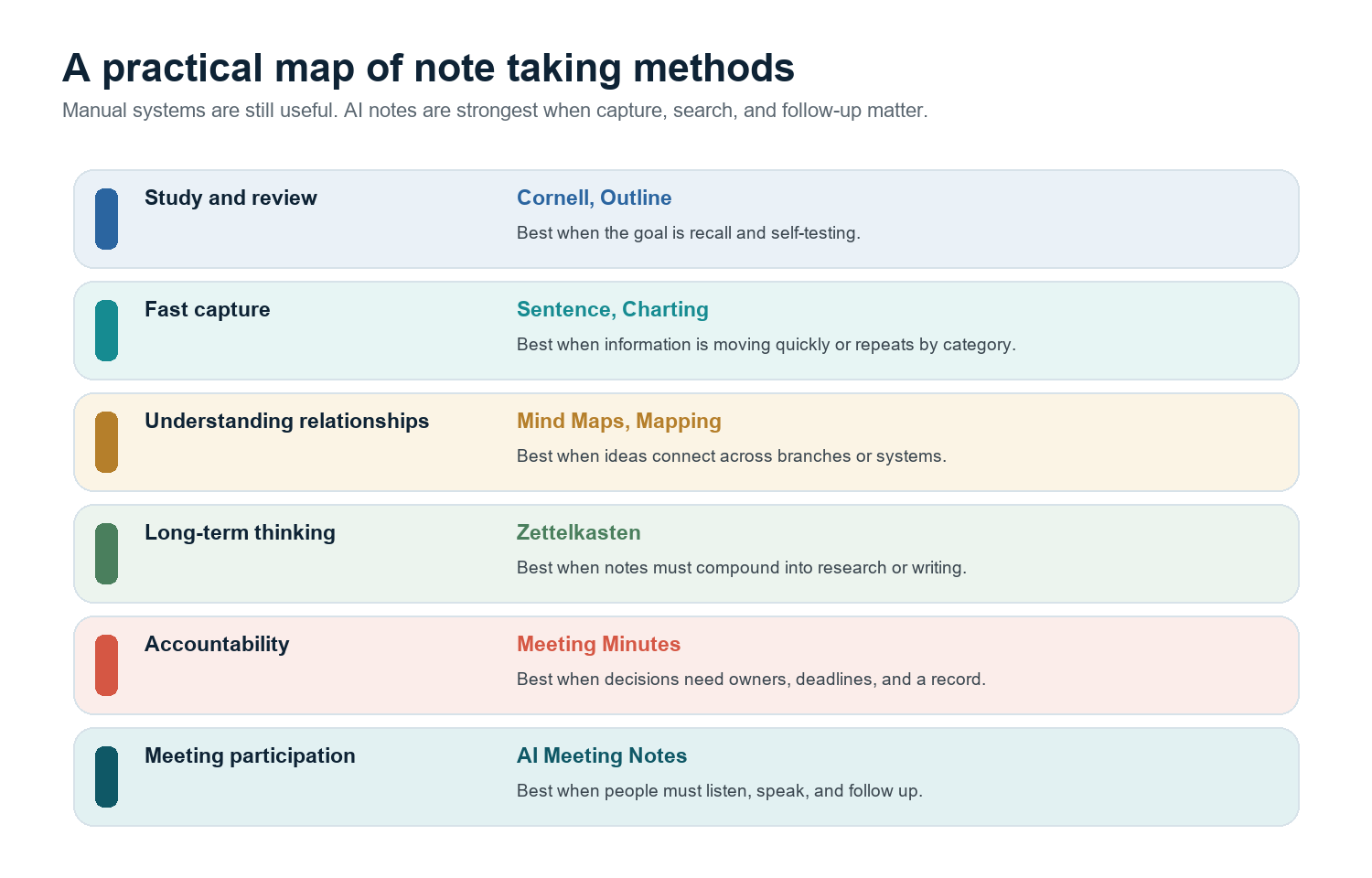
Short answer: Cornell is best for study review. Outline notes are best for structured material. Charting is best for comparisons. Mind maps are best for relationships. Zettelkasten is best for long-term thinking. Meeting minutes are best for formal accountability. AI note taking is best when the user must listen and participate at the same time. |
Note Taking Methods Comparison Table
Method | Best use case | Effort | Recall strength | HiNoter fit |
Cornell | Lectures, training, review | Medium | High | Useful after meetings as a review format, but not ideal for live capture. |
Outline | Structured talks, plans, documentation | Low | High | Good for turning AI summaries into a clean hierarchy. |
Charting | Comparisons, interviews, recurring fields | Medium | Medium-high | Good for extracting decisions, owners, risks, and next steps. |
Mapping / Mind Maps | Brainstorms, systems, relationships | Medium | High | Strong fit because HiNoter can create mind maps from meetings and sources. |
Sentence Method | Fast, messy, unfamiliar material | Low | Medium | Useful for personal capture; less useful for team retrieval. |
Zettelkasten | Research, writing, long-term knowledge | High | High | Good for turning cited meeting insights into linked notes. |
Meeting Minutes | Governance, decisions, accountability | Medium | Medium | Strong fit when AI extracts decisions, actions, owners, and deadlines. |
AI Meeting Notes | Meetings, videos, PDFs, multilingual teams | Low to medium | High | Best fit: auto-join, structure, action items, mind maps, cited answers. |
Manual Methods Still Matter
Manual note taking is not obsolete. Handwritten or self-typed notes force selection, interpretation, and compression. For study, research, and strategic thinking, that friction can be valuable. The problem appears when a person is expected to participate fully in a meeting while also producing a complete, searchable, multilingual, action-ready record. That is a different job.
Microsoft's 2025 Work Trend Index described a workday shaped by constant interruptions and heavy meeting load. In that context, teams need fewer notes that sit in private documents and more records that can move into decisions, tasks, and shared knowledge.
The 10 Methods
1. Cornell Method
What is the Cornell Method?: The Cornell Method divides a page into a main notes area, a cue column, and a summary section. The cue column turns notes into review prompts, while the summary forces the learner to restate the core idea. |
Best use case: Use Cornell notes for lectures, certification courses, training sessions, and material you plan to review repeatedly. Cornell University's Learning Strategies Center presents the system as a practical review method originally developed by Walter Pauk.
When it breaks down: It requires a second pass. In fast meetings, the cue column often gets ignored because the note taker is trying to keep up with the conversation.
Template: Cornell Method TOPIC / DATE CUES OR QUESTIONS | MAIN NOTES Key term: | Explanation and example Question: | Answer and evidence SUMMARY: 3-5 sentences in your own words |
Cornell Q&A: Is Cornell better than AI notes? Not for every job. Cornell is better for deliberate study and self-testing. AI notes are better when the priority is complete meeting capture, multilingual context, and follow-up actions. |
2. Outline Method
What is the Outline Method?: Outline notes use indentation to show hierarchy: main topic, supporting point, evidence, and detail. The structure is familiar because it mirrors reports, agendas, and documentation. |
Best use case: Use outlining for organized lectures, product plans, project briefs, SOPs, and conversations that follow a clear agenda.
When it breaks down: It can make messy discussions look more orderly than they really are. If the meeting jumps between topics, the outline may hide unresolved dependencies.
Template: Outline Method I. Main idea A. Supporting point 1. Evidence or example 2. Risk or exception II. Next main idea |
Outline Q&A: What are outline notes best for? Outline notes are best for material that already has structure. They are fast, readable, and easy to convert into briefs, but weaker for brainstorms and non-linear conversations. |
3. Charting Method
What is the Charting Method?: Charting turns notes into rows and columns. Each row represents an item, person, vendor, event, or option. Each column captures the same field across rows. |
Best use case: Use charting for comparisons, sales calls, interviews, research tables, timelines, and recurring meetings where the same fields appear every time.
When it breaks down: It struggles when the discussion is narrative or exploratory. The wrong columns can force important nuance into cramped cells.
Template: Charting Method ITEM | FACT | EVIDENCE | RISK | ACTION A | | | | B | | | | |
4. Mapping and Mind Maps
What is the Mapping and Mind Maps?: Mapping and mind maps arrange ideas visually around a central topic. Branches show categories, relationships, examples, and dependencies instead of a linear sequence. |
Best use case: Use mind maps for brainstorming, strategy, concept review, systems thinking, content planning, and meetings where relationships matter more than order. Cornell LSC also teaches concept mapping as a way to connect and organize ideas.
When it breaks down: Large maps become hard to read. They are not ideal for exact quotes, formal records, or detailed procedures.
Template: Mapping and Mind Maps CENTER: Main question Branch 1: Theme -> detail -> example Branch 2: Theme -> dependency Cross-link: A affects B because... |
Mind Mapping Q&A: When should I use mind maps? Use mind maps when the central challenge is seeing relationships. Use AI-generated mind maps when the source is too long to map by hand, such as a meeting, webinar, or PDF. |
5. Sentence Method
What is the Sentence Method?: The sentence method captures each new idea as a separate line. It is fast, simple, and useful when the structure is not clear yet. |
Best use case: Use it for live events, fast-moving lectures, or unfamiliar topics where stopping to design a structure would slow you down.
When it breaks down: It produces long notes that are hard to search and review unless you reorganize them later.
Template: Sentence Method 1. Main point or fact. 2. Evidence or example. 3. ? Question to verify. 4. -> Follow-up action. |
6. Zettelkasten Method
What is the Zettelkasten Method?: Zettelkasten is a linked-note system built from small, self-contained ideas. Each note should be understandable on its own and connected to related notes. |
Best use case: Use Zettelkasten for long-term research, writing, strategy, and fields where ideas develop over time. The method is strongly associated with sociologist Niklas Luhmann's card index, preserved by Bielefeld University's Niklas Luhmann Archive.
When it breaks down: It requires discipline. Collecting snippets without rewriting and linking them creates an archive, not a thinking system.
Template: Zettelkasten Method TITLE: One clear claim IDEA: Explain it in your own words SOURCE: URL / book / timestamp LINKS: [[related idea]] USE: Where this may matter |
7. Boxing Method
What is the Boxing Method?: Boxing groups related notes into visual blocks. Each box holds a topic, mini-summary, example, or action area. |
Best use case: Use it for tablet notes, project planning, workshops, and mixed media pages where you want scannable topic modules.
When it breaks down: Boxes can become decorative if the content inside them is not labeled consistently or connected to next steps.
Template: Boxing Method [TOPIC BOX] Key point: Evidence: Open question: Decision or action: |
8. Flow Notes
What is the Flow Notes?: Flow notes mix text, arrows, sketches, reactions, and questions. The goal is active thinking rather than a tidy transcript. |
Best use case: Use flow notes for workshops, coaching, design critiques, and creative discussions where your interpretation matters.
When it breaks down: They are personal. A teammate may not understand the arrows, shorthand, or private associations later.
Template: Flow Notes Idea -> consequence -> question Evidence: My interpretation: Connection to prior idea: What to test next: |
9. Meeting Minutes
What is the Meeting Minutes?: Meeting minutes are a formal record of agenda items, decisions, action items, owners, and deadlines. They capture outcomes rather than every sentence. |
Best use case: Use minutes for board meetings, client commitments, project reviews, and any discussion where accountability matters.
When it breaks down: Manual minutes can arrive late, omit context, or reduce one participant's ability to contribute. They also rarely capture multilingual nuance unless the team has a strong process.
Template: Meeting Minutes MEETING / DATE / ATTENDEES AGENDA ITEM: DECISION: ACTION: owner | task | due date OPEN ISSUE: |
10. AI Meeting Notes
What is the AI Meeting Notes?: AI meeting notes capture or import source material, create transcripts or extracted text, and turn the content into summaries, action items, mind maps, and searchable answers. |
Best use case: Use AI notes when the source is a live meeting, customer call, webinar, video, audio file, YouTube content, or PDF. They are especially helpful for multilingual teams that need one shared record.
When it breaks down: AI notes still need human review. Names, numbers, sensitive claims, and action ownership should be checked before distribution.
Template: AI Meeting Notes BEFORE: connect calendar / confirm consent CAPTURE: meeting, video, audio, or PDF OUTPUT: summary / actions / mind map VERIFY: facts and permissions ASK: cited questions later |
AI Notes Q&A: Is AI note taking better for meetings? Yes, when the user must listen and participate at the same time. It is not better because manual methods are bad; it is better because meeting capture, multilingual context, source references, and follow-up actions are too much for one person to manage reliably. |
Why Meetings Change the Decision
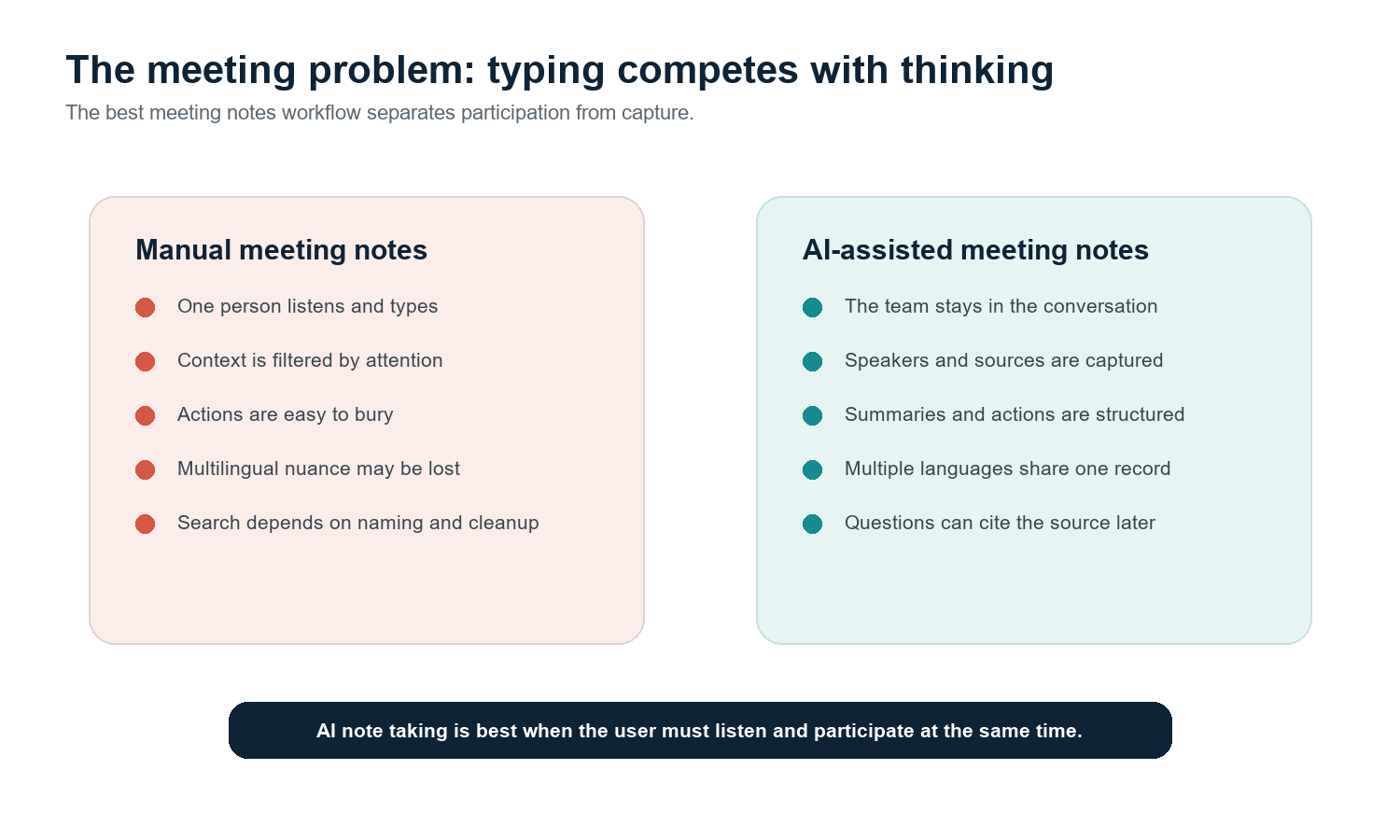
A lecture rewards quiet capture. A meeting rewards contribution. That difference is why the best note taking methods for school are not always the best systems for work. In a team meeting, the note taker must listen for decisions, identify owners, track deadlines, interpret context, and still contribute to the discussion. If the team works across languages, the problem gets harder.
Quotable takeaway: AI note taking is best when the user must listen and participate at the same time. Manual methods are still valuable for reflection, study, and synthesis. |
How HiNoter Fits Without Replacing Every Method
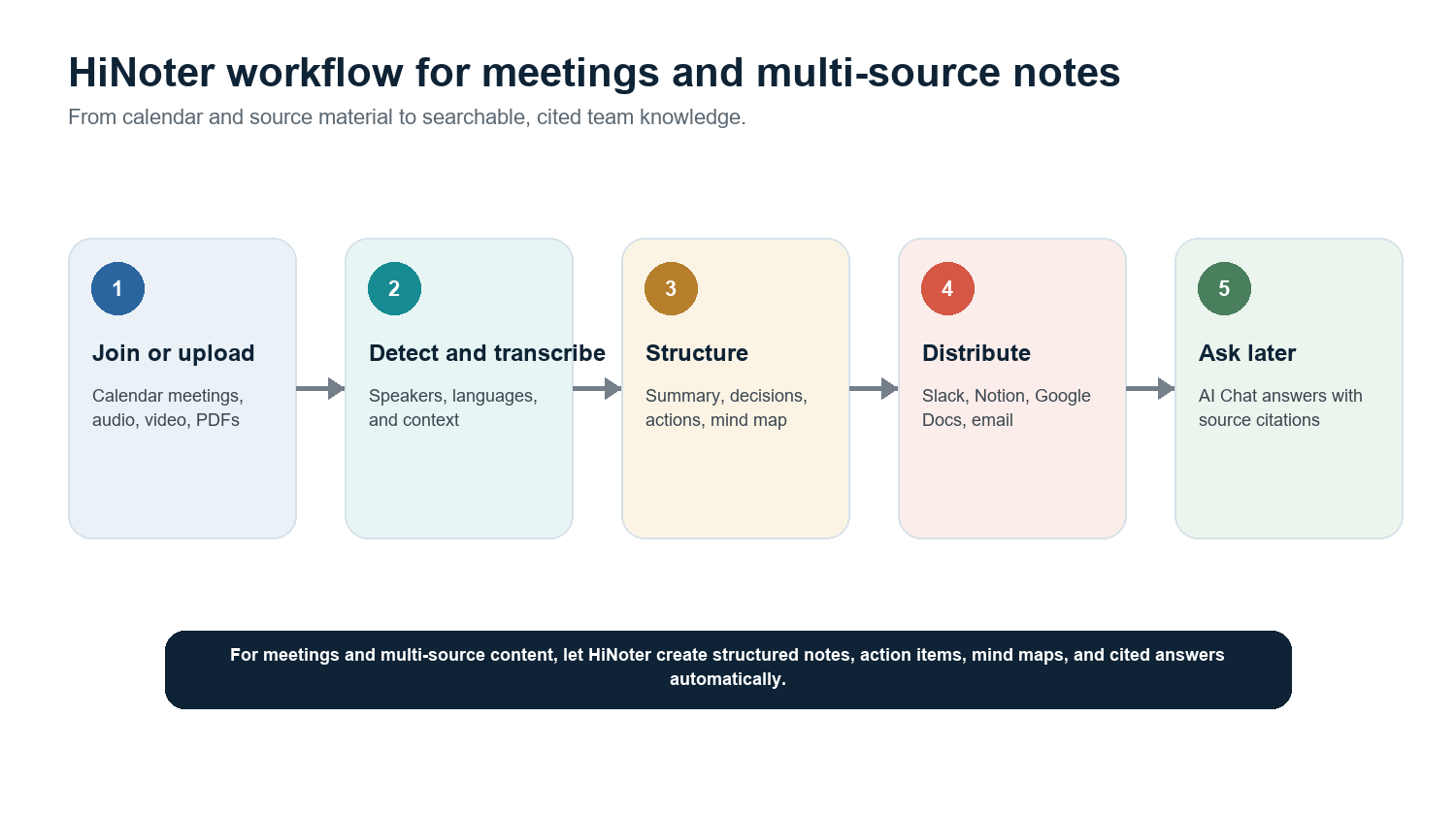
HiNoter is best understood as an AI meeting notes system and meeting knowledge base. It can auto-join scheduled meetings, generate structured summaries, create action items and mind maps, support 50+ languages with automatic detection, process sources beyond audio such as videos and PDFs, and let teams ask questions with source citations. That makes it a strong fit for the parts of note taking that happen after a conversation: retrieval, distribution, and follow-through.
For meetings and multi-source content, let HiNoter create structured notes, action items, mind maps, and cited answers automatically. For personal learning, research synthesis, or private thinking, keep using the manual method that helps you understand the material.
AI Meeting Notes works with AI Meeting Assistant, Multilingual Support, AI Chat with source references, and PDF to Text when a note needs to become searchable team knowledge.
Templates You Can Copy
Meeting notes template Purpose: Key context: Decisions: Action items: owner | task | due date Open questions: Source link or recording: |
Mind map generator prompt Central topic: Main branches: Dependencies: Open questions: Actions connected to each branch: |
AI note review checklist [ ] Consent and policy requirements are met [ ] Names, dates, figures, and commitments are correct [ ] Actions have one owner and a due date [ ] Sensitive content has the right access controls [ ] Summary is sent to the right workspace |
FAQ
What is the best note taking method?
The best note taking method depends on the job. Cornell is best for study review, outline notes for structured material, charting for comparisons, mind maps for relationships, Zettelkasten for long-term knowledge, meeting minutes for accountability, and AI notes for meetings where people must listen and participate.
Is AI note taking better for meetings?
AI note taking is usually better for meetings because it separates participation from capture. It can record context, summarize decisions, extract action items, support multilingual teams, and preserve source references for later review.
Are manual note taking methods still worth learning?
Yes. Manual methods build understanding, judgment, and memory. They are especially useful for studying, private reflection, research, and synthesis. AI notes are a complement when the capture burden is too high.
What is the Cornell note taking method?
The Cornell Method divides the page into cues, main notes, and summary. It is designed to support review and self-testing after a lecture or learning session.
What is the difference between outline notes and mind maps?
Outline notes show hierarchy in a linear order. Mind maps show relationships around a central topic. Use outlines for structured material and mind maps for brainstorming, systems, or non-linear ideas.
How does HiNoter support AI notes?
HiNoter can join meetings, structure summaries, create action items and mind maps, support multilingual conversations, process videos and PDFs, and answer questions with source citations through AI Chat.