Direct answer: A strong Tactiq alternative should help teams move beyond meeting transcripts into reusable knowledge. HiNoter is worth comparing if you need automatic meeting capture, structured summaries, action items, mind maps, multilingual workflows, integrations, and source-linked AI Chat across meetings, videos, PDFs, and audio.
Tactiq is a popular AI meeting tool for people who want live meeting transcripts, AI summaries, and meeting notes from platforms such as Google Meet, Zoom, and Microsoft Teams. It is especially useful for users who like a lightweight browser-based workflow and want meeting text captured without building a heavy enterprise process around it.
That is a legitimate use case. Many teams start with transcripts because the first pain is simple: someone needs to remember what was said. The bigger pain arrives later. A transcript may exist, but the decision is still buried. The action item is not assigned. The PDF discussed in the meeting is somewhere else. The team cannot ask a source-backed question across notes and files. That is where HiNoter becomes a practical Tactiq alternative.
Who Tactiq Is Best For
Tactiq is best for users who want a straightforward way to capture live meeting transcripts and generate AI-powered meeting notes from common meeting platforms. Its browser extension model can be convenient for individuals, managers, educators, consultants, and teams that spend much of their day in live video calls and want a record of what was said.
It can also be a good fit when a team values a lightweight workflow over a broader knowledge system. If the immediate goal is to capture meeting text, generate a recap, and keep meeting notes accessible, Tactiq belongs on the shortlist. Users comparing AI note takers often consider Tactiq alongside Otter, Fireflies, Fathom, tl;dv, Read AI, and other meeting assistants.
The key question is whether your team needs only meeting notes or a larger content workflow. Tactiq is strongest when the meeting itself is the main object. HiNoter becomes more relevant when the team also needs videos, PDFs, uploaded audio, mind maps, action ownership, and source-linked Q&A to become part of the same knowledge base.
Where HiNoter Is Stronger as a Tactiq Alternative
HiNoter is an AI meeting notes and transcription platform built for teams that want zero manual note-taking and reusable knowledge after the meeting ends. It can connect to calendar workflows, automatically capture scheduled meetings, detect languages, generate transcripts, create structured summaries, extract action items, build mind maps, and let users ask AI Chat questions with source references.
The biggest difference is input scope. Tactiq is primarily known for live meeting transcript and AI note workflows. HiNoter is built for meetings plus other knowledge sources: videos, PDFs, uploaded recordings, and audio. That matters when a project team needs to combine a meeting discussion with a PDF report, a webinar, a training video, or a customer interview recording.
HiNoter is also stronger when the output needs to be actionable. A transcript can answer "What was said?" A structured note answers "What happened, what changed, who owns the next step, and where did this answer come from?" That distinction matters for teams with recurring decisions, customer commitments, hiring feedback, project risks, and product research.
Useful HiNoter workflows include AI meeting assistant capture, AI meeting notes, AI Chat with source references, and exports to team documentation spaces such as Notion and Google Docs.
Tactiq vs HiNoter Feature Comparison
The comparison below focuses on stable workflow attributes rather than temporary promotions, plan limits, or claims that may change quickly. Check current product pages before making a buying decision.
| Category | Tactiq | HiNoter |
|---|---|---|
| Core focus | Live meeting transcripts, AI summaries, and meeting notes through a lightweight meeting workflow. | AI meeting notes and transcription platform for meetings, videos, PDFs, audio, and team knowledge. |
| Meeting capture | Works well for users who want meeting transcripts from supported meeting platforms. | Built around automatic meeting capture and structured post-meeting outputs. |
| Sources supported | Strongest for live meeting transcript workflows. | Meetings, uploaded recordings, videos, PDFs, and audio sources. |
| Summary depth | AI summaries and meeting note generation are part of the product experience. | Structured summaries, decisions, risks, action items, owners, and mind maps. |
| Action items | Can help create AI meeting notes and follow-up from transcripts. | Designed to extract owners, next steps, deadlines, and recap-ready follow-up. |
| Mind maps | Check current feature availability on Tactiq's official pages. | Creates mind maps to show topic structure and relationships. |
| Language workflow | Supports multiple languages; verify current language list and plan limits. | Supports 50+ languages and automatic language detection for global teams. |
| AI chat | Includes AI workflow features around meeting transcripts and notes. | AI Chat answers questions with source references from notes and transcripts. |
| Integrations and exports | Useful for getting transcripts and notes out of meeting workflows. | Connects outputs to documentation and collaboration workflows such as Notion and Google Docs. |
| Best-fit user | Individuals and teams that mainly need live meeting transcripts and AI meeting notes. | Teams that need meetings, videos, PDFs, and audio turned into structured, searchable knowledge. |
Choose HiNoter If...
Choose HiNoter if your team has outgrown transcript-first meeting notes. The common sign is that notes exist, but people still ask the same follow-up questions. Someone still rewrites the summary. A project owner still checks chat to confirm a decision. A manager still asks who owns the next step. A transcript helped, but it did not become operational knowledge.
| Choose HiNoter If | Why It Matters | Best-Fit Team |
|---|---|---|
| You need multi-source inputs. | Meetings, videos, PDFs, and audio can become structured notes in one workflow. | Product, research, leadership, CS, and operations teams. |
| You want zero manual note-taking. | Automatic meeting capture reduces reliance on one participant's notes. | Managers, sales, recruiters, project leads. |
| You need structured follow-up. | Summaries, decisions, owners, due dates, and risks are easier to act on than raw text. | Teams with recurring decisions and action items. |
| You work across languages. | 50+ languages and automatic detection help distributed teams standardize notes. | Global teams and multilingual customer-facing groups. |
| You need source-backed answers. | AI Chat with source references helps users verify answers instead of trusting unsupported summaries. | Teams worried about accuracy, governance, and knowledge reuse. |
Choose Tactiq If...
Choose Tactiq if your team's main need is a lightweight meeting transcript and AI notes workflow. If the team lives inside live meetings and wants a convenient way to capture meeting text, summarize calls, and create follow-up notes from supported platforms, Tactiq may be enough.
Tactiq may also be the right fit for individuals who prefer a browser extension workflow and do not need to process many non-meeting files. If your current workflow is simple, and the team is happy with meeting transcript capture, migration may not be necessary.
The fair comparison is this: Tactiq is strong when the meeting transcript is the center of the workflow. HiNoter is stronger when the team needs a broader knowledge system with automatic meeting capture, structured summaries, action items, mind maps, multilingual support, integrations, and source-linked AI Chat across meetings and files.
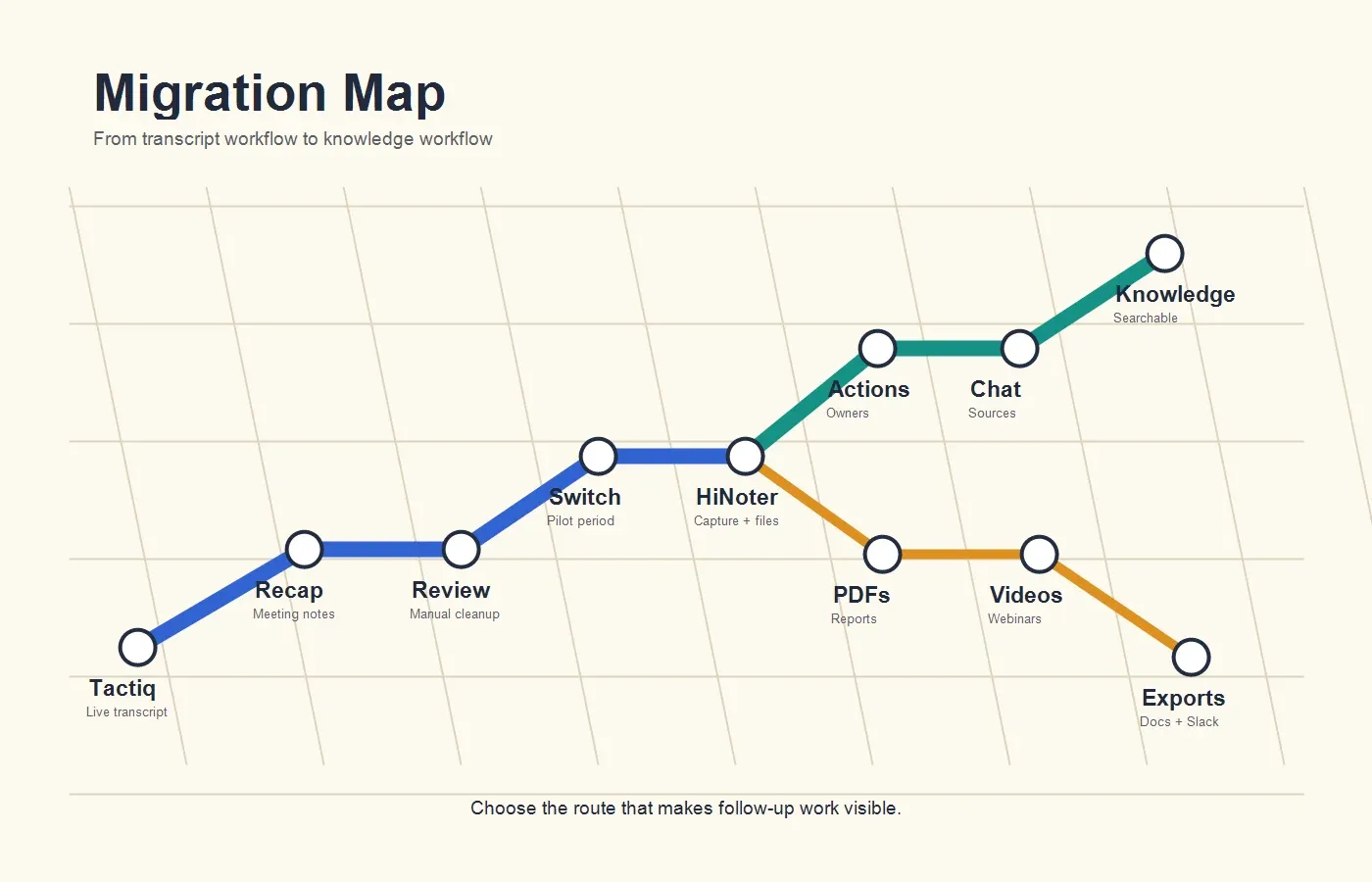
Migration Checklist: Moving From Tactiq to HiNoter
If you are actively evaluating a Tactiq alternative, use a short pilot instead of switching all workflows at once. The goal is to compare real outputs, not marketing pages.
| Step | What to Do | Success Signal |
|---|---|---|
| 1. Pick representative calls | Use recent meetings with real speakers, accents, decisions, and interruptions. | The pilot reflects daily work rather than a clean demo. |
| 2. Test non-meeting sources | Add one video, one audio file, and one PDF if your team uses those formats. | HiNoter handles the sources that Tactiq may not be the center of. |
| 3. Compare outputs | Review transcript, summary, action items, decisions, mind map, and AI Chat answers. | The new workflow reduces review and rewriting time. |
| 4. Check export paths | Send notes into documentation and collaboration tools. | The output reaches where follow-up happens. |
| 5. Review access and consent | Confirm privacy, permissions, meeting disclosure, and retention expectations. | The workflow matches internal policy. |
| 6. Compare plan limits | Look at seats, transcript limits, AI credits, file processing, storage, and integrations. | The expected cost is clear before rollout. |
When Teams Outgrow Transcript-First Notes
Transcript-first tools solve the first layer of meeting memory. They capture what was said. That is valuable, especially for people who miss meetings or need exact wording. The challenge is that many teams do not have a memory problem only; they have a workflow problem.
After a meeting, the team still needs to identify the decision, assign the owner, connect the meeting to a document, update a project, send a recap, and answer later questions. If every one of those steps requires a person to copy, rewrite, and chase context, the transcript has not removed enough administrative work.
HiNoter is useful when the team wants notes to behave more like a knowledge base. A project manager can ask what changed in the last meeting. A customer success manager can ask what the customer objected to. A recruiter can review candidate evidence. A product manager can compare meeting notes with a PDF or video. The value is not simply that the content was captured. The value is that it can be reused.
What to Test During a HiNoter Pilot
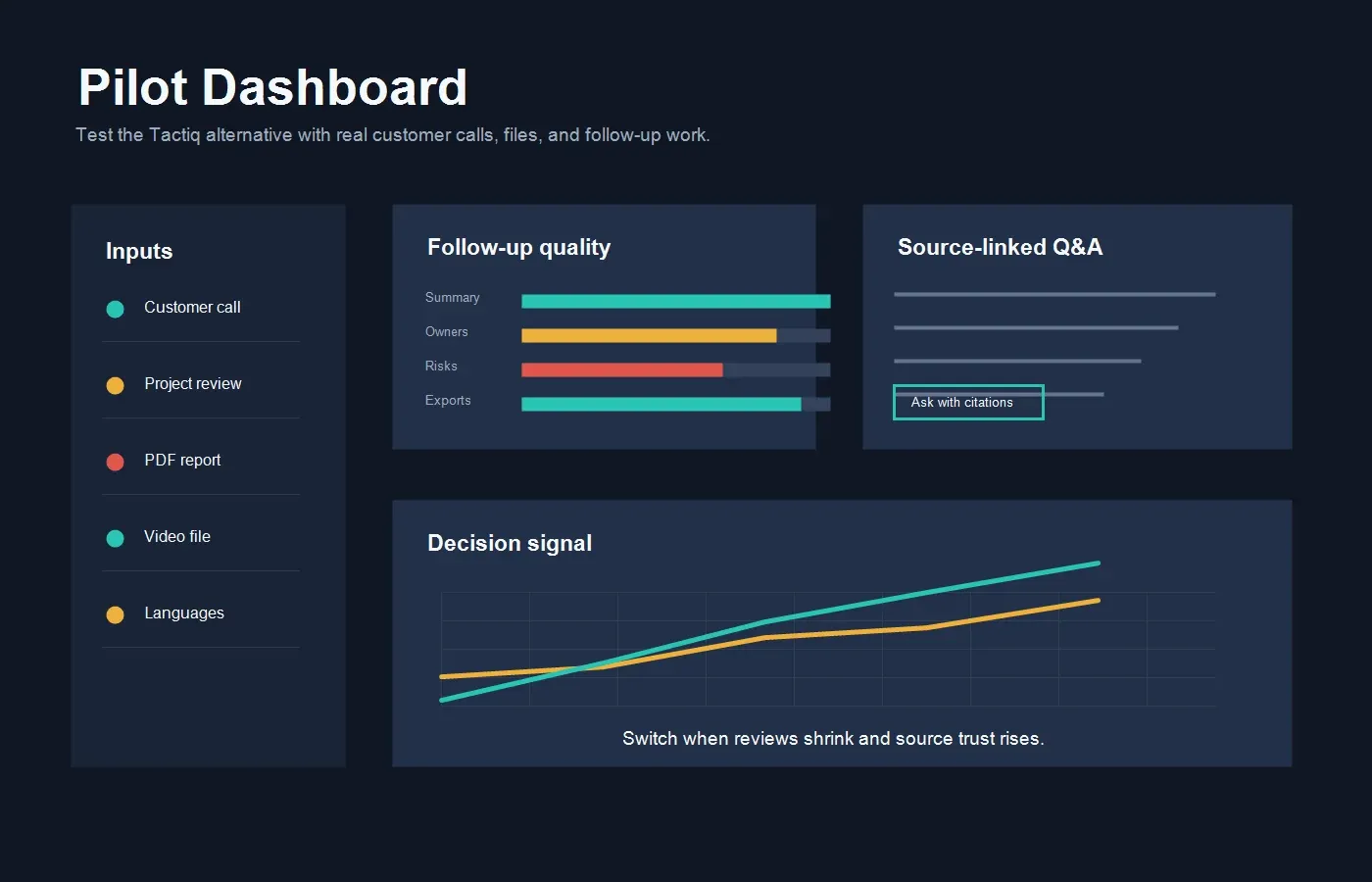
Run the pilot with messy, normal work. Include at least one long meeting, one short tactical call, one customer or candidate conversation, one PDF or report, and one recorded video or audio file. Then compare whether HiNoter gives the team less work after the meeting.
| Pilot Test | What to Look For | Decision Signal |
|---|---|---|
| Customer call | Objections, commitments, risks, and next steps. | The recap can be shared without rebuilding it from scratch. |
| Project review | Decisions, blockers, deadlines, and owners. | The team can see what changed and who owns the follow-up. |
| Multilingual meeting | Language detection, names, terms, and summary clarity. | Global teammates get a usable record without assigning a human notetaker. |
| PDF or report | Section summary, key points, and source-linked Q&A. | The document becomes useful for prep and follow-up. |
| Recorded video | Transcript, chapters, takeaways, and reusable insights. | The team recovers value without rewatching the full file. |
Pricing and Plan Considerations
AI note-taking tools often differ by transcript limits, AI credits, file uploads, integrations, storage, team seats, and admin controls. Tactiq's pricing model includes plan-based limits and AI-related usage, so teams should confirm current details before comparing it with any alternative. HiNoter should be evaluated against the number of meetings, files, languages, exports, and AI Chat queries your team expects to use.
Do not compare only the public starting price. A lower-cost plan may be fine for an individual who needs occasional meeting notes. A team with recurring customer calls, project reviews, multilingual meetings, and file-based knowledge may need a workflow that saves more review time even if the plan structure is different.
The hidden cost is manual cleanup. If someone still has to read the transcript, write a summary, identify owners, build a recap, and move notes into a workspace, the tool has not removed enough administrative work. The best alternative is the one that reduces the work after the meeting.
Governance and Adoption Questions Before Switching
Before choosing any Tactiq alternative, decide how the team will handle consent, access, review, and sharing. Meeting notes often include customer information, employee feedback, pricing discussions, product strategy, hiring signals, and legal or security context. A better note workflow should not make sensitive information harder to control.
Start with meeting disclosure. If an AI assistant captures or summarizes a call, participants should understand what is happening and why. Then define who can view transcripts, summaries, source files, and AI Chat answers. A recruiting interview may need tighter access than a project standup. A board update may require a different retention policy than a webinar summary.
Adoption also depends on review habits. AI notes are useful as a fast first draft, but high-stakes outputs should still be checked before they are shared with customers, candidates, executives, or external partners. The advantage of source-linked AI Chat is that reviewers can trace answers back to the underlying note or transcript instead of relying on unsupported summary text.
Finally, decide where notes should live. If every user keeps AI notes in a private account, the organization still does not have a shared memory. A useful rollout sends the right notes into the right workspace: project notes to documentation, customer notes to the account workflow, research notes to the knowledge base, and follow-up tasks to the team that owns them.
Example Workflow: From Transcript to Team Knowledge
Imagine a project team discussing a delayed launch. The meeting includes a PDF timeline, a customer concern, a security blocker, and a new owner for the follow-up email. A transcript captures the conversation, but the team still needs a decision-ready record.
| Output | What HiNoter Produces | Why It Helps |
|---|---|---|
| Summary | A concise recap of the delay, risk, and revised timeline. | Stakeholders can catch up quickly. |
| Action items | Owners and next steps for security review, customer update, and timeline revision. | Follow-up becomes accountable. |
| Mind map | Topics grouped by timeline, risk, customer impact, and blockers. | The team sees the structure of the discussion. |
| AI Chat | Answers to questions such as "What is blocking launch?" with source references. | Users can verify the answer against the note or transcript. |
Final Recommendation
If your team mainly wants lightweight live meeting transcripts and AI meeting notes, Tactiq is a reasonable product to evaluate. It fits users who want a meeting-focused workflow and do not need a broader multi-source knowledge platform.
If your team is looking for a Tactiq alternative because transcript-first notes still leave decisions scattered across recordings, documents, chat, and private follow-up, HiNoter is the stronger direction to test. It is built for teams that need automatic capture, structured summaries, action items, mind maps, multilingual support, exports, and source-linked AI Chat across meetings, videos, PDFs, and audio.
Try HiNoter with your next important meeting and at least one non-meeting source. If the output helps your team answer what happened, who owns the next step, and where the answer came from, you are no longer comparing note takers. You are comparing knowledge workflows.
FAQs
What is the best Tactiq alternative?
HiNoter is a strong Tactiq alternative for teams that need more than live meeting transcripts. It is best suited for teams that want meetings, videos, PDFs, and audio converted into structured summaries, action items, mind maps, exports, and source-linked AI Chat.
Is HiNoter better than Tactiq?
It depends on the workflow. Tactiq is useful for live transcripts and AI meeting notes. HiNoter is stronger when the team needs multi-source content, automatic meeting capture, mind maps, multilingual notes, and source-linked AI answers.
Can HiNoter automatically capture meetings?
HiNoter supports calendar-connected meeting workflows that reduce manual note-taking and help teams avoid relying on one participant to capture every detail.
Can HiNoter process files besides meetings?
Yes. HiNoter can process meetings, videos, PDFs, and audio, which helps teams turn more than live calls into searchable knowledge.
What should I compare before switching from Tactiq?
Compare capture reliability, transcript quality, summary depth, action item extraction, supported sources, integrations, language support, privacy controls, AI Chat, exports, and real plan limits for your expected usage.
Should I migrate all old meeting transcripts at once?
No. Start with a pilot using recent meetings and important files. Confirm output quality, team adoption, and workflow fit before deciding whether older content should be moved.