Direct answer: For Tactiq vs Otter, choose Tactiq if you want a lightweight live transcript and AI workflow layer inside browser-based meetings. Choose Otter if you want a familiar transcription workspace for meetings and voice notes. Choose HiNoter if your team needs automatic meeting notes plus videos, PDFs, audio, summaries, action items, mind maps, and source-linked AI Chat.
Most teams do not struggle because they forgot to record one meeting. They struggle because useful information gets scattered across transcripts, private notes, chat threads, follow-up emails, and files nobody revisits. A transcript can be valuable, but only if it becomes decisions, owners, risks, and knowledge that people can find later.
This comparison looks at Tactiq, Otter, and HiNoter from that practical angle. Tactiq and Otter are both popular AI meeting note tools, but they solve different parts of the workflow. HiNoter is included as the option for teams that want the full journey from meeting capture and content upload to structured notes, action items, mind maps, exports, and source-backed answers.
Quick Recommendation: Tactiq vs Otter vs HiNoter
| Tool | Best fit | Watch for | Choose it when |
|---|---|---|---|
| Tactiq | Teams that want a lightweight meeting transcript and AI summary workflow inside browser-based calls. | Extension-based workflows may depend on browser, meeting platform, and user setup. | You need quick live transcripts, AI prompts, and convenient meeting summaries without a heavy rollout. |
| Otter | Teams and individuals that want an established transcription workspace for meetings, voice notes, and summaries. | Transcript-first workflows may still require manual structuring for owners, risks, and reusable knowledge. | You want searchable transcripts, meeting notes, speaker context, and a familiar review experience. |
| HiNoter | Teams that want meetings, videos, PDFs, and audio converted into structured team knowledge. | Teams should define capture, consent, sharing, and retention rules before broad deployment. | You need zero manual note-taking, 50+ language detection, summaries, action items, mind maps, exports, and AI Chat with sources. |
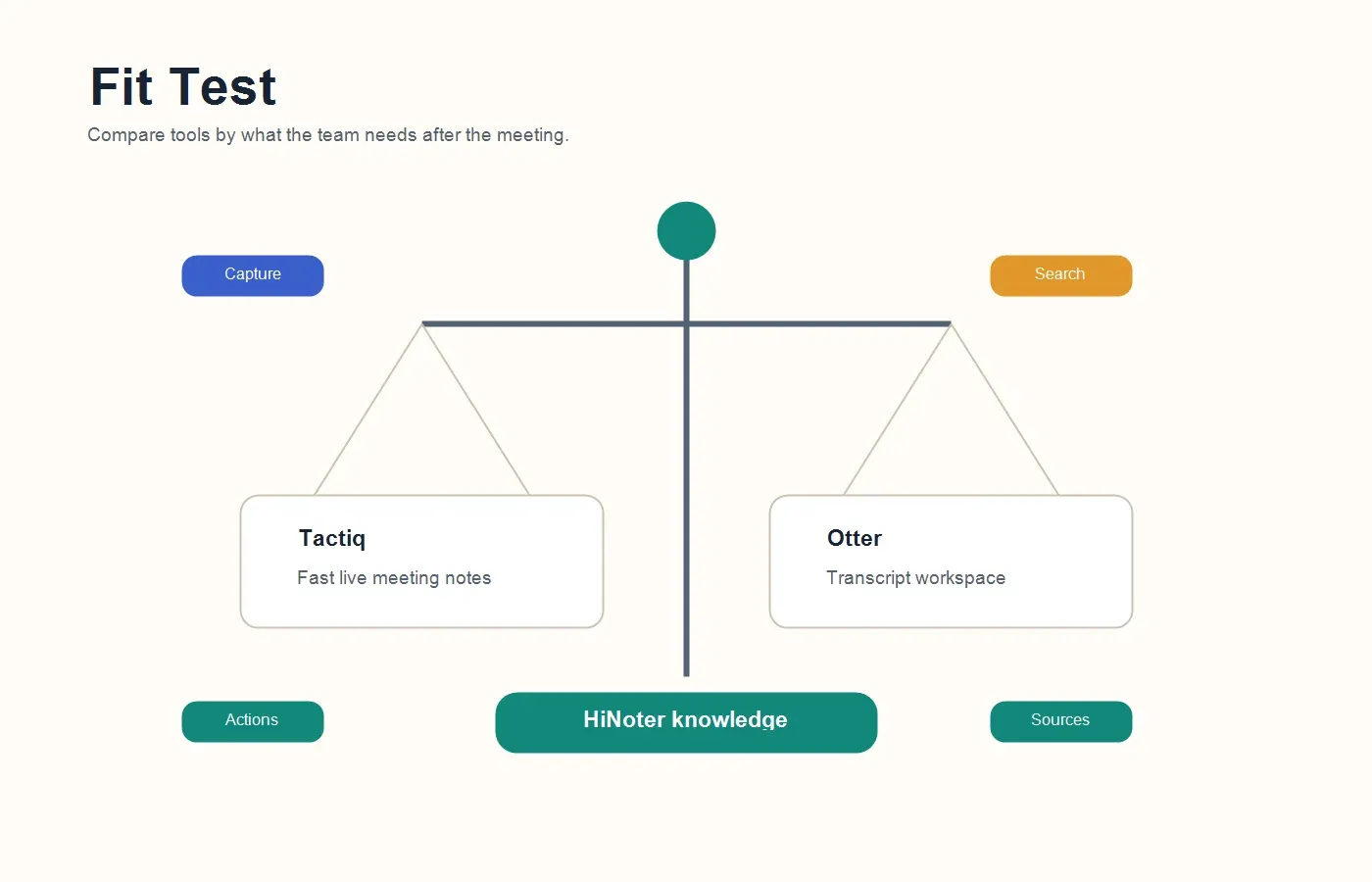
The short version is straightforward. Tactiq is appealing when you want a fast browser-friendly transcript and AI layer. Otter is appealing when you want a dedicated transcription and meeting notes workspace. HiNoter is appealing when the meeting is only one source in a broader knowledge workflow that includes files, videos, PDFs, and searchable source references.
Methodology: How We Compared the Tools
This review uses public product pages, help content, pricing pages, security pages, and feature descriptions available as of July 16, 2026. Because SaaS plans change frequently, verify current minute limits, upload rules, admin controls, AI usage limits, and integrations during your own trial.
The evaluation criteria are meeting capture, transcription quality, summary quality, action items, integrations, language support, privacy controls, exports, AI chat, pricing clarity, and multi-source support. Those criteria matter because the most expensive meeting tool is not always the one with the highest subscription fee. It is the one that still leaves managers chasing people for decisions, tasks, and context.
What We Did Not Score
We did not assign a universal winner or a synthetic rating. A founder, student, recruiter, customer success manager, and product lead need different outputs. Instead, this page explains which tool fits which operating model and what to test before you commit.
Tactiq vs Otter: The Short Version
Tactiq is often a good fit for users who want live meeting transcripts and AI-generated notes without building a large operations workflow. It is commonly positioned around browser-based meeting capture, transcripts, AI prompts, summaries, and integrations with common work tools. For teams that live in Google Meet, Zoom, or Microsoft Teams and want a fast transcript layer, Tactiq can be easy to adopt.
Otter is often a good fit for users who want a dedicated transcription workspace. It is widely associated with meeting transcription, voice notes, summaries, speaker identification, searchable conversations, and collaboration around captured speech. Otter can feel more complete when the user wants a home base for spoken content rather than only a browser extension experience.
The core difference is workflow shape. Tactiq tends to feel lightweight and meeting-adjacent. Otter tends to feel more like a transcription workspace. Both can reduce manual note-taking. Neither automatically solves team knowledge unless the outputs are structured, synced, reviewed, and reused.
Where HiNoter Fits in the Comparison
HiNoter fits when teams want zero manual note-taking and a broader content-to-knowledge workflow. With HiNoter meeting assistant, teams can connect calendars, let the assistant join scheduled meetings, and receive structured notes after the call. That helps participants stay present instead of splitting attention between conversation and documentation.
The bigger distinction is source coverage. HiNoter is not limited to live meeting transcripts. Teams can also process permitted videos, uploaded audio, YouTube-style content, PDFs, and other files that contain decisions or knowledge. That matters because modern work rarely fits neatly into a meeting transcript. A customer commitment may appear in a call, a product requirement may sit in a PDF, and a training insight may live in a webinar.
HiNoter is strongest when outputs need to be reusable: summaries, decisions, action items, owners, due dates, risks, mind maps, exports, and AI Chat with source references. The goal is not only to know what was said. The goal is to know what changed and what should happen next.
Feature Comparison: Tactiq vs Otter vs HiNoter
| Criterion | Tactiq | Otter | HiNoter |
|---|---|---|---|
| Meeting capture | Browser-friendly transcript workflow for supported meeting platforms. | Meeting assistant and transcription workflows for supported meeting platforms. | Calendar-connected auto-join workflow for scheduled meetings. |
| Transcription | Live transcript orientation with AI note workflows. | Dedicated transcription workspace with searchable conversations. | Transcript plus structured notes, summaries, decisions, action items, and mind maps. |
| Summaries | AI summaries and prompt-based outputs from meeting transcripts. | AI summaries and meeting notes for captured conversations. | Executive-style summaries, blockers, risks, next steps, and source-backed answers. |
| Action items | Can generate follow-up items from meeting content depending on workflow. | Can surface follow-up from meeting notes depending on plan and setup. | Extracts action items with owners, due dates, risks, and reusable follow-up context. |
| AI chat and search | AI prompt and question workflows around meeting transcripts. | Search and AI-assisted querying across supported content. | AI Chat with source references across notes and supported content sources. |
| Multi-source input | Strongest around live meeting transcripts and meeting content. | Strong for meetings, transcripts, and spoken notes. | Meetings, audio, video, YouTube-style content, PDFs, and other permitted files. |
| Language support | Supports multilingual meeting workflows, with exact support depending on current product packaging. | Supports multilingual workflows, with details depending on current product packaging. | 50+ languages with automatic language detection for global teams. |
| Integrations | Useful exports and integrations for common knowledge and collaboration tools. | Useful meeting and productivity integrations, depending on plan. | Designed to sync with Notion, Slack, Google Docs, calendar, and email workflows. |
| Best outcome | Fast live transcript plus AI summaries and prompt-driven meeting outputs. | Searchable transcript workspace for meetings and voice content. | Structured team knowledge from meetings and files, with source-backed answers. |
What Tactiq Is Best For
Tactiq is a strong fit when the team wants live transcripts and quick AI outputs without a heavy implementation. It can be especially useful for people who spend most of their day in browser-based meetings and want an assistant that captures the conversation, turns the transcript into summaries, and helps generate follow-up content.
The lightweight nature of Tactiq can be an advantage. A team may not need a complex meeting intelligence stack for every call. Sometimes the requirement is simple: capture what was said, summarize it, extract key points, and send it to a doc or collaboration tool. Tactiq can work well for those workflows.
The caution is that lightweight tools still need governance. If each user controls their own capture settings, prompts, exports, and follow-up habits, meeting records can become inconsistent. Tactiq is strongest when the team defines when to use it, what template to produce, and where the output should live.
What Otter Is Best For
Otter is a strong fit when users want a dedicated home for transcripts and meeting notes. It is useful for meetings, interviews, lectures, voice notes, and other spoken content where the transcript itself is a key asset. Users who want to review, search, highlight, and share spoken records may prefer that more central workspace.
Otter can also be a good choice for individuals and small teams that need reliable transcription without building a full knowledge operations system. A consultant may use it to review client calls. A researcher may use it to find interview quotes. A manager may use it to recall meeting details and share summaries with a team.
The caution is that transcripts can still be too raw. If a team needs owner fields, due dates, risks, decision logs, mind maps, exports, and source-linked AI answers, it may need a more structured workflow. Otter is helpful when spoken content is the center of the job. It may feel narrower when the job is turning many content sources into team knowledge.
What HiNoter Is Best For
HiNoter is strongest when automatic notes need to become a shared knowledge system. The HiNoter AI meeting notes workflow captures meetings, detects languages, generates summaries, extracts action items, builds mind maps, and supports source-linked AI Chat. This makes it useful for teams that need structured outcomes, not just transcripts.
Global teams are a good example. A company operating across the United States, Europe, Brazil, Portugal, and other regions may have multilingual meetings and mixed-language source materials. HiNoter supports 50+ languages with automatic detection, reducing the need to assign a human notetaker or translator for every call.
HiNoter also fits teams that need to combine meeting content with documents and media. A product manager may summarize user interviews, PDF research, and webinar content. A customer success team may combine renewal calls, account notes, and support recordings. A founder may need meeting recaps, investor Q&A, and PDF summaries in one searchable place.
Decision Matrix: Which Tool Should You Choose?
| Team need | Best choice | Reason |
|---|---|---|
| Browser-friendly live transcript | Tactiq | Strong fit when users want quick meeting capture and AI summaries with minimal setup. |
| Dedicated transcription workspace | Otter | Strong fit when transcripts, voice notes, and searchable spoken records are the main deliverable. |
| Automatic notes from meetings and files | HiNoter | Strong fit when the team needs meetings, audio, video, PDFs, and permitted content summarized together. |
| Global team documentation | HiNoter | 50+ language detection helps distributed teams create consistent summaries without manual note assignment. |
| Lightweight meeting follow-up | Tactiq or Otter | Choose based on whether you prefer a browser extension workflow or a dedicated transcript workspace. |
| Source-linked knowledge base | HiNoter | Best fit when users need to ask questions later and verify answers against source material. |
Pricing and Plan Considerations
Do not compare Tactiq vs Otter by headline price alone. The real cost depends on transcription minutes, meeting limits, file uploads, AI credits, export options, workspace seats, admin controls, and retention. A plan that looks affordable can still create manual work if the team needs to copy summaries into docs, reformat tasks, or use a second tool for PDFs and videos.
A fair pilot should use real work. Include a short internal meeting, a long customer call, a noisy recording, a recruiting interview, and one non-meeting source such as a PDF report or training video. Then ask users to complete real follow-up: find a decision, write the recap, assign owners, export notes, and answer a manager's question with evidence.
| Question | Why it matters | What to verify |
|---|---|---|
| How are minutes and AI credits counted? | Heavy meeting teams can hit limits quickly. | Meeting duration, transcription minutes, AI prompts, uploads, storage, and retention. |
| Which platforms are supported? | Capture reliability depends on where your team meets. | Google Meet, Zoom, Microsoft Teams, calendar support, and browser requirements. |
| Which exports are included? | Missing exports create manual work after every meeting. | Docs, Notion, Slack, email, CRM, task tools, and workflow automation. |
| Can it handle non-meeting content? | Important knowledge may live outside live calls. | Audio uploads, videos, YouTube-style content, PDFs, and source-linked Q&A. |
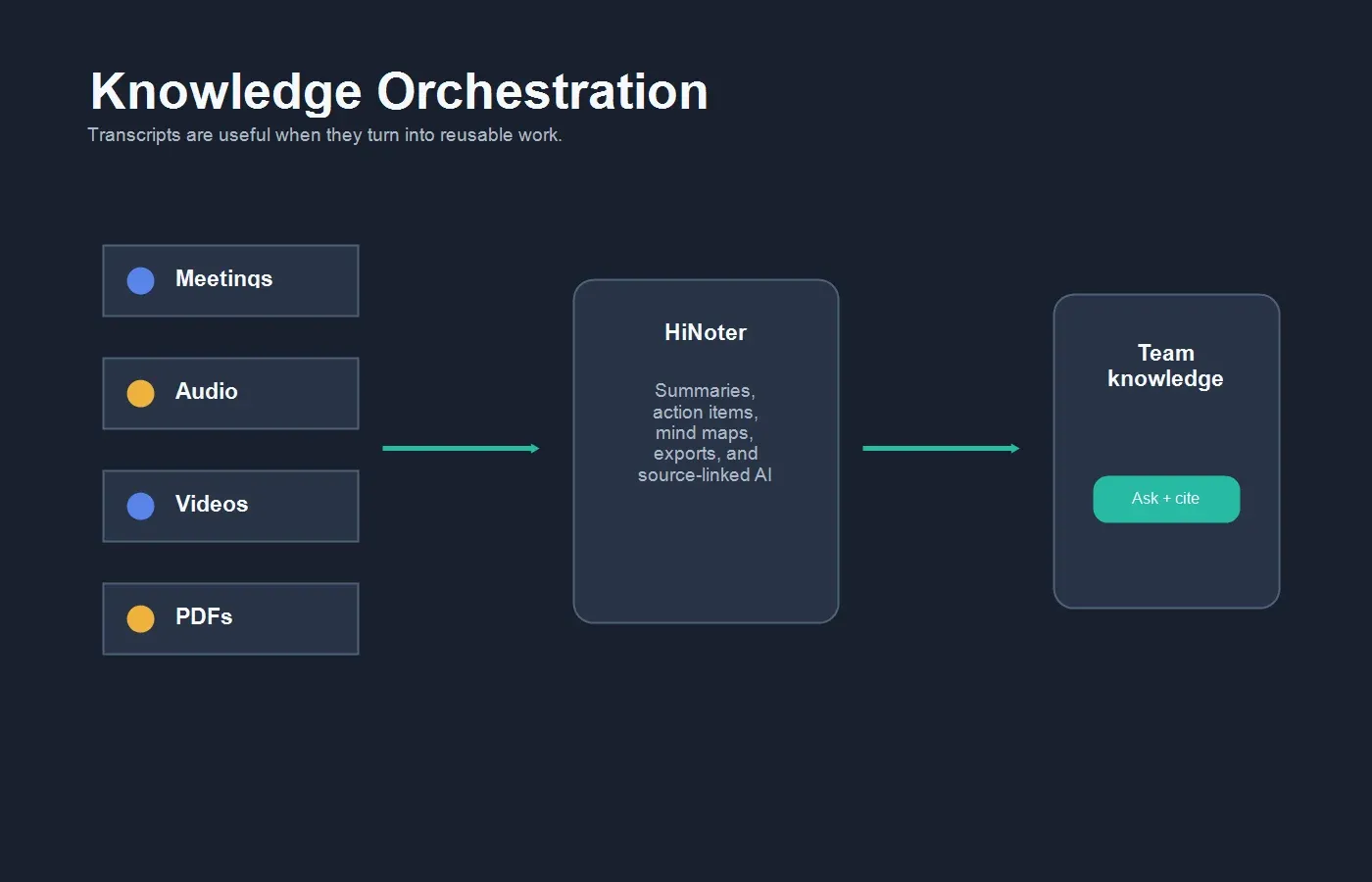
Workflow Example: From Meeting to Searchable Knowledge
A good AI note workflow has five steps. First, define which meetings and files can be captured. Second, connect the calendar or use the approved capture method. Third, generate the transcript and structured summary. Fourth, extract decisions, action items, risks, owners, and deadlines. Fifth, sync the result into the systems where the team already works.
HiNoter is designed for that full loop. Notes can move into team documentation through Notion integration or become editable recaps through Google Docs integration. When meeting notes can travel into docs, team spaces, chat, calendar, and email, they become part of the operating system instead of another archive.
This workflow matters because managers rarely need the whole transcript first. They need the answer to a specific question. What did the customer commit to? Which risk appeared? Who owns the next step? What evidence supports the decision? A transcript may contain those answers, but a source-linked knowledge workflow makes them much faster to retrieve and verify.
Privacy, Consent, and Governance
Every AI meeting notes tool should be deployed with clear rules. Tell participants when a meeting assistant, transcript tool, or AI note workflow is active. Define which meetings can be captured, summarized, shared, or queried. Avoid recording sensitive legal, HR, medical, financial, or confidential customer conversations unless the organization has approved the process.
Governance is not only about compliance. It also affects trust. People behave differently when they feel surprised by recording or automated notes. Teams should set expectations, publish internal usage rules, define retention periods, and make sensitive-meeting exceptions clear.
When comparing Tactiq, Otter, and HiNoter, ask vendors about data retention, deletion, admin roles, encryption, audit logs, AI training policies, workspace permissions, and export rights. If your organization handles regulated or confidential content, procurement and legal review should happen before company-wide rollout.
Migration Checklist
If you are moving from Tactiq or Otter to HiNoter, start with one workflow rather than every meeting. Customer success renewal calls, project reviews, recruiting interviews, and product discovery calls work well because they produce measurable decisions and action items.
| Step | Action | Success signal |
|---|---|---|
| 1 | Select 10 to 20 real meetings and files. | The sample includes short calls, long meetings, noisy audio, and at least one non-meeting source. |
| 2 | Define the output template before testing. | Everyone agrees on summary, decision, owner, deadline, risk, and next-step fields. |
| 3 | Connect calendar and destinations. | Notes arrive where the team already works instead of sitting in a private transcript tool. |
| 4 | Compare transcript, summary, and action item quality. | Managers spend less time editing notes and chasing participants for context. |
| 5 | Ask source-linked questions after the meeting. | Users can verify answers against the original note, transcript, file, or source passage. |
Choose Tactiq If...
Choose Tactiq if you want a lightweight way to capture meeting transcripts and generate AI notes inside your existing meeting flow. It is a good fit for users who want quick summaries, prompt-based outputs, and convenient exports without managing a heavier meeting intelligence platform.
Tactiq may also be a good fit for teams that are early in their AI note-taking rollout. If the immediate goal is to stop losing meeting context and produce basic follow-up, a browser-friendly transcript tool can be a practical starting point.
Choose Otter If...
Choose Otter if you want a dedicated transcription workspace for meetings, voice notes, interviews, lectures, and searchable spoken content. It is useful when the transcript itself is the key deliverable and users want an established place to review and share conversation records.
Otter is especially relevant for individuals and small teams that need reliable speech-to-text and meeting notes without a complex knowledge workflow. If your work centers on reviewing conversations and pulling quotes or summaries, Otter can be a strong option.
Choose HiNoter If...
Choose HiNoter if your team wants automatic meeting notes plus a knowledge layer. HiNoter is the strongest fit in this comparison when the workflow includes meetings, videos, PDFs, uploaded audio, multilingual summaries, action items, mind maps, exports, and AI Chat with source references.
It is also the better fit when the team needs notes to become shared memory. A transcript tells you what was said. A structured, source-linked knowledge workflow tells you what changed, who owns the next step, and where the evidence lives.
Final Verdict: Tactiq vs Otter vs HiNoter
Tactiq vs Otter is not a simple winner-take-all comparison. Tactiq is compelling for lightweight live transcripts and fast AI meeting outputs. Otter is compelling for users who want a dedicated transcription workspace. HiNoter is compelling for teams that want meeting content and non-meeting sources converted into structured, searchable, source-backed knowledge.
If your immediate need is a browser-friendly meeting transcript, start with Tactiq. If your main need is a reliable transcript workspace, evaluate Otter. If your deeper problem is that decisions, tasks, risks, and insights disappear across meetings, PDFs, videos, recordings, chat, and private notes, HiNoter is built closer to the workflow your team needs.
CTA: Try HiNoter to connect your calendar, capture your next meeting automatically, and turn meetings or permitted files into transcripts, summaries, action items, mind maps, exports, and source-linked AI Chat.
FAQs
Is Tactiq better than Otter?
Tactiq can be better if you want a lightweight browser-based transcript and AI note workflow. Otter can be better if you want a dedicated transcription workspace for meetings, voice notes, interviews, and searchable spoken records. The better choice depends on whether you prefer speed and convenience or a central transcript library.
How is HiNoter different from Tactiq and Otter?
HiNoter focuses on turning meetings and multiple content sources into structured knowledge. It supports automatic meeting attendance, summaries, action items, mind maps, multilingual workflows, exports, and AI Chat with source references. It is designed for teams that need more than isolated transcripts.
Can AI meeting notes replace manual note-taking?
They can remove routine note-taking for many meetings, but humans should review sensitive commitments, legal topics, hiring feedback, customer promises, and high-stakes decisions. AI notes work best when the team has clear review and approval rules.
Which tool is best for multilingual teams?
Tactiq and Otter support multilingual use cases depending on their current product settings and plans. HiNoter is especially strong for distributed teams because it supports 50+ languages with automatic language detection and structured summaries.
Do I need a meeting bot if I use a transcript tool?
Not always. If you only need a live transcript, a lightweight tool may be enough. If you want automatic attendance, structured notes, follow-up tasks, exports, and source-linked answers, a meeting assistant workflow may be more useful.
What should I test during a trial?
Test capture reliability, transcript accuracy, summary usefulness, action item extraction, source references, exports, language handling, permissions, and how quickly managers can find answers after the meeting. Use real meetings and files, not polished demo calls.